
Kangar, Perlis
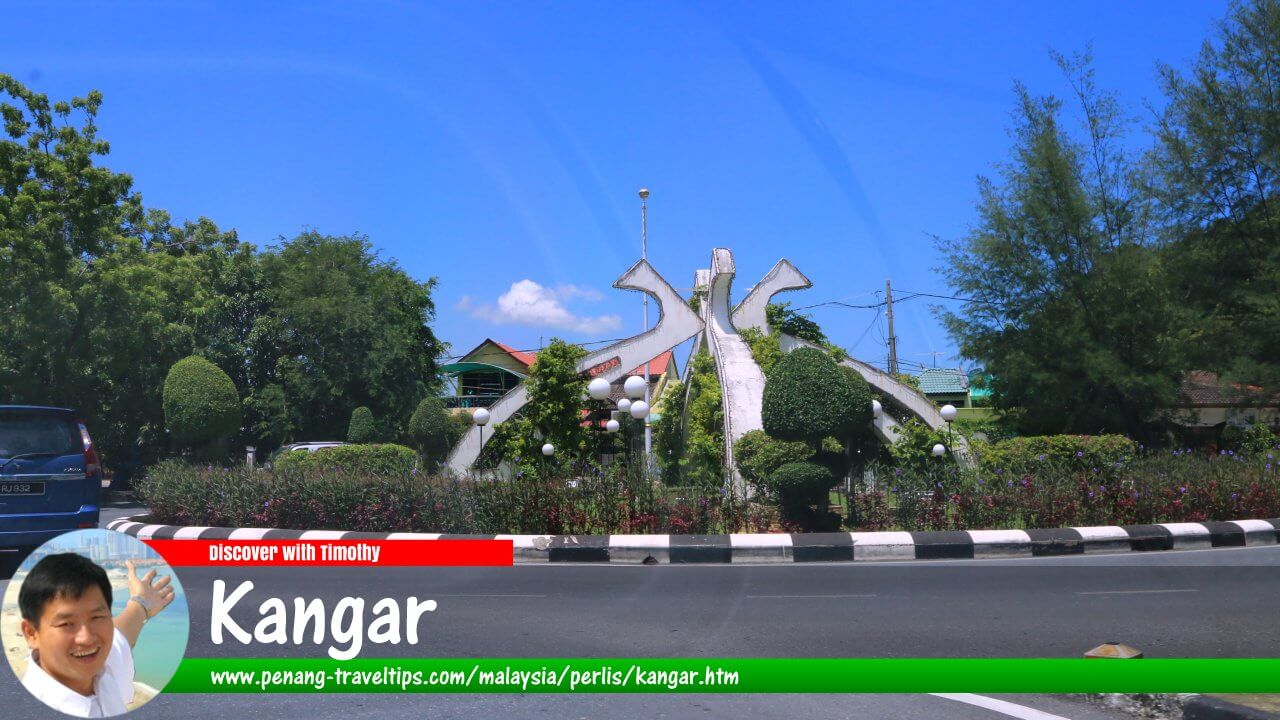 Kangar (1 November 2009)
Also available: Kangar (Malay Edition)
Kangar is the state capital of Perlis, Malaysia's smallest and northernmost state, and serves as its principal administrative and commercial centre.1 Situated on fertile alluvial plains close to the Malaysia-Thailand border, Kangar developed from a modest riverside trading post into the seat of state government, home today to Perlis's key administrative buildings, its state legislative assembly, and a concentration of retail and commercial activity unmatched elsewhere in the state.2 Unlike Malaysia's larger state capitals, Kangar has deliberately retained a low-rise, unhurried character, with government complexes and heritage buildings taking precedence over the high-rise skylines found in cities such as Kuala Lumpur or George Town.3 While the town itself holds relatively few ancient historical sites, it functions as the natural base for exploring the wider attractions of Perlis, and as a transit point for travellers moving between Thailand and the popular island destination of Langkawi.4
Geography and Climate
Kangar lies in the heart of Perlis's fertile plains, a region historically prized for paddy cultivation and still surrounded by extensive rice fields on its outskirts.4 The town's position close to the Thai border, within easy reach of the crossing at Padang Besar, has long shaped its role as a trading and transit hub rather than an industrial centre.5 Kangar experiences a tropical climate typical of northern Peninsular Malaysia, with generally high temperatures and humidity throughout the year, alongside a fairly distinct wet season running from around April to November, during which rainfall can occur on as many as 27 days a month at its peak.4 The remaining months tend to be noticeably drier, making them the more comfortable period for outdoor sightseeing in and around the town.
History
Origins as a River Trading Post
Kangar's earliest recorded origins trace back to 1653, when the settlement began as a pengkalan, or land port, a small riverside trading hub where merchants gathered to conduct business, reportedly under the shade of a tree known locally as the Pohon Kangar, which some accounts suggest may have lent the settlement its name.6 An alternative and equally popular local account holds that the name instead derives from the Kangor, a species of hawk once commonly seen perched near the early river port, though the precise origin of the town's name remains a matter of local folklore rather than settled historical record.7 In its early period, Kangar's economy was inextricably tied to agriculture, with the settlement functioning as the main market town for surrounding paddy farmers, and life in the town moving to the rhythm of river trade and the seasonal rice harvest.3
Growth Under British-Era Trade
Around the turn of the twentieth century, following the discovery of new economic opportunities through tin mining in the surrounding region, Chinese traders began constructing more substantial stone shophouses along the main road connecting Kangar to Alor Setar in neighbouring Kedah, with development concentrated along what is now known as Persiaran Jubli Emas.8 This period of commercial construction marked the beginning of Kangar's emergence as the focal point of economic activity in Perlis, gradually eclipsing older riverine trading patterns as road-based commerce took hold.8 The town's institutional development continued in the years before independence, with Derma English School established in 1948, part of a broader expansion of educational and civic infrastructure in the town during the late colonial period.8
Post-Independence Administrative Development
Following Malaysian independence, and particularly from the 1970s onward, the federal and state governments undertook a substantial building programme in Kangar, constructing government offices that further cemented its role as the state's administrative centre and capital city.8 Development subsequently branched out from the original Kangar-Alor Setar road corridor, gradually expanding the town's footprint to accommodate its growing administrative and commercial functions. In more recent years, the launch of the Urban Transformation Centre, known locally as UTC Perlis, has served as a notable example of successful urban revitalisation, converting existing buildings into a modern hub for government services, reviving business activity in the town centre, and simplifying everyday administrative tasks for local residents.3
Administration
Kangar functions as the seat of the Perlis state government, hosting the state's key administrative buildings, including the State Secretariat building, known as Bangunan Dato' Wan Ahmad, and the Perlis State Legislative Assembly building, which combines modern architectural forms with Islamic geometric patterning.3 Local governance within the town itself falls under the Kangar Municipal Council (Majlis Perbandaran Kangar), which oversees municipal services, urban planning, and local development in accordance with Malaysia's Local Government Act 1976 and Town and Rural Planning Act 1972.9 While Kangar serves as the administrative and commercial capital of Perlis, it should be distinguished from Arau, a nearby town that remains the traditional royal capital and official residence of the Raja of Perlis.10
Economy
Kangar's economy remains closely tied to its historical role as the primary market and trading centre for the surrounding agricultural region, with commerce in rice, sugar, seafood, mangoes, and other locally grown fruit continuing to underpin much of the town's business activity.5 Food processing, particularly the handling and processing of sugar and prawns, has also developed into a notable component of the local economy in more recent decades.9 The town's position close to the Thai border has additionally reinforced its role as a trading hub, with cross-border commerce through nearby Padang Besar contributing meaningfully to Kangar's broader commercial activity.6 Logistical improvements in recent years, including the development of the Bukit Lagi bus terminal and general upgrades to the surrounding road network, have further strengthened Kangar's role as a transport hub, an important function given that the town has no airport of its own and instead relies on Sultan Abdul Halim Airport in nearby Kedah for air travel.3
Demographics and Culture
As the capital of Malaysia's smallest and most agrarian state, Kangar's population is predominantly Malay, reflecting the wider demographic character of Perlis, though the town's long history as a trading centre has also supported a longstanding Chinese business community, particularly visible in the older shophouse architecture along its historic commercial streets.8 Malay is the primary language spoken throughout the town, and Islam is the majority religion, with the town's mosques serving as important focal points for both religious and community life.4
Architecture and Landmarks
Kangar's architectural character reflects its status as a tranquil administrative capital rather than a commercial metropolis, favouring low-rise development that blends historical heritage with functional government complexes rather than pursuing the high-rise skylines seen in Malaysia's larger cities.3 Among its most notable landmarks is the Alwi Mosque, a striking example of Mughal-influenced architecture completed in the 1930s, recognised as a National Heritage site and known for its golden domes and elegant minarets that remain a focal point of the town's skyline.7 More recent additions include Dewan 2020, a multi-purpose hall complex distinguished by a roof design resembling an open fan or traditional motifs, and the State Legislative Assembly building, both notable examples of postmodern civic architecture completed in the late twentieth and early twenty-first centuries.3
Attractions
While Kangar itself does not offer the density of historical sites found in some of Malaysia's older cities, it nonetheless provides a handful of worthwhile attractions and serves as a convenient base for exploring the wider natural and cultural sites of Perlis.2
- Alwi Mosque — a National Heritage-listed mosque known for its Mughal-style architecture, golden domes, and minarets, and one of the town's most recognisable landmarks.7
- Kota Kayang Museum — also known as the Perlis State Museum, showcasing the history and culture of the state and its ruling family, set within attractive grounds that include a royal mausoleum and a small cave.11
- Al-Hussain Mosque — a mosque near the Kuala Perlis Jetty noted for its striking appearance of seeming to float on water, drawing visitors interested in its architecture and setting.12
- Tasik Melati Recreational Park — a lakeside recreational park offering a quieter, family-friendly outdoor space within easy reach of the town centre.12
- Bukit Ayer Amenity Forest — a forested recreational area offering walking trails and a natural retreat close to town.12
Kangar also serves as the natural base for day trips to the wider attractions of Perlis, including Perlis State Park and the limestone caves of Gua Kelam, as well as the royal town of Arau, and the ferry town of Kuala Perlis, which connects travellers onward to Langkawi Island.2
Cuisine
Kangar's food scene reflects the wider agricultural character of Perlis, with rice, seafood, and locally grown produce forming the backbone of the town's culinary offerings. As the main commercial centre for a region famous for its rice cultivation, the town takes particular pride in dishes built around freshly harvested rice, alongside seafood sourced from the state's coastal waters and mangoes, for which the wider Perlis region is especially well known.5 Kangar's markets and eateries also offer a range of traditional Malay dishes and locally grown fruit, reflecting the town's continuing role as the commercial hub for Perlis's surrounding farming communities.13
Connectivity
Kangar is well connected by road to the rest of Peninsular Malaysia, with the main route to Alor Setar and onward toward Kuala Lumpur historically shaping much of the town's early commercial development.8 Given that the town has no airport of its own, most air travellers rely on Sultan Abdul Halim Airport in Kedah, a short distance to the south.3 The Bukit Lagi bus terminal serves as Kangar's main hub for intercity and cross-border bus travel, providing connections to Kuala Lumpur as well as destinations across the border in Thailand.3 For travellers heading onward to Langkawi, the nearby port town of Kuala Perlis offers regular ferry services, making Kangar a convenient overnight stop for those combining a visit to Perlis with an island getaway.2
Conclusion
As the capital of Malaysia's smallest state, Kangar has never sought to compete with the scale or pace of the country's larger cities, and its character reflects that choice: a low-rise, administratively focused town built around the rhythms of trade, agriculture, and government service rather than rapid urban growth. From its origins as a modest riverside trading post in the seventeenth century to its present role as the seat of Perlis's state government, Kangar's development mirrors the wider story of Perlis itself, quiet, agrarian, and shaped by its position at the crossroads of Malaysia and Thailand. For visitors, the town offers a relaxed entry point into the natural and cultural attractions of Perlis, and a convenient stepping stone toward the more famous shores of Langkawi Island just across the water.
Map of sights in Kangar
Sights in Kangar
- Arulmigu Arumugaswamy Devasthanam (GPS: 6.435766, 100.190755)

- Arulmigu Kovil Sri Veera Mahakaliamman Alayam (GPS: 6.435766, 100.190755)

- Church of Our Lady of Fatima (GPS: 6.440609, 100.185546)

- Dewan 2020 (GPS: 6.41494, 100.19482)

- Gurdwara Sahib Kangar (GPS: 6.43838, 100.19671)

- Kangar Entrance Arch (GPS: 6.4393, 100.19687)

- Kangar Nine Emperor Gods Temple (GPS: 6.440609, 100.185546)

- Kangar State Museum (GPS: 6.43966, 100.1877)

- Kangar Town Hall Field
- Perlis Cultural Park (GPS: 6.41233, 100.19446)

- Perlis State Assembly Complex (GPS: 6.4141, 100.18786)

- Rumah Dato Wan Ahmad (GPS: 6.43725, 100.18608)

- Stadium Datuk Sheikh Ahmad
- State Mosque & Heritage Hall
- Taman Rekreasi Sungai Kechor (GPS: 6.438, 100.19028)

Hotels in Perlis
- Hotel Seri Malaysia (GPS: 6.41414, 100.19475)

Government Buildings in Perlis
- JKKN Complex (GPS: 6.41239, 100.19475)

- Perlis Youth & Sports Complex (GPS: 6.44028, 100.19244)

Eateries in Kangar
- Kedai Kopi dan Makanan CCS Embassi (GPS: 6.43612, 100.19104)
Category of sights in Kangar
- Churches in Kangar
- Coffee Shops in Kangar
- Government Office Buildings in Kangar
- Hindu temples in Kangar
- Mosques in Kangar
- Museums in Kangar
- Parks in Kangar
- Shopping Malls in Kangar
- Streets in Kangar
Shopping Places in Kangar
- Gedung Ten Ten (GPS: 6.4361, 100.19136)

- Kompleks Kayangan Square
- Pasar Borong
- Pasaraya Aneka (GPS: 6.43692, 100.1941)

Streets in Kangar
Rivers in Kangar
Medical Attention in Kangar
- Hospital Tuanku Fauziah (GPS: 6.44106, 100.19135)

- Klinik Kesihatan Kangar (GPS: 6.43941, 100.19014)

- Pejabat Kesihatan Kangar (GPS: 6.44337, 100.19102)

Sights in Perlis in the vicinity of Kangar
- Arau
- Bukit Keteri
- Bukit Keteri Cement Factory
- Gua Kelam
- Bukit Cabang
- Kuala Perlis
- Museum Kota Kayang
- Sungai Batu Pahat Snake & Reptile Farm
- Padang Besar
- Perlis Grape Farm
- Perlis Craft Cultural Complex
- Tasik Melati
- Timah Tasoh Dam
- Taman Herba Negeri Perlis
- Universiti Malaysia Perlis
- Wang Kelian Border Market
- Wang Kelian State Park
- Wang Tangga Recreational Park
- Wat Machimaprasit
References
- Kangar Municipal Council. "Kangar Background."
- Wisdom Library. "Kangar (city information)."
- Kupi. "Kangar History and Architecture Guide – Capital of Perlis."
- Kupi. "Kangar Travel Guide – Explore the Capital of Perlis."
- Malaysia Site. "Kangar, Capital of Perlis."
- CitiesABC. "Kangar, Perlis: Guide to Malaysia's Smallest State Capital."
- Kupi. "Kangar Travel Guide: Alwi Mosque."
- Kangar Municipal Council. "Origin of Kangar."
- CitiesABC. "Kangar: Economy and Administration."
- Malaysia Traveller. "Top Perlis Attractions - Best Things To Do In Perlis."
- Malaysia Traveller. "Kota Kayang Museum."
- Audiala. "Comprehensive Guide to Visiting Kangar, Perlis, Malaysia."
- Wikipedia. "Perlis."
Page Details
This page was created on 29 July 2026. Hi, my name is Timothy and created it from my research, for my own entertainment, knowledge and to satisfy my curiosity. I am providing the information to you in good faith and hope it is useful. I try to get the details as accurate as possible. I also try to update the page whenever I stumble on new details. So this and all my other pages are perpetual work in progress. If you discover any error, please politely inform me, pointing out where the error lies, and I will correct it as soon as possible. Your helpfulness will keep this page accurate, relevant and helpful to those who need the information. Latest Pages & Updates
Buy Me A Coffee
If you enjoy the information I provide and want to support the work I do, please buy me a coffee! I appreciate it immensely, thank you so much!
