
Guangzhou Travel Guide
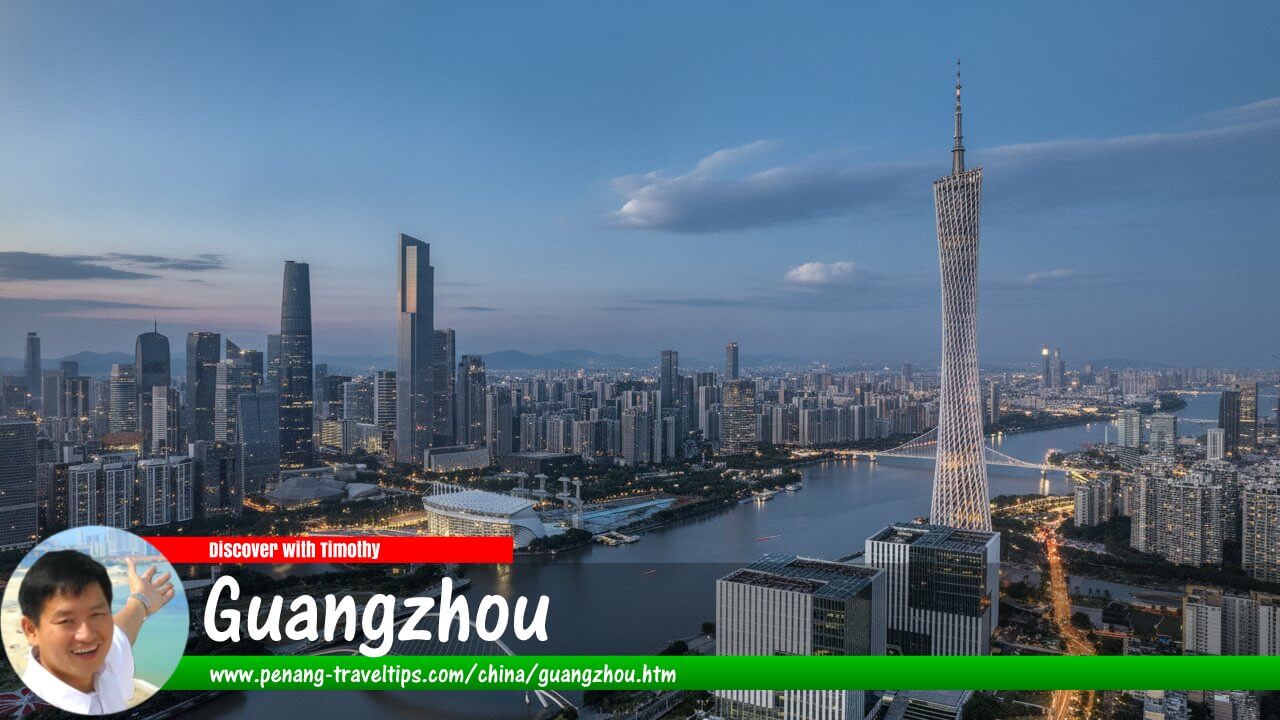 Guangzhou, China (Photo edited with AI on 16 June 2026)
Also available: Guangzhou (Malay Edition)
Guangzhou (广州; Guǎngzhōu), historically known in the West as Canton, is the capital of Guangdong Province in southern China and one of the country's oldest and most important cities. Situated on the Pearl River, Guangzhou has served as a major trading port for over two thousand years and played a pivotal role in China's maritime commerce with the rest of the world. Today, it is a thriving metropolis where ancient temples, traditional Lingnan architecture and bustling markets stand alongside futuristic skyscrapers, modern shopping districts and one of the busiest transportation hubs in Asia.
As the political, economic and cultural centre of Guangdong Province, Guangzhou is widely regarded as the heart of Cantonese culture. The city is famous for its world-renowned Cantonese cuisine, dim sum traditions, colourful festivals and warm hospitality. Visitors can explore centuries-old heritage sites, cruise along the Pearl River, admire panoramic views from the iconic Canton Tower, discover museums and parks, and experience one of China's most dynamic commercial cities.
Guangzhou is also one of China's principal international gateways. Guangzhou Baiyun International Airport connects the city with destinations across Asia, Europe, Oceania, the Middle East and North America, while its extensive high-speed rail network provides convenient access to cities such as Shenzhen, Hong Kong, Zhuhai, Foshan and Guilin. These excellent transport links make Guangzhou an ideal starting point for exploring southern China.
The city enjoys a humid subtropical climate with relatively mild winters and long, warm summers, making it a year-round destination. Spring and autumn are generally considered the most pleasant seasons for sightseeing, while winter offers comfortable temperatures compared with many cities in northern China.
Guangzhou is particularly attractive to travellers interested in history, architecture, food and shopping. Historic landmarks such as the Chen Clan Ancestral Hall, the Temple of the Six Banyan Trees and the Huaisheng Mosque reflect the city's long and multicultural past, while modern districts such as Zhujiang New Town showcase Guangzhou's rapid urban development. Traditional shopping streets, wholesale markets and luxury malls cater to every type of visitor, from bargain hunters to luxury shoppers.
For Muslim travellers, Guangzhou is among the most accommodating cities in southern China. The city has a long-established Muslim community dating back more than a thousand years, several historic mosques, including the renowned Huaisheng Mosque, and a good selection of halal restaurants serving Chinese Muslim and international cuisine.
This Guangzhou Travel Guide provides everything you need to plan your visit, including the city's history, culture, top attractions, transportation, accommodation, shopping, Cantonese cuisine, halal food, practical travel advice and suggested itineraries. Whether you are visiting Guangzhou for business, leisure or as part of a longer journey through China, this guide will help you make the most of your stay in one of the country's most fascinating and influential cities.
History of Guangzhou
Guangzhou has a history spanning more than 2,200 years, making it one of China's oldest and most historically significant cities. Throughout its long history, the city has served as a political centre, an international trading port, a cultural crossroads and a gateway between China and the outside world. Known for centuries to foreign merchants as Canton, Guangzhou played a central role in the development of the Maritime Silk Road and remains one of China's most important commercial cities today.
Early History
The area around present-day Guangzhou has been inhabited since prehistoric times. During the Qin dynasty (221–206 BC), the region came under imperial Chinese control after Qin Shi Huang unified China. In 214 BC, the Qin established the commandery of Nanhai, with Panyu serving as its administrative centre. Modern Guangzhou traces its origins to this ancient settlement.
Following the collapse of the Qin dynasty, the region became part of the independent Kingdom of Nanyue, established by Zhao Tuo around 204 BC. The kingdom covered much of present-day Guangdong, Guangxi and northern Vietnam, with Panyu as its capital. In 111 BC, during the reign of Emperor Wu of the Han dynasty, the Han Empire conquered Nanyue and incorporated the region into imperial China.
The Rise of a Great Trading Port
Thanks to its strategic location on the Pearl River near the South China Sea, Guangzhou developed into one of China's earliest international ports. By the Tang dynasty (618–907), it had become a thriving centre of maritime commerce, attracting merchants from Persia, Arabia, India and Southeast Asia.
Foreign traders brought spices, precious stones, perfumes and textiles, while Chinese merchants exported silk, porcelain, ceramics and tea. This flourishing trade made Guangzhou one of the principal ports along the ancient Maritime Silk Road and helped shape its cosmopolitan character.
The Arrival of Islam
Guangzhou was among the first Chinese cities visited by Muslim merchants from Arabia and Persia. By the seventh century, a sizeable Muslim trading community had become established in the city.
According to Islamic tradition, the Huaisheng Mosque, one of the oldest mosques in China, was founded during the Tang dynasty. Although parts of the present structure date from later periods, the mosque symbolises Guangzhou's long-standing connections with the Islamic world and its role as a meeting place for different cultures and religions.
Guangzhou During the Song and Ming Dynasties
During the Song (960–1279) and Ming (1368–1644) dynasties, Guangzhou continued to prosper as one of China's busiest ports. Maritime trade expanded significantly, and the city became known for its skilled artisans, thriving markets and commercial wealth.
The surrounding Pearl River Delta also developed into one of China's most productive agricultural and manufacturing regions, strengthening Guangzhou's importance as a centre for trade and administration.
The Canton System
During the Qing dynasty (1644–1912), Guangzhou occupied a unique position in China's foreign trade. From 1757 until the outbreak of the First Opium War in 1839, the Qing government restricted most foreign trade with Western countries to Guangzhou under what became known as the Canton System.
European trading companies established warehouses and offices in the district known as the Thirteen Factories, located outside the old city walls. British, Dutch, French, Danish, Swedish and American merchants conducted business here, making Guangzhou the principal point of contact between China and the Western world.
The Opium Wars and Foreign Influence
Guangzhou was one of the key battlegrounds during the First and Second Opium Wars in the nineteenth century. These conflicts profoundly changed China's relationship with foreign powers and marked the beginning of a period of increasing foreign influence in the country.
Following the wars, Guangzhou remained an important commercial city while adapting to changing political and economic circumstances. Western architecture, education and industry gradually became part of the city's urban landscape.
Guangzhou in Modern China
During the twentieth century, Guangzhou played an important role in modern Chinese history. The city became closely associated with revolutionary leader Sun Yat-sen, who used Guangzhou as one of the bases for his efforts to modernise China and overthrow the Qing dynasty.
After the founding of the People's Republic of China in 1949, Guangzhou continued to develop as a major industrial and commercial centre. The economic reforms introduced from the late 1970s transformed the city into one of China's leading manufacturing, financial and trading hubs.
The Canton Fair
Since 1957, Guangzhou has hosted the China Import and Export Fair, better known internationally as the Canton Fair. Held twice each year, it is China's largest and most influential trade exhibition, attracting buyers and exhibitors from around the world.
The Canton Fair has reinforced Guangzhou's reputation as one of the world's leading centres for international commerce and continues to contribute significantly to the city's economy.
Guangzhou Today
Today, Guangzhou is a modern metropolis with a population of more than 18 million people in its metropolitan area. Despite its impressive skyline and advanced infrastructure, the city has carefully preserved many reminders of its rich past, including ancient temples, traditional Lingnan architecture, historic neighbourhoods and cultural landmarks.
From its origins as the ancient city of Panyu to its status as a global centre for trade and innovation, Guangzhou has continuously reinvented itself while remaining one of China's most influential cities. Its remarkable history is reflected not only in its historic monuments but also in its diverse culture, world-famous cuisine and enduring role as China's gateway to the world.
Geography and Administrative Division of Guangzhou
Guangzhou is the capital of Guangdong Province in southern China and one of the country's largest metropolitan areas. Situated on the northern edge of the Pearl River Delta, the city occupies a strategic position between mainland China and the South China Sea. Its location has long made Guangzhou an important centre for trade, transportation and cultural exchange, helping it develop into one of China's most influential cities.
Today, Guangzhou is part of the Guangdong–Hong Kong–Macao Greater Bay Area, an ambitious economic region that links Guangzhou with Hong Kong, Macau, Shenzhen and several other major cities in southern China. Together, these cities form one of the world's largest urban and economic regions.
Location
Guangzhou lies approximately 120 kilometres (75 miles) northwest of Hong Kong and about 145 kilometres (90 miles) north of Macau. The city occupies the central part of Guangdong Province and is connected to neighbouring cities by an extensive network of expressways, high-speed railways and waterways.
Its location makes Guangzhou an excellent base for exploring southern China. Cities such as Shenzhen, Foshan, Dongguan, Zhuhai, Zhongshan and Huizhou are all within easy reach, while high-speed trains provide convenient access to destinations farther afield, including Guilin, Changsha and Beijing.
The Pearl River
The Pearl River (珠江; Zhū Jiāng) flows through the heart of Guangzhou and has been central to the city's history and prosperity. Formed by the convergence of several major rivers, it is China's third-longest river system after the Yangtze and Yellow rivers.
For centuries, the Pearl River served as Guangzhou's principal transportation route, connecting inland China with the South China Sea. Merchant ships carrying silk, porcelain, tea and spices once sailed along these waterways, making Guangzhou one of the world's busiest trading ports.
Today, the river remains an important commercial waterway while also providing attractive waterfront promenades, public parks and popular evening river cruises that showcase the city's illuminated skyline.
Topography
Much of Guangzhou is built on low-lying plains within the fertile Pearl River Delta. Numerous rivers, canals and tributaries cross the city, contributing to its extensive network of waterways.
Although much of the urban area is relatively flat, hills and low mountains rise in the northern and northeastern districts. Among the best-known natural landmarks is Baiyun Mountain (White Cloud Mountain), which offers scenic walking trails, gardens and panoramic views of the city.
Climate
Guangzhou has a humid subtropical climate, characterised by warm temperatures and relatively high humidity throughout much of the year.
The four seasons are generally:
- Spring (March to May): Warm and humid, with occasional rain showers.
- Summer (June to September): Hot, humid and the wettest time of the year, with frequent thunderstorms and occasional typhoons affecting southern China.
- Autumn (October to November): Pleasant temperatures, lower humidity and generally clear skies, making it one of the best seasons to visit.
- Winter (December to February): Mild and relatively dry, with daytime temperatures usually comfortable for sightseeing.
Because of its southern location, Guangzhou experiences much warmer winters than cities in northern China, making it an attractive destination throughout the year.
Administrative Division
Guangzhou is administered as a prefecture-level city and consists of eleven urban districts. Each district has its own character and attractions, ranging from historic neighbourhoods and commercial centres to modern business districts and suburban communities.
The eleven districts are:
- Yuexiu District (越秀区)
- Liwan District (荔湾区)
- Haizhu District (海珠区)
- Tianhe District (天河区)
- Baiyun District (白云区)
- Huangpu District (黄埔区)
- Panyu District (番禺区)
- Huadu District (花都区)
- Nansha District (南沙区)
- Conghua District (从化区)
- Zengcheng District (增城区)
Major Districts for Visitors
While Guangzhou is a vast city, most visitors spend the majority of their time in several key districts.
Yuexiu District
Yuexiu is the historic heart of Guangzhou. Many of the city's most important cultural landmarks, museums, temples and historical sites are located here, making it an excellent area for first-time visitors.
Tianhe District
Tianhe is Guangzhou's modern financial and commercial centre. Home to Zhujiang New Town, Canton Tower, luxury shopping malls and numerous international hotels, it represents the city's contemporary skyline.
Liwan District
Liwan preserves much of old Guangzhou's traditional character. Visitors can explore historic streets, traditional Lingnan architecture, local markets and cultural attractions that reflect the city's rich heritage.
Haizhu District
Situated along the Pearl River, Haizhu is known for its exhibition centres, riverside parks and convenient transport connections. It is also home to the Canton Fair Complex, which hosts the famous China Import and Export Fair.
Panyu District
Panyu is located south of the city centre and is home to several popular attractions, including Chimelong Tourist Resort, one of China's leading entertainment destinations featuring theme parks, safari attractions and water parks.
The Greater Bay Area
Guangzhou plays a leading role in the Guangdong–Hong Kong–Macao Greater Bay Area, a regional development initiative that promotes closer economic integration between southern China's major cities.
For travellers, this means excellent transport connections and the opportunity to combine Guangzhou with nearby destinations such as Hong Kong, Macau, Shenzhen, Zhuhai and Foshan within a single itinerary.
Why Guangzhou's Geography Matters
Guangzhou's location at the centre of the Pearl River Delta has shaped its history, economy and culture for more than two thousand years. Its river network supported international maritime trade, while its position within one of China's most prosperous regions continues to drive commerce, innovation and tourism. Today, this strategic location makes Guangzhou not only an attractive destination in its own right but also an ideal gateway for exploring southern China.
People, Language and Culture of Guangzhou
Guangzhou is widely regarded as the cultural heart of southern China and the birthplace of modern Cantonese culture. Although it is one of China's most modern and economically developed cities, Guangzhou has preserved many of its traditional customs, performing arts, architecture, cuisine and festivals. The city's long history as an international trading port has also given it a cosmopolitan character, where Chinese traditions blend with influences from around the world.
Visitors to Guangzhou will quickly notice that the city has a distinct identity compared with many other parts of China. Its language, food, architecture and way of life reflect the rich heritage of the Lingnan region, which has developed over thousands of years in southern China.
The People of Guangzhou
Guangzhou has a permanent population of more than 18 million people, making it one of the largest metropolitan areas in China. As the capital of Guangdong Province, it attracts residents from across the country, creating a diverse and multicultural population.
The majority of local residents are Han Chinese, while smaller communities from China's many ethnic minorities also live and work in the city. In addition, Guangzhou is home to sizeable international communities, particularly businesspeople, students and professionals from Asia, Africa, Europe and the Middle East.
Because of its long history as a trading port, Guangzhou has traditionally been one of China's most outward-looking cities, welcoming visitors and merchants from around the world.
Lingnan Culture
Guangzhou is the principal centre of Lingnan culture, which developed in the region south of the Nanling Mountains, covering much of present-day Guangdong and neighbouring areas.
Lingnan culture is known for its openness, practicality and willingness to embrace new ideas while preserving traditional values. Centuries of maritime trade brought foreign influences that shaped the region's architecture, crafts, cuisine and commercial traditions.
Characteristics of Lingnan culture include:
- Elegant traditional architecture designed for a warm, humid climate.
- A strong emphasis on commerce and entrepreneurship.
- Refined culinary traditions.
- Colourful festivals and folk customs.
- A long history of international cultural exchange.
The Cantonese Language
Cantonese (广东话; Gwóngdūng wá) is the traditional language of Guangzhou and remains widely spoken by local residents. It belongs to the Yue branch of Chinese languages and differs significantly from Mandarin in pronunciation, vocabulary and expressions.
Although Mandarin (Putonghua) is the official national language of China and is taught in schools, Cantonese continues to play an important role in everyday life, local media, traditional opera and popular culture.
Many residents speak both Cantonese and Mandarin fluently, while younger generations often have some knowledge of English, particularly in the tourism and hospitality sectors.
Religion in Guangzhou
Guangzhou has long been a city where different religions have coexisted. Buddhism, Taoism, Islam, Christianity and traditional Chinese beliefs have all contributed to the city's cultural landscape.
Historic places of worship include:
- Huaisheng Mosque.
- Temple of the Six Banyan Trees.
- Guangxiao Temple.
- Sacred Heart Cathedral.
- Numerous Taoist temples and ancestral halls.
These landmarks reflect Guangzhou's role as one of China's earliest centres of international trade and cultural exchange.
Arts and Performing Traditions
Guangzhou has a rich artistic heritage that continues to thrive today.
Traditional performing arts include:
- Cantonese Opera: A UNESCO-recognised performing art combining music, singing, martial arts and elaborate costumes.
- Lion Dance: Frequently performed during festivals, business openings and Chinese New Year celebrations.
- Dragon Dance: A traditional performance symbolising prosperity and good fortune.
The city is also home to numerous theatres, concert halls, galleries and cultural centres that showcase both traditional and contemporary Chinese arts.
Festivals and Celebrations
Many traditional Chinese festivals are celebrated enthusiastically in Guangzhou, often with distinctive Cantonese customs.
Major festivals include:
- Chinese New Year.
- Lantern Festival.
- Qingming Festival.
- Dragon Boat Festival.
- Mid-Autumn Festival.
These celebrations feature colourful decorations, traditional foods, family gatherings and cultural performances throughout the city.
Cantonese Cuisine as a Cultural Tradition
Food occupies a central place in Cantonese culture. Meals are regarded not only as an opportunity to eat but also as an important social activity that brings together family, friends and business associates.
The famous tradition of yum cha, where diners enjoy tea together with a variety of dim sum dishes, is one of Guangzhou's best-known cultural experiences. This centuries-old custom remains an essential part of daily life for many local residents.
Architecture and Urban Character
Guangzhou's architecture reflects the city's long and varied history. Visitors will find ancient temples, traditional Lingnan residences, colonial-era buildings and modern skyscrapers within a relatively short distance of one another.
Traditional Lingnan architecture is particularly well adapted to the subtropical climate, incorporating features such as:
- Open courtyards.
- Decorative brick carvings.
- Wide verandas.
- Ventilated layouts.
- Intricate wood and stone craftsmanship.
Modern districts such as Zhujiang New Town, meanwhile, showcase Guangzhou's transformation into one of China's leading financial and commercial centres.
Hospitality and Local Customs
Residents of Guangzhou are generally known for their practical outlook and welcoming attitude towards visitors. Having interacted with international traders and travellers for centuries, the city has developed a reputation for openness and adaptability.
Simple gestures such as greeting people politely, respecting local customs and observing good manners when dining or visiting religious sites are appreciated and help create positive interactions with local residents.
A City Shaped by Tradition and Innovation
Guangzhou's unique character lies in its ability to balance tradition with progress. While its skyline continues to evolve with modern architecture and technological innovation, the city remains deeply rooted in the customs, language and heritage of Cantonese culture. For visitors, this blend of history, culture and contemporary urban life is one of Guangzhou's greatest attractions and forms the foundation of its enduring appeal as one of China's most fascinating cities.
Guangzhou's Main Attractions
Guangzhou offers a fascinating blend of ancient heritage, modern architecture, cultural landmarks and natural scenery. As one of China's oldest cities and a major international gateway, Guangzhou appeals to a wide variety of travellers, from history enthusiasts and food lovers to families, photographers and business visitors.
Many of the city's most popular attractions are conveniently connected by the Guangzhou Metro, allowing visitors to explore historic neighbourhoods, museums, temples, shopping districts and riverside promenades with ease.
Canton Tower
The Canton Tower is Guangzhou's most recognisable landmark and dominates the city's modern skyline. Standing 600 metres (1,969 feet) tall, it is among the world's tallest towers and offers spectacular panoramic views from its observation decks.
In addition to sightseeing, the tower features restaurants, entertainment facilities and one of the world's highest outdoor observation platforms. It is especially popular after sunset, when both the tower and the surrounding skyline are illuminated.
The Pearl River
The Pearl River has been central to Guangzhou's history for more than two thousand years. Today, visitors can enjoy scenic river cruises that pass many of the city's best-known landmarks, particularly in the evening when colourful lights reflect across the water.
The riverfront also offers pleasant walking paths, landscaped parks and excellent opportunities for photography.
Zhujiang New Town
Zhujiang New Town is Guangzhou's modern financial and commercial district. Filled with striking skyscrapers, luxury hotels, shopping centres and cultural venues, it represents the city's rapid transformation into a global business hub.
The district is home to several iconic buildings, including the Guangzhou International Finance Center and the CTF Finance Centre, while its spacious public squares provide attractive places to relax and admire the city's contemporary architecture.
Chen Clan Ancestral Hall
The Chen Clan Ancestral Hall is widely regarded as one of the finest examples of traditional Lingnan architecture. Built during the late Qing dynasty, it features beautifully carved wood, brick, stone and ivory decorations that demonstrate the exceptional craftsmanship of southern China.
Today, the complex houses the Guangdong Folk Art Museum, where visitors can learn more about the region's artistic traditions and cultural heritage.
Yuexiu Park
Yuexiu Park is the largest urban park in central Guangzhou and one of the city's most popular recreational areas. The park contains lakes, gardens, walking trails, museums and several historic monuments.
Its most famous landmark is the Five Rams Statue, the symbol of Guangzhou, which is associated with an ancient legend explaining the city's origins.
Baiyun Mountain
Known as the "lungs of Guangzhou," Baiyun Mountain (White Cloud Mountain) offers a refreshing escape from the busy city centre. Visitors can hike forest trails, take a cable car, enjoy landscaped gardens or admire sweeping views of the metropolitan skyline.
The mountain is particularly popular during weekends and public holidays among both local residents and tourists.
Temple of the Six Banyan Trees
The Temple of the Six Banyan Trees is one of Guangzhou's oldest Buddhist temples, dating back more than 1,400 years. It is best known for the elegant Flower Pagoda, one of the city's most recognisable historic structures.
The temple remains an active place of worship while welcoming visitors interested in Chinese Buddhism and traditional architecture.
Huaisheng Mosque
The Huaisheng Mosque is among the oldest mosques in China and reflects Guangzhou's long history of contact with Muslim merchants through the Maritime Silk Road.
For many Muslim travellers, the mosque is both an important religious site and a reminder of the city's centuries-old multicultural heritage.
Sacred Heart Cathedral
The Sacred Heart Cathedral, completed in the nineteenth century, is one of the largest Gothic-style cathedrals in China. Constructed almost entirely from granite, it is often referred to as the "Stone House" by local residents.
Its impressive architecture makes it one of Guangzhou's most photographed religious landmarks.
Shamian Island
Shamian Island preserves one of Guangzhou's best collections of European-style architecture. Once a foreign concession during the nineteenth century, the island features tree-lined streets, elegant colonial buildings, peaceful gardens and charming cafés.
Today, it provides a relaxing contrast to the modern skyscrapers found elsewhere in the city.
Chimelong Tourist Resort
Chimelong Tourist Resort is one of China's premier entertainment destinations. The resort includes several world-class attractions, such as:
- Chimelong Safari Park.
- Chimelong Paradise theme park.
- Chimelong Water Park.
- Chimelong International Circus.
It is especially popular with families travelling with children.
Beijing Road Pedestrian Street
Beijing Road is one of Guangzhou's most famous shopping streets, combining modern retail outlets with historical significance. Visitors can view preserved sections of ancient roadways beneath glass panels while exploring department stores, boutiques, restaurants and traditional snack stalls.
The lively atmosphere makes it a favourite destination for both shopping and evening walks.
Guangzhou Museum and Other Museums
Guangzhou is home to numerous museums covering history, art, science and local culture. Among the most notable are the Guangzhou Museum, the Guangdong Museum and the Museum of the Mausoleum of the Nanyue King.
These institutions provide valuable insights into the city's development from ancient times to the present day.
A City with Something for Every Traveller
From historic temples and traditional neighbourhoods to futuristic skyscrapers, riverside promenades and family-friendly attractions, Guangzhou offers experiences to suit every interest. Whether visitors are exploring its rich cultural heritage, enjoying world-famous Cantonese cuisine, shopping in bustling commercial districts or simply relaxing along the Pearl River, Guangzhou rewards travellers with a unique blend of history, innovation and authentic southern Chinese culture.
Canton Tower and Zhujiang New Town
Canton Tower and Zhujiang New Town represent the modern face of Guangzhou. Located on the banks of the Pearl River, this area showcases the city's transformation into one of China's leading financial and commercial centres. With its futuristic skyline, cultural venues, shopping districts and spectacular night views, it has become one of the most popular areas for visitors to Guangzhou.
Canton Tower (广州塔)
Canton Tower (广州塔; Guǎngzhōu Tǎ), also known as the Guangzhou TV Astronomical Tower, is the most recognisable landmark in Guangzhou. Completed in 2010, the tower was built to serve as a broadcasting and observation tower and quickly became a symbol of the city's modern identity.
Standing 600 metres tall, including its antenna, Canton Tower is among the tallest structures in the world. Its slender, twisting design has earned it the nickname "Super Model" because of its elegant curved shape.
Design and Architecture
The distinctive appearance of Canton Tower comes from its hyperboloid structure, where the outer steel framework narrows and twists as it rises. This unusual design allows the tower to appear light and graceful despite its enormous height.
The tower was designed to withstand the strong winds and typhoons that occasionally affect southern China. Its engineering represents the combination of advanced technology and creative architectural design.
Observation Decks
One of the main reasons visitors come to Canton Tower is to enjoy its panoramic views of Guangzhou.
The observation areas provide views of:
- The Pearl River.
- Zhujiang New Town skyline.
- Historic districts of Guangzhou.
- Surrounding mountains and urban areas.
The best time to visit is usually late afternoon, allowing visitors to see the city during daylight, sunset and the spectacular evening illumination.
Popular Attractions at Canton Tower
Bubble Tram
The Bubble Tram is one of Canton Tower's most famous attractions. A series of transparent glass cabins travel around the upper section of the tower, offering visitors a unique rotating view of the city below.
It is particularly popular among photographers and families seeking a memorable experience.
Sky Drop
The Sky Drop offers visitors a thrilling experience by allowing them to experience a vertical free-fall ride from a great height. It is one of the world's highest outdoor drop rides.
Revolving Restaurant
Canton Tower also features restaurants where diners can enjoy meals while taking in changing views of Guangzhou's skyline.
Canton Tower at Night
Canton Tower becomes especially impressive after sunset when its exterior lighting system transforms the structure into a colourful beacon along the Pearl River.
The illuminated tower forms part of Guangzhou's famous night skyline, together with the surrounding skyscrapers of Zhujiang New Town. Many visitors photograph the tower from the opposite riverbank or enjoy a Pearl River night cruise for the best views.
Zhujiang New Town (珠江新城)
Zhujiang New Town is Guangzhou's central business district and the heart of its modern skyline. Developed from the early 2000s, the district was designed as a world-class urban centre combining finance, culture, commerce and public spaces.
Today, it is home to some of Guangzhou's most impressive buildings, luxury hotels, shopping malls and cultural institutions.
Major Landmarks in Zhujiang New Town
Guangzhou International Finance Center (广州国际金融中心)
The Guangzhou International Finance Center, often called the West Tower, is one of Guangzhou's most recognisable skyscrapers. Standing 432 metres tall, it was once among the tallest buildings in China.
The building contains offices, a luxury hotel and observation facilities offering excellent views of the city.
CTF Finance Centre (周大福金融中心)
The CTF Finance Centre, also known as the East Tower, is one of the tallest buildings in Guangzhou and one of the tallest skyscrapers in the world.
Its mixed-use design includes offices, residences, a hotel and retail spaces, reflecting Guangzhou's role as a major international business hub.
Guangzhou Opera House (广州大剧院)
Designed by renowned architect Zaha Hadid, the Guangzhou Opera House is one of China's most distinctive cultural buildings.
Its flowing design was inspired by the shapes of river stones shaped by water. The venue hosts opera, ballet, concerts and international performances throughout the year.
Guangdong Museum (广东省博物馆)
The Guangdong Museum is one of the leading museums in southern China. Its collections cover:
- Natural history.
- Ancient Chinese art.
- Guangdong culture.
- Marine history.
The museum's modern architecture itself is also an attraction.
Huacheng Square (花城广场)
Huacheng Square, or Flower City Square, is the largest public square in Guangzhou and the centrepiece of Zhujiang New Town.
The open space provides excellent views of:
- Canton Tower.
- Guangzhou Opera House.
- Guangzhou International Finance Center.
- Pearl River waterfront.
The square is especially attractive in the evening when the surrounding buildings are illuminated.
How to Visit Canton Tower and Zhujiang New Town
The area is easily accessible by Guangzhou Metro.
Useful stations include:
- Canton Tower Station: For Canton Tower.
- Zhujiang New Town Station: For the business district and Huacheng Square.
- Guangzhou Opera House Station: For cultural attractions.
The area is also well connected by buses, taxis and ride-hailing services.
Best Time to Visit
The ideal time to explore Canton Tower and Zhujiang New Town is from late afternoon into the evening.
A recommended schedule:
- Arrive before sunset.
- Visit the observation deck during daylight.
- Watch the city lights appear after sunset.
- Take evening photographs of the skyline.
Tips for Visitors
- Check visibility before visiting the observation deck, as haze can affect views.
- Purchase tickets in advance during weekends and holidays.
- Allow extra time to explore Huacheng Square and nearby attractions.
- Bring a camera for night photography.
- Wear comfortable shoes as the area involves considerable walking.
Canton Tower and Zhujiang New Town perfectly represent the contrast that defines Guangzhou today: a city that honours its ancient maritime heritage while embracing modern innovation. For first-time visitors, this area provides one of the clearest impressions of Guangzhou's ambition, creativity and transformation into a global city.
The Pearl River and Guangzhou Waterfront
The Pearl River (珠江; Zhū Jiāng) has shaped the history, economy and identity of Guangzhou for more than two thousand years. Flowing through the heart of the city, the river was once the lifeline of Guangzhou's maritime trade and remains one of its most important landmarks today.
For centuries, merchants from China and overseas sailed along the Pearl River carrying silk, porcelain, tea and other goods. The river connected Guangzhou with the South China Sea and helped transform the city into one of the world's earliest international trading ports.
Today, the Guangzhou waterfront has been revitalised into a vibrant area featuring scenic promenades, cultural landmarks, modern skyscrapers and one of China's most popular evening attractions: the Pearl River night cruise.
The Pearl River System
The Pearl River is China's third-longest river system after the Yangtze River and the Yellow River. Unlike a single river channel, it is formed by the meeting of several major waterways, including the Xi River, Bei River and Dong River.
The river flows through Guangdong Province before reaching the South China Sea near the Pearl River Delta. This fertile delta region has become one of China's most economically productive areas, home to major cities including Guangzhou, Shenzhen, Dongguan and Foshan.
The Historical Importance of the Pearl River
Guangzhou's location along the Pearl River was the key factor behind its rise as a major port. Long before modern highways and railways existed, waterways were the most efficient means of transporting goods and people.
During ancient and imperial China, ships from Southeast Asia, India, Arabia and beyond arrived at Guangzhou carrying valuable goods and cultural influences. The river became a channel not only for trade but also for the exchange of ideas, religions and technologies.
The Pearl River and the Maritime Silk Road
Guangzhou was one of the most important ports along the ancient Maritime Silk Road, a network of sea routes connecting China with Southeast Asia, South Asia, the Middle East and Africa.
Through this maritime network, Guangzhou exported Chinese products such as:
- Silk.
- Porcelain.
- Tea.
- Paper products.
- Handcrafted goods.
At the same time, foreign merchants brought:
- Spices.
- Precious stones.
- Fragrances.
- Religious traditions.
- New cultural influences.
This history explains why Guangzhou developed a more international outlook compared with many inland Chinese cities.
Guangzhou Waterfront Today
Modern Guangzhou has transformed many sections of the riverfront into attractive public spaces. The waterfront now combines historical landmarks with contemporary architecture, creating one of the best places to experience the contrast between old and new Guangzhou.
Popular riverside areas include:
- Haizhu Square.
- Ersha Island.
- Zhujiang New Town waterfront.
- Canton Tower area.
- Shamian Island waterfront.
Pearl River Night Cruise
The Pearl River Night Cruise is one of Guangzhou's most popular tourist experiences. After sunset, sightseeing boats travel along the river, offering views of the illuminated city skyline.
During the cruise, visitors can see:
- Canton Tower.
- Zhujiang New Town skyscrapers.
- Historic bridges.
- Riverside buildings.
- Colourful city lights reflected on the water.
The evening atmosphere provides a completely different perspective from daytime sightseeing.
Recommended Cruise Routes
Most tourist cruises depart from piers near the central waterfront areas.
Common departure points include:
- Tianzi Wharf (天字码头).
- Dashatou Wharf (大沙头码头).
- Xidi Wharf (西堤码头).
Cruise durations vary, but many journeys last between one and two hours.
Best Time for a Pearl River Cruise
The best time for a cruise is usually after sunset when Guangzhou's skyline becomes illuminated.
Recommended timing:
- Arrive before sunset.
- Explore the waterfront area while waiting.
- Take the cruise after the city lights turn on.
During clear evenings, the views of Canton Tower and Zhujiang New Town are particularly impressive.
Photography Along the Pearl River
The Pearl River waterfront provides some of the best photography opportunities in Guangzhou.
Popular photography locations include:
- The riverside opposite Canton Tower.
- Huacheng Square.
- Haixinsha Island.
- Ersha Island.
- Bridges crossing the Pearl River.
Night photography is especially rewarding because the illuminated skyline creates dramatic reflections on the water.
Haixinsha Island (海心沙)
Haixinsha Island is a small island in the Pearl River near Zhujiang New Town. It became internationally known as the main venue for the opening and closing ceremonies of the 2010 Asian Games.
Today, it serves as a public recreational space offering excellent views of Canton Tower and the surrounding skyline.
Ersha Island (二沙岛)
Ersha Island is an upscale residential and cultural area located in the Pearl River. It is known for its peaceful environment, green spaces and cultural institutions.
Attractions include:
- Guangzhou Xinghai Concert Hall.
- Guangdong Museum of Art.
- Riverside walking paths.
The island provides a quieter alternative to the busy city centre.
Haizhu Square (海珠广场)
Haizhu Square is one of Guangzhou's historic riverside landmarks. Located near the traditional commercial areas of the city, it has long been an important public gathering space.
The nearby Haizhu Bridge, completed in the early twentieth century, is also an important historical structure connecting different parts of central Guangzhou.
Tips for Visitors
- Visit the waterfront in the evening for the best atmosphere.
- Check weather conditions before booking a cruise.
- Bring a camera or smartphone for night photography.
- Combine a river cruise with visits to Canton Tower or Zhujiang New Town.
- Wear comfortable shoes as waterfront areas can involve considerable walking.
A River That Defines Guangzhou
The Pearl River is more than a scenic attraction; it is the foundation upon which Guangzhou was built. From ancient merchant ships arriving from distant lands to today's illuminated skyline and modern river cruises, the river continues to connect Guangzhou's past, present and future. For visitors, experiencing the Pearl River is one of the best ways to understand the city's identity as a historic gateway and a modern global metropolis.
Historic Guangzhou — Old City Areas and Heritage Neighbourhoods
Historic Guangzhou reveals a side of the city that is very different from its modern skyline. Beyond the skyscrapers of Zhujiang New Town and the busy commercial districts, Guangzhou preserves ancient temples, traditional streets, old merchant neighbourhoods and architectural treasures that reflect more than two thousand years of history.
The old city developed around the northern banks of the Pearl River, where Guangzhou grew from an ancient settlement into one of China's most important maritime trading ports. Walking through these historic areas allows visitors to experience the traditional character of Lingnan culture and understand how Guangzhou evolved over centuries.
The Old City of Guangzhou
The traditional centre of Guangzhou was historically located within the area enclosed by the old city walls. Although most of the walls no longer exist, many neighbourhoods still preserve the layout, streets and cultural landmarks of ancient Guangzhou.
The old city is concentrated mainly around:
- Yuexiu District.
- Liwan District.
- The areas around Beijing Road.
- The neighbourhoods near the Pearl River.
These areas offer visitors a chance to explore temples, markets, traditional residences and historic commercial streets.
Beijing Road Pedestrian Street (北京路步行街)
Beijing Road is one of Guangzhou's most famous historic commercial streets. Its name comes from the fact that it was once an important route connecting different parts of the ancient city.
Today, Beijing Road combines modern shopping with historical discoveries. One of its most interesting features is the preserved sections of ancient road surfaces displayed beneath transparent glass panels, allowing visitors to see layers of streets built during different historical periods.
Visitors can find:
- Department stores.
- Fashion shops.
- Traditional snacks.
- Restaurants.
- Cultural souvenirs.
Because of its combination of shopping and history, Beijing Road is one of the best places to experience both old and modern Guangzhou.
Liwan District (荔湾区)
Liwan District is one of the best areas to experience traditional Guangzhou. Historically known as the western gateway of the city, Liwan developed as a commercial and residential area connected to the Pearl River trade.
The district is famous for:
- Traditional Lingnan architecture.
- Historic shopping streets.
- Tea houses.
- Local food culture.
- Ancient temples and ancestral halls.
For travellers interested in authentic local experiences, Liwan provides a glimpse of Guangzhou before the rise of modern skyscrapers.
Shangxiajiu Pedestrian Street (上下九步行街)
Shangxiajiu Pedestrian Street is one of Guangzhou's oldest and most popular shopping streets. Located in Liwan District, it has long been a centre of commerce and daily life.
The street is especially known for its Qilou (骑楼) buildings — traditional arcaded shophouses that combine Chinese and Western architectural influences.
Visitors can explore:
- Traditional shops.
- Cantonese restaurants.
- Local snacks.
- Historic façades.
It is an excellent place to experience Guangzhou's traditional commercial atmosphere.
Qilou Architecture (骑楼)
One of the most distinctive features of historic Guangzhou is the Qilou, or arcade-style buildings. These structures were designed to suit the subtropical climate of southern China.
The covered walkways allowed pedestrians to avoid strong sunlight and heavy rain while providing shop owners with practical commercial spaces.
Qilou architecture reflects the meeting of:
- Traditional Chinese design.
- Western architectural influences.
- Southern China's tropical environment.
Many Qilou buildings remain along streets such as Shangxiajiu and parts of the old city.
Xiguan (西关) — Traditional Western Guangzhou
Xiguan refers to the historic western part of Guangzhou, particularly the area around present-day Liwan District. It was once home to wealthy merchants, craftsmen and traditional families.
Xiguan is famous for:
- Xiguan mansions.
- Traditional residences.
- Cantonese opera culture.
- Local cuisine.
The area represents the refined lifestyle of old Guangzhou's merchant families.
Xiguan Mansions (西关大屋)
Xiguan mansions were large traditional residences built by wealthy Guangzhou families during the late Qing period.
These homes typically featured:
- Narrow entrances facing the street.
- Long corridors.
- Courtyards for ventilation.
- Decorative wooden carvings.
- Traditional furniture.
They demonstrate how local architecture adapted to Guangzhou's climate and social customs.
Lychee Bay (荔枝湾)
Lychee Bay is a historic waterway area in Liwan District that once represented the traditional riverside lifestyle of Guangzhou.
After restoration, the area has become a pleasant cultural destination featuring:
- Canals.
- Traditional bridges.
- Historic buildings.
- Restaurants.
- Nighttime scenery.
It provides visitors with a peaceful contrast to the busy city centre.
Traditional Markets and Local Life
Historic Guangzhou is also best experienced through its markets and everyday neighbourhoods.
Visitors may discover:
- Fresh food markets.
- Traditional herbal medicine shops.
- Tea merchants.
- Local snack stalls.
- Small family businesses.
These places offer insights into the daily life of Guangzhou residents beyond the main tourist attractions.
Exploring Historic Guangzhou
The best way to experience old Guangzhou is slowly, preferably on foot. Many historic areas are close enough to combine in a single day.
A suggested walking route:
- Beijing Road.
- Temple of the Six Banyan Trees.
- Chen Clan Ancestral Hall.
- Shangxiajiu Pedestrian Street.
- Lychee Bay.
Visitors should allow time to explore side streets, small shops and local restaurants, as some of Guangzhou's most memorable experiences are found away from the main roads.
A Living Heritage City
Historic Guangzhou is not a museum frozen in time. It remains a living part of the modern city, where residents continue to work, eat, shop and celebrate traditions that have existed for generations. Exploring these neighbourhoods provides a deeper appreciation of Guangzhou's identity as a city where ancient maritime history and contemporary urban life exist side by side.
Chen Clan Ancestral Hall and Traditional Lingnan Architecture
Chen Clan Ancestral Hall (陈家祠; Chén Jiā Cí), also known as the Chen Clan Academy, is one of Guangzhou's most remarkable historical landmarks. Built during the late Qing dynasty, the complex represents the highest achievements of traditional Lingnan architecture and provides a fascinating insight into the cultural values, craftsmanship and social traditions of southern China.
Today, the Chen Clan Ancestral Hall houses the Guangdong Folk Art Museum, preserving and displaying the region's traditional arts, crafts and cultural heritage. For visitors interested in architecture, history and Chinese art, it is one of the must-visit attractions in Guangzhou.
History of Chen Clan Ancestral Hall
The Chen Clan Ancestral Hall was constructed between 1890 and 1894 during the late Qing dynasty. It was funded by members of the Chen family clan from across Guangdong Province, who contributed money to establish a place where family members could gather, worship their ancestors and prepare for imperial examinations.
During imperial China, success in the civil service examinations was an important path to social advancement. Clan academies provided accommodation, education and support for young scholars preparing for these examinations.
The Chen Clan Ancestral Hall therefore served several purposes:
- Ancestral worship hall.
- Educational institution.
- Meeting place for the Chen clan.
- Symbol of family unity and achievement.
Architecture of the Chen Clan Ancestral Hall
The complex covers an area of approximately 15,000 square metres and consists of multiple halls, courtyards and pavilions arranged according to traditional Chinese architectural principles.
The design follows the typical layout of Lingnan architecture, featuring:
- A symmetrical arrangement of buildings.
- Courtyards connecting different sections.
- Decorative entrances.
- Wooden and stone carvings.
- Carefully designed ventilation for the southern climate.
The architecture demonstrates a balance between practicality and artistic beauty, reflecting the creativity of craftsmen from Guangdong.
The Art of Lingnan Craftsmanship
One of the greatest attractions of the Chen Clan Ancestral Hall is its extraordinary collection of decorative artworks. Almost every surface contains intricate details created by highly skilled artisans.
Visitors can admire:
- Wood carvings.
- Stone carvings.
- Brick carvings.
- Ceramic sculptures.
- Iron decorations.
- Painted murals.
These artworks often depict themes from:
- Chinese mythology.
- Historical stories.
- Traditional legends.
- Scenes from daily life.
- Symbols of prosperity and good fortune.
Ceramic Ridge Decorations
The colourful ceramic decorations along the roof ridges are among the most impressive features of the Chen Clan Ancestral Hall.
These ceramic sculptures, known as Shiwan pottery decorations, were produced in Guangdong's famous Shiwan ceramic tradition. They display vivid colours and elaborate scenes featuring people, animals and mythical figures.
The roof decorations are not only decorative but also express wishes for prosperity, harmony and protection.
Wood Carvings
The wooden carvings throughout the complex demonstrate the exceptional skill of traditional Guangdong craftsmen.
Many carvings feature:
- Dragons.
- Phoenixes.
- Flowers.
- Traditional stories.
- Scenes from Chinese classics.
The level of detail shows the importance placed on craftsmanship in traditional Chinese architecture.
Stone and Brick Carvings
The stone and brick carvings of the Chen Clan Ancestral Hall are equally impressive. Unlike simple structural decoration, these carvings transform ordinary building materials into works of art.
Common themes include:
- Nature.
- Animals.
- Chinese legends.
- Symbolic patterns.
These decorations reveal the artistic sophistication of Lingnan craftsmen during the Qing dynasty.
Guangdong Folk Art Museum
Since 1959, the Chen Clan Ancestral Hall has served as the home of the Guangdong Folk Art Museum. The museum plays an important role in preserving and promoting traditional arts from Guangdong Province.
Its collections include:
- Traditional handicrafts.
- Embroidery.
- Carved artworks.
- Ceramics.
- Folk paintings.
- Traditional furniture.
Exhibitions change periodically, allowing repeat visitors to discover different aspects of Guangdong's cultural heritage.
Lingnan Architecture
The Chen Clan Ancestral Hall represents the unique architectural style of the Lingnan region. Unlike northern Chinese architecture, which often emphasises enclosed courtyards and heavy structures, Lingnan buildings developed to suit southern China's warmer and wetter climate.
Common characteristics include:
- Open courtyards for airflow.
- High ceilings.
- Decorative façades.
- Covered walkways.
- Integration with natural surroundings.
This practical yet artistic approach remains one of the defining features of southern Chinese architecture.
How to Visit Chen Clan Ancestral Hall
The Chen Clan Ancestral Hall is conveniently located in central Guangzhou and is easy to reach by public transport.
The nearest Guangzhou Metro station is:
- Chen Clan Academy Station (陈家祠站) on Line 1 and Line 8.
The attraction can be combined with visits to other historic sites nearby, including Liwan District, Shangxiajiu Pedestrian Street and Lychee Bay.
Visitor Tips
- Allow at least one to two hours to explore the complex.
- Look closely at the small decorative details, especially on roofs and doorways.
- Visit earlier in the day to avoid crowds.
- Photography is highly rewarding because of the intricate craftsmanship.
- Combine the visit with other historic attractions in old Guangzhou.
A Masterpiece of Southern Chinese Heritage
The Chen Clan Ancestral Hall is more than an architectural monument; it is a representation of Guangzhou's cultural identity. It reflects the importance of family, education, craftsmanship and community values that shaped traditional Cantonese society.
For visitors seeking to understand the soul of Guangzhou beyond its modern skyline, the Chen Clan Ancestral Hall offers one of the most complete and beautiful expressions of Lingnan heritage.
Museums and Cultural Attractions in Guangzhou
Guangzhou has a rich collection of museums and cultural institutions that tell the story of southern China from ancient times to the modern era. As one of China's oldest cities and a major international trading port, Guangzhou has accumulated a remarkable heritage shaped by archaeology, maritime exchange, art, religion and commerce.
The city's museums provide visitors with an opportunity to understand not only Guangzhou's local history but also its important role in China's wider development. From ancient royal tombs and traditional folk arts to modern science and contemporary culture, Guangzhou offers museums suitable for visitors of all interests.
Guangzhou Museum (广州博物馆)
The Guangzhou Museum is one of the city's most important institutions for preserving and presenting local history. Its main exhibition venue is located inside the historic Zhenhai Tower (镇海楼) at Yuexiu Park.
Built during the Ming dynasty in 1380, Zhenhai Tower is one of Guangzhou's most recognisable historical structures. It was originally constructed as a defensive watchtower and later became a symbol of the city.
The museum's collections cover:
- Guangzhou's ancient history.
- Maritime trade development.
- Historical maps and documents.
- Cultural artefacts from different periods.
- The city's transformation into a modern metropolis.
From the upper levels of Zhenhai Tower, visitors can also enjoy views of Yuexiu Park and the surrounding city.
Guangdong Museum (广东省博物馆)
The Guangdong Museum is the largest comprehensive museum in Guangdong Province and one of the most impressive museums in southern China. Located in Zhujiang New Town, it combines historical collections, natural science exhibits and cultural displays in a striking modern building.
The museum's exhibitions cover four major themes:
- History and culture of Guangdong.
- Natural history.
- Art collections.
- Marine heritage.
Guangdong History Exhibitions
These exhibitions explore the development of Guangdong from ancient settlements to its role as a major economic centre. Visitors can learn about:
- The Maritime Silk Road.
- Ancient trade networks.
- Lingnan culture.
- Traditional crafts.
Natural History Exhibitions
The natural history section features:
- Fossils.
- Minerals.
- Plants and animals.
- Geological discoveries.
These displays are especially popular with families and children.
Museum of the Mausoleum of the Nanyue King (西汉南越王博物馆)
The Museum of the Mausoleum of the Nanyue King is one of Guangzhou's most significant archaeological attractions. It preserves the tomb of Zhao Mo, the second ruler of the ancient Kingdom of Nanyue.
The tomb was accidentally discovered in 1983 during construction work in central Guangzhou. The discovery was considered one of the most important archaeological findings in southern China during the twentieth century.
The Kingdom of Nanyue
Nanyue existed from 204 BC to 111 BC after the collapse of the Qin dynasty. Its capital was Panyu, located in the area of present-day Guangzhou.
The kingdom represented an important period when Chinese civilisation interacted with local southern cultures and neighbouring regions.
Museum Highlights
Visitors can see:
- The original burial chamber.
- Jade burial clothing.
- Gold and jade artefacts.
- Bronze objects.
- Objects reflecting cultural exchange.
The museum provides a fascinating glimpse into the sophistication of southern China's early civilisation.
Guangzhou Thirteen Factories Museum
The Thirteen Factories (十三行) were the area where foreign merchants conducted trade with China during the Qing dynasty's Canton System.
Although most original buildings no longer survive, the history of the area is an important part of Guangzhou's role in international trade.
Museums and exhibitions related to the Thirteen Factories explore:
- China's early foreign trade.
- Relations between China and Western merchants.
- The development of Guangzhou as a global port.
Guangdong Folk Art Museum
Located inside the Chen Clan Ancestral Hall, the Guangdong Folk Art Museum preserves the traditional artistic heritage of Guangdong.
Its collections include:
- Embroidery.
- Ceramics.
- Wood carvings.
- Folk paintings.
- Traditional handicrafts.
The museum is especially valuable for visitors who want to understand Lingnan craftsmanship and traditional Cantonese culture.
Guangdong Museum of Art
The Guangdong Museum of Art focuses on Chinese and contemporary art. Its exhibitions include paintings, sculptures, calligraphy and works by modern artists.
The museum plays an important role in promoting artistic development in southern China and regularly hosts temporary exhibitions.
Guangdong Science Center (广东科学中心)
The Guangdong Science Center is one of the largest science museums in China and is particularly popular with families.
Its interactive exhibitions cover topics such as:
- Space exploration.
- Robotics.
- Human biology.
- Environmental science.
- Technology.
Hands-on displays make it an engaging destination for children and adults alike.
Sun Yat-sen Memorial Hall (广州中山纪念堂)
The Sun Yat-sen Memorial Hall commemorates Dr. Sun Yat-sen, widely regarded as the founding figure of modern China. Guangzhou played an important role in Sun Yat-sen's revolutionary activities, and the memorial hall reflects the city's connection with modern Chinese history.
The building itself is an architectural landmark, featuring a large blue-tiled roof and an impressive octagonal design.
Cultural Experiences Beyond Museums
Beyond formal museums, Guangzhou's culture can also be experienced through:
- Traditional tea houses.
- Cantonese opera performances.
- Historic neighbourhoods.
- Local markets.
- Temple visits.
- Traditional festivals.
These experiences allow visitors to encounter Guangzhou's heritage as a living culture rather than simply viewing historical objects behind glass.
Planning a Museum Visit
Many of Guangzhou's museums are located near metro stations and can be combined with nearby attractions.
Suggested combinations:
- Yuexiu Park: Guangzhou Museum and Sun Yat-sen Memorial Hall.
- Zhujiang New Town: Guangdong Museum, Canton Tower and Huacheng Square.
- Old Guangzhou: Nanyue King Museum, Chen Clan Ancestral Hall and historic districts.
Visitors should check opening days and ticket requirements before visiting, as some museums require advance reservation.
Discovering Guangzhou Through Its Museums
Guangzhou's museums reveal the many layers of the city's identity — an ancient Chinese settlement, a maritime trading hub, a centre of Cantonese culture and a modern global city. Exploring these museums provides visitors with a deeper understanding of why Guangzhou has remained one of China's most important cities for more than two thousand years.
Religious Heritage of Guangzhou
Guangzhou has a remarkable religious heritage shaped by more than two thousand years of cultural exchange. As one of China's oldest maritime trading ports, the city welcomed merchants, travellers and communities from different parts of Asia, the Middle East and Europe, bringing with them diverse religious traditions.
Today, Guangzhou's religious landscape reflects this multicultural history. Ancient Buddhist temples, Taoist sites, historic mosques and Christian churches stand as reminders of the many communities that have contributed to the city's development.
For visitors, these religious landmarks are not only places of worship but also important cultural and architectural attractions that reveal Guangzhou's role as a meeting point between China and the world.
Huaisheng Mosque (怀圣寺)
Huaisheng Mosque is one of the oldest mosques in China and one of Guangzhou's most important historical landmarks. Located in the old city area, the mosque represents the long-standing connection between Guangzhou and the Islamic world through maritime trade.
According to traditional accounts, the mosque was established during the Tang dynasty, when Arab and Persian merchants arrived in Guangzhou through the Maritime Silk Road. Although the present structures have undergone reconstruction and renovation over the centuries, the site continues to represent the city's ancient Muslim heritage.
The Light Tower (光塔)
The most recognisable feature of Huaisheng Mosque is the Light Tower (Guangta; 光塔), a tall cylindrical minaret that has stood as a landmark for centuries.
The tower's unusual design reflects the influence of early Islamic architecture while adapting to the local Chinese environment. Its name is believed to refer to its function as a landmark guiding ships along the Pearl River.
Guangzhou's Muslim Heritage
Guangzhou's Muslim community has existed for more than a thousand years. Historically, foreign Muslim merchants settled in the city, forming one of China's earliest overseas communities.
Today, Guangzhou continues to have a Muslim population including both local Chinese Muslims and international residents. The area around Huaisheng Mosque remains an important centre for Islamic culture and halal food.
Temple of the Six Banyan Trees (六榕寺)
Temple of the Six Banyan Trees is one of Guangzhou's most famous Buddhist temples. Founded in AD 537 during the Liang dynasty, it has a history of nearly 1,500 years.
The temple is best known for the elegant Flower Pagoda (花塔), which rises above the surrounding city and has become one of Guangzhou's most recognisable historical landmarks.
History and Significance
The temple has undergone several reconstructions throughout history due to wars and natural disasters. Despite these changes, it has remained an important centre of Buddhist practice and learning.
The temple received its present name after the famous poet and scholar Su Shi of the Song dynasty visited the site and wrote an inscription praising its banyan trees.
Architecture
The Flower Pagoda is notable for its colourful exterior and unusual octagonal structure. Its height and design make it an outstanding example of traditional Chinese Buddhist architecture.
Visitors can explore the temple grounds, admire Buddhist statues and experience a peaceful atmosphere away from the busy streets outside.
Guangxiao Temple (光孝寺)
Guangxiao Temple is one of the oldest Buddhist temples in Guangzhou and holds a special place in Chinese Buddhist history.
The temple's origins date back more than 1,700 years, although the current buildings have been rebuilt and restored over different periods.
Importance in Chinese Buddhism
Guangxiao Temple is traditionally associated with important Buddhist figures, including Bodhidharma, the Indian monk traditionally credited with bringing Chan (Zen) Buddhism to China, and Huineng, the sixth patriarch of Chinese Chan Buddhism.
Because of these associations, the temple remains an important pilgrimage site for Buddhist visitors.
Architectural Features
The temple complex includes:
- Ancient halls.
- Buddhist statues.
- Stone carvings.
- Traditional courtyards.
- Historic trees.
Its quiet atmosphere provides a contrast to the surrounding urban environment.
Sacred Heart Cathedral (石室圣心大教堂)
Sacred Heart Cathedral is one of China's most impressive Gothic-style churches and a major architectural landmark in Guangzhou.
Located near the old commercial centre, the cathedral was completed in 1888 after decades of construction. Because it was built almost entirely from granite, it is often called the "Stone House" by local residents.
Architecture
The cathedral features:
- Gothic towers.
- Large stained-glass windows.
- Pointed arches.
- Granite walls.
- Traditional European church design.
Its architecture reflects the international influences that reached Guangzhou during the nineteenth century.
Christian Heritage in Guangzhou
Christianity arrived in Guangzhou through missionaries and foreign communities during different historical periods. Churches such as Sacred Heart Cathedral represent the city's connections with global religious and cultural movements.
Temple of the Five Immortals (五仙观)
Temple of the Five Immortals is a Taoist temple associated with one of Guangzhou's most famous legends about the city's origins.
According to local tradition, five immortals arrived riding colourful goats and brought rice stalks as a blessing, ensuring that the region would never suffer from famine. This legend is closely connected with Guangzhou's nickname, the "City of Five Rams."
The temple contains historical structures, stone carvings and the famous footprint-shaped rock associated with the legend.
Religious Diversity and Cultural Exchange
The variety of religious sites in Guangzhou demonstrates the city's long history of openness and cultural exchange.
Within the same city, visitors can find:
- Buddhist temples dating back more than a millennium.
- A mosque connected to ancient maritime trade.
- Historic Taoist temples.
- European-style Christian architecture.
This diversity reflects Guangzhou's unique position as a city where different cultures have met and interacted for centuries.
Visiting Religious Sites in Guangzhou
Visitors should remember that many religious sites remain active places of worship. When visiting, it is recommended to:
- Dress respectfully.
- Observe quiet behaviour.
- Follow photography rules.
- Avoid disturbing worshippers.
- Respect local religious customs.
A City of Faiths and Encounters
Guangzhou's religious heritage tells the story of a city that has always looked beyond its borders. From Arab merchants arriving by sea to Buddhist scholars travelling across China and European missionaries establishing churches, different traditions have left their mark on Guangzhou's cultural landscape. These religious landmarks provide visitors with a deeper understanding of the city's history as one of China's great gateways to the world.
Parks and Natural Attractions in Guangzhou
Guangzhou is often recognised as a modern commercial metropolis, but the city also offers an impressive variety of parks, mountains, riverside landscapes and ecological areas. These green spaces provide residents and visitors with opportunities to escape the urban environment, enjoy nature and experience another side of southern China.
Thanks to its subtropical climate, Guangzhou has abundant vegetation throughout the year. From historic imperial gardens and scenic mountains to wetlands and riverside parks, the city offers many places for walking, photography, relaxation and outdoor activities.
Yuexiu Park (越秀公园)
Yuexiu Park is the largest and one of the most famous parks in central Guangzhou. Located in Yuexiu District, the park combines natural scenery with important historical landmarks, making it one of the best places to experience both the beauty and heritage of the city.
The park covers an area of more than 60 hectares and includes hills, lakes, gardens, historical monuments and cultural attractions.
Five Rams Statue (五羊石像)
The most famous landmark in Yuexiu Park is the Five Rams Statue, which has become the symbol of Guangzhou.
According to local legend, five immortals riding colourful goats arrived in ancient Guangzhou carrying rice stalks as a blessing. They gave the rice to the people, ensuring that the region would always have abundant harvests.
The legend represents prosperity and good fortune, and the five-rams image appears throughout Guangzhou as a symbol of the city.
Zhenhai Tower (镇海楼)
Located within Yuexiu Park, Zhenhai Tower is one of Guangzhou's most important historical structures. Built during the Ming dynasty, it was originally used as a defensive tower and later became the home of the Guangzhou Museum.
The tower offers visitors an opportunity to combine historical exploration with views over the surrounding city.
Three Artificial Lakes
Yuexiu Park contains three lakes:
- North Lake.
- South Lake.
- East Lake.
The lakes, bridges and gardens create a peaceful environment popular for morning walks, photography and relaxation.
Baiyun Mountain (白云山)
Baiyun Mountain, meaning "White Cloud Mountain", is one of Guangzhou's most beloved natural attractions. Located north of the city centre, it is often called the "lungs of Guangzhou" because of its forests, fresh air and natural beauty.
The mountain consists of more than 30 peaks and covers a large area of green landscape overlooking the city.
Scenery and Activities
Visitors to Baiyun Mountain can enjoy:
- Walking trails.
- Forest scenery.
- Gardens.
- Waterfalls.
- Traditional pavilions.
- Panoramic viewpoints.
The highest peak, Moxing Ridge (摩星岭), provides one of the best viewpoints of Guangzhou.
Cable Car Experience
For visitors who prefer not to hike, the Baiyun Mountain cable car provides a convenient way to reach higher areas while enjoying views of the surrounding landscape.
The mountain is suitable for travellers of different fitness levels, with both easy walking routes and more challenging hiking paths.
Haizhu Wetland Park (海珠湿地公园)
Haizhu Wetland Park is one of Guangzhou's most important ecological areas. Located within the urban district of Haizhu, it demonstrates how a major city can preserve natural landscapes while continuing to develop.
The wetland features:
- Lakes.
- Rivers.
- Fruit orchards.
- Walking paths.
- Bird habitats.
The park is particularly known for its seasonal flowers and peaceful scenery, offering visitors a relaxing break from the city's busy streets.
Liwan Lake Park (荔湾湖公园)
Liwan Lake Park is located in the historic Liwan District and reflects the traditional water culture of Guangzhou.
The park features:
- Artificial lakes.
- Traditional bridges.
- Pavilions.
- Gardens.
- Waterfront walking areas.
Its scenery represents the classic Lingnan landscape style, where architecture and nature are designed to complement each other.
Ersha Island (二沙岛)
Ersha Island offers one of Guangzhou's most pleasant riverside environments. Located in the Pearl River, the island combines green spaces, cultural venues and peaceful walking paths.
Visitors can enjoy:
- Riverside views.
- Jogging paths.
- Public gardens.
- Views of Canton Tower.
The island is especially popular among local residents seeking a quieter environment away from the city centre.
South China Botanical Garden (华南植物园)
The South China Botanical Garden is one of China's largest botanical gardens and an important centre for plant research and conservation.
The garden contains thousands of plant species, including tropical and subtropical plants from around the world.
Highlights include:
- Tropical plant greenhouses.
- Seasonal flower displays.
- Forest trails.
- Educational exhibitions.
It is an excellent destination for families, nature lovers and photography enthusiasts.
Baomo Garden (宝墨园)
Baomo Garden is a traditional Chinese garden located in Panyu District. Although reconstructed in modern times, it recreates the beauty of classical Lingnan garden design.
The garden features:
- Pavilions.
- Bridges.
- Water features.
- Traditional sculptures.
- Beautiful landscaping.
It provides visitors with a glimpse of traditional Chinese garden aesthetics.
Best Time to Enjoy Guangzhou's Nature
The most comfortable seasons for outdoor activities are generally:
- Autumn: Pleasant temperatures and lower humidity.
- Winter: Cool and comfortable for hiking and walking.
- Spring: Beautiful flowers and fresh greenery.
Summer can be hot and humid, but early mornings and evenings are still suitable for outdoor visits.
Outdoor Experiences for Different Travellers
Guangzhou's natural attractions appeal to different types of visitors:
- Families: Yuexiu Park, Haizhu Wetland and botanical gardens.
- Photographers: Baiyun Mountain and Pearl River viewpoints.
- Hikers: Baiyun Mountain trails.
- Relaxation seekers: Ersha Island and Liwan Lake Park.
A Greener Side of Guangzhou
The parks and natural landscapes of Guangzhou reveal a city that is not defined only by commerce and skyscrapers. From ancient hills and legendary landmarks to modern ecological parks, these green spaces show how Guangzhou has maintained a connection with nature while growing into one of China's largest urban centres.
Day Trips from Guangzhou
Guangzhou is not only a destination in its own right but also an excellent base for exploring southern China. Thanks to an extensive network of metro lines, intercity trains, highways and buses, visitors can easily reach many fascinating destinations in Guangdong Province within a day.
These day trips offer a different perspective of the region, ranging from ancient towns and traditional architecture to coastal landscapes and modern cities. For travellers who have several days in Guangzhou, exploring the surrounding areas provides a deeper understanding of Guangdong's history and culture.
Foshan (佛山)
Foshan is one of the easiest and most rewarding day trips from Guangzhou. Located immediately west of Guangzhou, Foshan has a history of more than 1,000 years and is famous as a centre of martial arts, ceramics and traditional Cantonese culture.
Highlights of Foshan
- Ancestral Temple (祖庙): A historic temple complex dedicated to Taoist worship and local heritage.
- Huang Feihong Memorial Hall: Dedicated to the legendary martial artist.
- Ip Man Memorial Hall: Celebrating the famous Wing Chun master.
- Nanfeng Ancient Kiln: A historic ceramic production site.
- Lingnan Tiandi: A restored heritage district with traditional architecture, shops and restaurants.
Foshan is particularly appealing to visitors interested in martial arts, traditional crafts and Cantonese culture.
Getting to Foshan
Foshan is easily accessible from Guangzhou by metro and intercity transport. The journey usually takes less than one hour, making it one of the most convenient day trips.
Kaiping Diaolou (开平碉楼)
The Kaiping Diaolou are among Guangdong's most unique cultural attractions and a UNESCO World Heritage Site. Located in Kaiping, about 130 kilometres southwest of Guangzhou, these fortified towers reflect the history of overseas Chinese communities.
History of the Diaolou
Built mainly during the late Qing dynasty and early twentieth century, the diaolou were constructed by wealthy Chinese emigrants who returned from overseas. They combined Chinese architectural traditions with Western influences and were designed both as homes and defensive structures.
The towers represent the cultural exchanges created by migration between China and the wider world.
Visiting Kaiping
Popular sites include:
- Zili Village (自力村).
- Majianglong Village (马降龙村).
- Li Garden (立园).
Kaiping is best visited as a full-day trip because of the distance from Guangzhou.
Zhongshan (中山)
Zhongshan is a pleasant city known as the birthplace of Sun Yat-sen, the influential figure in modern Chinese history.
Major Attractions
- Sun Yat-sen's Former Residence: A museum complex preserving the birthplace and early life of Sun Yat-sen.
- Sun Wen West Road: A historic pedestrian street with colonial-era buildings.
- Zhongshan Hot Spring: A popular leisure destination.
Zhongshan offers a quieter atmosphere compared with Guangzhou and provides insights into modern Chinese history.
Zhuhai (珠海)
Zhuhai is a coastal city known for its relaxed atmosphere, waterfront scenery and connection to Macau.
Highlights of Zhuhai
- Lovers' Road: A scenic coastal promenade with views of the sea.
- Fisher Girl Statue: A famous symbol of the city.
- New Yuanming Palace: A cultural attraction inspired by Beijing's former Old Summer Palace.
- Hengqin Island: A modern development area near Macau.
Zhuhai is ideal for travellers seeking a slower pace, sea views and a break from urban sightseeing.
Shenzhen (深圳)
Shenzhen is one of China's most dynamic modern cities and a symbol of China's economic transformation. Once a small fishing village, it became a global technology and innovation centre after being designated China's first Special Economic Zone in 1980.
Attractions in Shenzhen
- Shenzhen Bay: A scenic waterfront area.
- OCT Loft: A creative arts district.
- Window of the World: A theme park featuring miniature global landmarks.
- Splendid China Folk Village: Showcasing Chinese culture and architecture.
- Dafen Oil Painting Village: Known for its art studios and galleries.
Getting to Shenzhen
High-speed trains connect Guangzhou and Shenzhen frequently, making the journey convenient for visitors.
Dongguan (东莞)
Dongguan is located between Guangzhou and Shenzhen and is known for its manufacturing industries, cultural heritage and traditional landscapes.
Attractions in Dongguan
- Keyuan Garden: A classical Lingnan garden.
- Opium War Museum: Located in Humen and connected with China's nineteenth-century history.
- Songshan Lake: A scenic area combining nature and technology development.
Huizhou (惠州)
Huizhou offers a combination of mountains, lakes and coastal scenery. It is popular among locals seeking relaxation away from the major cities.
Highlights of Huizhou
- West Lake of Huizhou: A historic scenic area with gardens and waterways.
- Luofu Mountain: A famous Taoist mountain.
- Daya Bay: A coastal destination with beaches and islands.
Shunde (顺德)
Shunde, part of Foshan, is famous throughout China for its cuisine and is considered one of the birthplaces of Cantonese cooking.
Food lovers can visit Shunde to experience:
- Traditional Cantonese restaurants.
- Fresh seafood.
- Double-skin milk (双皮奶).
- Local dim sum.
- Authentic Cantonese dishes.
Choosing the Best Day Trip
The best destination depends on the traveller's interests:
- History and culture: Foshan, Kaiping, Zhongshan.
- Modern cities: Shenzhen, Zhuhai.
- Nature and scenery: Huizhou, Zhuhai.
- Food experiences: Shunde, Foshan.
- Family attractions: Shenzhen, Zhuhai.
Travel Tips for Day Trips
- Start early to maximise sightseeing time.
- Check high-speed train schedules in advance.
- Consider staying overnight for destinations farther away, such as Kaiping.
- Use digital payment apps commonly used in China.
- Carry identification documents when travelling by train.
Guangzhou's location at the centre of the Pearl River Delta makes it one of China's best bases for regional exploration. Whether discovering ancient villages, coastal cities, martial arts heritage or world-famous cuisine, day trips from Guangzhou allow visitors to experience the extraordinary diversity of Guangdong Province.
Getting to Guangzhou
Guangzhou is one of the easiest cities in China to reach, especially from Southeast Asia. As a major international gateway and the capital of Guangdong Province, the city is served by one of China's busiest airports, an extensive railway network and modern highways connecting it with the rest of the country.
For Malaysian travellers, Guangzhou is a particularly accessible destination, with direct flights from Kuala Lumpur and convenient connections from other Malaysian cities. Its location within the Pearl River Delta also makes it an excellent entry point for exploring southern China.
Arriving by Air
Most international visitors arrive at Guangzhou Baiyun International Airport (广州白云国际机场), the main airport serving Guangzhou and one of China's busiest aviation hubs.
The airport handles flights from major cities across Asia, Europe, the Middle East, Africa and Oceania, making Guangzhou an important international gateway.
Guangzhou Baiyun International Airport (广州白云国际机场)
Guangzhou Baiyun International Airport is located in Baiyun District, approximately 30 kilometres north of central Guangzhou.
The airport has two main passenger terminals:
- Terminal 1: Primarily serving domestic and selected international flights.
- Terminal 2: A modern terminal serving many international and domestic airlines.
The airport provides comprehensive facilities including:
- Immigration counters.
- Customs facilities.
- Currency exchange services.
- Restaurants and shops.
- Airport hotels.
- Transport connections into Guangzhou.
Flights from Malaysia to Guangzhou
For Malaysian travellers, Guangzhou is one of the most convenient Chinese destinations to reach. Direct flights operate from Malaysia, particularly from Kuala Lumpur, while travellers from other cities can connect through major Malaysian airports.
Kuala Lumpur to Guangzhou
Kuala Lumpur International Airport (KLIA) has regular direct flights to Guangzhou Baiyun International Airport.
Several airlines operate or have operated routes between Kuala Lumpur and Guangzhou, including major Chinese carriers and Malaysian airlines. Flight duration is generally around four hours, making Guangzhou a practical short-haul international destination.
Penang to Guangzhou
For travellers from Penang, direct flight availability may vary depending on airline schedules and seasons. When direct flights are unavailable, convenient connections are usually possible through Kuala Lumpur or other regional hubs.
Penang travellers can typically:
- Fly from Penang International Airport to Kuala Lumpur and connect to Guangzhou.
- Connect through other major Asian airports.
- Combine Guangzhou with nearby destinations such as Hong Kong or Shenzhen.
Other Malaysian Cities
Travellers from other Malaysian cities, including Johor Bahru, Kota Kinabalu and Kuching, can generally reach Guangzhou through connecting flights via Kuala Lumpur or other regional hubs.
Arriving by High-Speed Rail
Visitors already travelling within China can reach Guangzhou conveniently by high-speed rail. Guangzhou is one of southern China's most important railway hubs, with connections to major cities throughout the country.
Popular high-speed rail routes include:
- Hong Kong West Kowloon to Guangzhou South: A convenient route for visitors arriving through Hong Kong.
- Shenzhen to Guangzhou: Frequent trains connecting the two major Pearl River Delta cities.
- Beijing to Guangzhou: One of China's longest high-speed rail routes.
- Shanghai to Guangzhou: A major intercity connection.
- Guilin to Guangzhou: Popular with travellers combining southern China destinations.
Guangzhou Railway Stations
Guangzhou has several major railway stations serving different types of train services.
Guangzhou South Railway Station (广州南站)
Guangzhou South Railway Station is the city's main high-speed railway station and one of the largest railway stations in China.
It serves destinations including:
- Shenzhen.
- Hong Kong.
- Guilin.
- Changsha.
- Beijing.
- Shanghai.
Guangzhou Railway Station (广州站)
The original Guangzhou Railway Station remains an important transport hub, serving conventional train routes and regional connections.
Guangzhou East Railway Station (广州东站)
Guangzhou East Railway Station serves regional trains and some routes connecting Guangzhou with eastern Guangdong and neighbouring areas.
Arriving from Hong Kong
Many international visitors combine Guangzhou with Hong Kong because of their geographical proximity and excellent transport links.
Travellers can reach Guangzhou from Hong Kong by:
- High-speed rail from Hong Kong West Kowloon Station.
- Cross-border buses.
- Private transfers.
The high-speed rail journey between Hong Kong and Guangzhou is one of the fastest and most convenient options, making it easy to include both destinations in one itinerary.
Arriving from Macau
Guangzhou is also accessible from Macau through land transport connections. Travellers can use:
- Cross-border buses.
- Private transfers.
- Connections through Zhuhai.
Because Macau, Zhuhai and Guangzhou are all located within the Greater Bay Area, combining these destinations is increasingly popular among visitors.
Choosing the Best Way to Reach Guangzhou
The most suitable transport option depends on where the journey begins:
- From Malaysia: Flying to Guangzhou Baiyun International Airport is usually the most practical option.
- From Hong Kong: High-speed rail is often the fastest and easiest choice.
- From other Chinese cities: High-speed rail provides convenient connections.
- For regional travel: Combining Guangzhou with Shenzhen, Zhuhai or Macau is highly recommended.
A Convenient Gateway to Southern China
Guangzhou's excellent air and rail connections make it one of the most accessible cities in China. Whether arriving directly from Malaysia, entering through Hong Kong or travelling from another Chinese city, visitors will find Guangzhou well connected and easy to include in a southern China itinerary.
Getting Around Guangzhou
Guangzhou is a large and densely populated city, but getting around is relatively easy thanks to its extensive public transport network. The city has one of the most developed metro systems in China, supported by buses, taxis, ride-hailing services and pedestrian-friendly areas.
For most visitors, the Guangzhou Metro is the most convenient way to travel between major attractions. However, combining different transport methods often provides the best experience, especially when visiting older neighbourhoods, scenic areas and places outside the city centre.
Guangzhou Metro (广州地铁)
The Guangzhou Metro is the backbone of the city's public transportation system. With numerous lines covering central districts and outer areas, it provides fast, affordable and reliable transport for both residents and tourists.
The metro connects many of Guangzhou's major attractions, including:
- Canton Tower.
- Zhujiang New Town.
- Chen Clan Ancestral Hall.
- Yuexiu Park.
- Beijing Road.
- Guangzhou South Railway Station.
- Guangzhou Baiyun International Airport.
Using the Guangzhou Metro
Visitors can purchase single journey tickets from ticket machines at stations or use electronic payment options where available.
The metro system is generally:
- Clean.
- Safe.
- Affordable.
- Well signposted.
Station signs and announcements are available in Chinese and English, making navigation easier for international visitors.
Guangzhou Metro Lines
The network consists of numerous lines covering different parts of the city.
Important lines for tourists include:
- Line 1: Useful for central Guangzhou attractions including Chen Clan Ancestral Hall.
- Line 2: Connects Guangzhou South Railway Station with central areas.
- Line 3: Serves Guangzhou East Railway Station and airport connections.
- Line 5: Connects important commercial areas.
- Line 8: Useful for areas including the Chen Clan Academy area.
- APM Line: Serves Zhujiang New Town and Canton Tower surroundings.
Airport Transport
Travellers arriving at Guangzhou Baiyun International Airport have several options to reach the city centre.
Metro
The Guangzhou Metro provides one of the most economical ways to travel between the airport and the city.
The airport is served by Line 3, connecting passengers with central Guangzhou and other metro lines.
Taxi
Taxis are available outside the airport terminals. They are convenient for travellers with heavy luggage or those arriving late at night.
Airport Shuttle Buses
Airport shuttle buses connect Baiyun Airport with major hotels, railway stations and districts throughout Guangzhou.
Taxis in Guangzhou
Taxis remain a convenient option, especially for short journeys where taking the metro may require multiple transfers.
Official taxis in Guangzhou are generally metered and can be identified by their standard appearance and taxi markings.
Useful tips:
- Have the destination written in Chinese characters if possible.
- Keep the hotel address saved on your phone.
- Traffic congestion can occur during peak hours.
Ride-Hailing Services
Ride-hailing services are widely used in Guangzhou and throughout China. The most common platform is Didi Chuxing, China's equivalent of services such as Grab or Uber.
For foreign visitors, ride-hailing can be especially useful because the destination is entered digitally, reducing language difficulties with drivers.
Visitors should prepare:
- A working mobile data connection.
- A compatible payment method.
- The correct destination address.
Buses in Guangzhou
Guangzhou has an extensive bus network covering areas not directly served by the metro.
However, buses may be less convenient for first-time visitors because:
- Routes can be difficult to understand.
- Traffic conditions affect journey times.
- Most information is primarily in Chinese.
For tourists, buses are most useful when travelling to specific attractions that are not close to metro stations.
Walking Around Guangzhou
Although Guangzhou is a large city, many attractions are located in walkable areas.
Good areas for walking include:
- Beijing Road.
- Shangxiajiu Pedestrian Street.
- Shamian Island.
- Lychee Bay.
- Huacheng Square.
- Pearl River waterfront.
Walking is often the best way to discover hidden shops, local restaurants and historic streets that cannot be experienced from a vehicle.
Cycling in Guangzhou
Shared bicycles are available in many parts of Guangzhou and can be a convenient option for short distances.
Cycling is particularly enjoyable around:
- Pearl River waterfront.
- University areas.
- Large parks.
- Quiet neighbourhood streets.
Visitors should be aware of traffic conditions and use caution when cycling in busy areas.
Payment and Transport Apps
China has become highly digitalised, and many daily transactions are completed through mobile payment systems.
Visitors should consider preparing:
- Mobile payment capability.
- Translation apps.
- Maps that work in China.
- Transport apps where possible.
Digital payment makes travelling around Guangzhou significantly easier, especially for taxis, ride-hailing and purchases at shops or restaurants.
Transport Tips for Foreign Visitors
- Download offline maps before travelling if possible.
- Keep attraction names in Chinese characters.
- Avoid rush hours when travelling long distances.
- Allow extra time when transferring between metro lines.
- Carry some cash as a backup.
- Use the metro for predictable travel times.
Recommended Transport Strategy
For most visitors, the most practical approach is:
- Metro: Main method for sightseeing around the city.
- Walking: Exploring historic districts and shopping streets.
- Taxi or ride-hailing: Late nights, luggage or places with limited metro access.
- High-speed rail: Day trips outside Guangzhou.
Exploring Guangzhou with Ease
Despite its enormous size, Guangzhou is a visitor-friendly city because of its efficient transport infrastructure. With a combination of metro, walking and occasional taxis, travellers can comfortably explore ancient temples, modern skyscrapers, historic neighbourhoods and cultural attractions throughout the city.
Where to Stay in Guangzhou
Guangzhou is a large metropolitan city with many districts, each offering a different experience. The best area to stay depends on the purpose of the visit, whether it is sightseeing, shopping, business, food exploration, family travel or using Guangzhou as a base for exploring Guangdong Province.
For first-time visitors, it is generally recommended to stay near a Guangzhou Metro station, as the city's attractions are spread across a wide area. Good accommodation locations provide easy access to transport, restaurants and major sightseeing areas.
Tianhe District (天河区)
Tianhe District is one of the most modern and convenient areas of Guangzhou. It is the city's main commercial and business district, featuring skyscrapers, shopping malls, luxury hotels and excellent transport connections.
Tianhe is particularly suitable for:
- First-time visitors.
- Business travellers.
- Travellers seeking modern facilities.
- Visitors who prefer international hotels.
Advantages of Staying in Tianhe
- Excellent metro connections.
- Many restaurants and shopping centres.
- Close to Zhujiang New Town.
- Convenient access to Guangzhou East Railway Station.
- Wide choice of hotels.
Nearby Attractions
- Zhujiang New Town.
- Guangdong Museum.
- Guangzhou Opera House.
- Canton Tower.
- Taikoo Hui shopping complex.
Popular accommodation areas include around Tianhe Sports Centre, Tiyu Xilu and Zhujiang New Town.
Zhujiang New Town (珠江新城)
Zhujiang New Town is Guangzhou's premium modern district and one of the city's most impressive areas to stay.
The area is ideal for travellers who enjoy:
- Luxury hotels.
- Modern architecture.
- Fine dining.
- Night views.
- Easy access to Canton Tower.
Staying here places visitors close to Guangzhou's most iconic skyline and cultural attractions.
Yuexiu District (越秀区)
Yuexiu District is one of the best choices for visitors interested in history and traditional Guangzhou. It is located in the central part of the city and contains many important cultural attractions.
Yuexiu is suitable for:
- History lovers.
- First-time visitors who want central location.
- Travellers interested in traditional neighbourhoods.
Nearby Attractions
- Yuexiu Park.
- Guangzhou Museum.
- Sun Yat-sen Memorial Hall.
- Temple of the Six Banyan Trees.
- Beijing Road.
The district offers a good balance between sightseeing convenience and local atmosphere.
Liwan District (荔湾区)
Liwan District is the best choice for visitors who want to experience old Guangzhou. This area preserves traditional neighbourhoods, historic streets and Cantonese cultural heritage.
Liwan is suitable for:
- Culture enthusiasts.
- Food lovers.
- Travellers interested in local life.
- Visitors seeking a less modern atmosphere.
Nearby Attractions
- Chen Clan Ancestral Hall.
- Shangxiajiu Pedestrian Street.
- Lychee Bay.
- Historic Xiguan neighbourhood.
The accommodation choices here may be less luxurious than Tianhe, but the cultural experience is excellent.
Haizhu District (海珠区)
Haizhu District is located south of the Pearl River and offers a mixture of residential areas, cultural attractions and modern developments.
It is suitable for:
- Travellers attending events at the Canton Fair.
- Visitors seeking quieter accommodation.
- Those interested in riverside areas.
Nearby Attractions
- Pearl River waterfront.
- Haizhu Wetland Park.
- Pazhou Exhibition Complex.
Pazhou Area (琶洲)
Pazhou is best known as the location of the China Import and Export Fair Complex, commonly known as the Canton Fair venue.
This area is mainly recommended for:
- Canton Fair exhibitors.
- Business travellers.
- Visitors attending conferences.
For ordinary tourists, other districts usually provide better access to sightseeing attractions.
Near Guangzhou Baiyun International Airport
Some travellers may choose to stay near the airport, especially if they have:
- Early morning flights.
- Late-night arrivals.
- Short overnight stays.
However, the airport area is far from most tourist attractions, so it is generally not recommended for visitors staying several days.
Accommodation Types in Guangzhou
Luxury Hotels
Guangzhou has many international five-star hotels, particularly in Tianhe and Zhujiang New Town. These hotels are suitable for travellers seeking premium facilities, business services and international standards.
Mid-Range Hotels
Mid-range hotels are widely available throughout central Guangzhou and often provide excellent value, especially near metro stations.
Budget Hotels and Guesthouses
Budget accommodation can be found in areas such as Yuexiu and Liwan. These locations are often convenient for travellers who prioritise sightseeing and local experiences.
Choosing the Best Area
A quick guide:
- First visit to Guangzhou: Tianhe or Yuexiu.
- Luxury and modern city experience: Zhujiang New Town.
- History and culture: Yuexiu or Liwan.
- Food exploration: Liwan.
- Canton Fair: Pazhou or nearby Haizhu.
- Early flight: Airport area.
Tips for Booking Accommodation
- Choose hotels close to a metro station.
- Check the distance from attractions, not only the hotel rating.
- Consider travel time during peak hours.
- Confirm whether the hotel accepts foreign guests.
- Save the hotel address in Chinese for taxi or ride-hailing use.
A Comfortable Base for Exploring Guangzhou
Guangzhou offers accommodation options for every type of traveller, from luxury business hotels overlooking the Pearl River to traditional neighbourhood stays near historic attractions. Choosing the right district allows visitors to spend less time travelling and more time experiencing the city's culture, cuisine and heritage.
What to Eat in Guangzhou
Guangzhou is considered one of China's greatest culinary cities and is the birthplace of many dishes that have made Cantonese cuisine famous worldwide. Food is deeply connected with Guangzhou's culture, from traditional morning tea gatherings to family dinners and festive celebrations.
Cantonese cuisine is known for its emphasis on fresh ingredients, delicate flavours, careful preparation and respect for the natural taste of food. Unlike some regional cuisines that rely heavily on strong spices, Cantonese cooking often highlights subtle flavours and high-quality ingredients.
For visitors, exploring Guangzhou through its food is one of the best ways to understand the city's traditions and lifestyle.
Cantonese Cuisine (粤菜)
Cantonese cuisine (Yue cuisine; 粤菜) is one of China's eight major culinary traditions. Originating from Guangdong Province, it has become one of the most internationally recognised Chinese cuisines.
The characteristics of Cantonese cuisine include:
- Fresh ingredients.
- Light seasoning.
- Balance of flavours.
- Attention to texture.
- Skilled cooking techniques.
Common cooking methods include:
- Steaming.
- Stir-frying.
- Roasting.
- Braising.
- Double boiling.
Morning Tea Culture (饮茶)
One of Guangzhou's most famous food traditions is morning tea (yum cha; 饮茶). Despite its name, yum cha is not simply drinking tea. It is a social dining experience where people gather to enjoy tea and small dishes of dim sum.
Traditionally, families and friends spend hours in tea restaurants chatting while sharing plates of food.
Popular Dim Sum Dishes
- Har gow (虾饺): Steamed shrimp dumplings with translucent wrappers.
- Siu mai (烧卖): Open-topped pork or shrimp dumplings.
- Char siu bao (叉烧包): Steamed buns filled with barbecued pork.
- Cheung fun (肠粉): Soft rice noodle rolls served with sauce.
- Egg tarts (蛋挞): Pastry shells filled with sweet egg custard.
- Chicken feet (凤爪): A traditional dim sum favourite.
Roast Meats (烧味)
Guangzhou is famous for its traditional roasted meats, displayed prominently in restaurants and food shops throughout the city.
Popular Roast Dishes
- Char siu (叉烧): Barbecued pork with a sweet savoury glaze.
- Roast goose (烧鹅): Crispy-skinned goose with tender meat.
- Roast pork (烧肉): Crispy pork belly with crackling skin.
- Soy sauce chicken (豉油鸡): Chicken cooked with aromatic soy sauce.
These dishes are commonly served with rice and are popular everyday meals among Guangzhou residents.
White Cut Chicken (白切鸡)
White cut chicken is a classic Cantonese dish that demonstrates the cuisine's philosophy of simplicity and respect for ingredients.
The chicken is gently cooked without heavy seasoning, allowing the natural flavour and texture of the meat to remain the focus. It is usually served with ginger and spring onion sauce.
Wonton Noodles (云吞面)
Wonton noodles are another iconic Guangzhou dish. The dish consists of thin egg noodles served in a clear, flavourful broth with shrimp wontons.
A good bowl of Guangzhou wonton noodles is known for:
- Springy noodles.
- Fresh shrimp filling.
- Light but aromatic soup.
Claypot Rice (煲仔饭)
Claypot rice is a traditional Cantonese comfort food where rice is cooked in a clay pot until it develops a crispy layer at the bottom.
Common toppings include:
- Chinese sausage.
- Chicken.
- Beef.
- Preserved meats.
The crispy rice at the bottom, known as guoba (锅巴), is considered one of the highlights of the dish.
Double Skin Milk (双皮奶)
Double skin milk is a famous Cantonese dessert originating from Shunde, near Guangzhou.
It is a sweet milk pudding with a smooth texture and delicate flavour. It is especially popular among visitors exploring the food culture of the Pearl River Delta.
Seafood in Guangzhou
Although Guangzhou is not directly on the coast, its location near the Pearl River Delta gives it access to abundant seafood supplies.
Popular seafood dishes include:
- Steamed fish.
- Prawns.
- Crabs.
- Shellfish.
- Freshwater seafood.
Many seafood restaurants allow customers to select live seafood before cooking.
Halal Food in Guangzhou
Guangzhou has one of China's oldest Muslim communities, dating back more than a thousand years to the era of maritime trade between China and the Islamic world.
As a result, halal food is available in Guangzhou, especially around the area near Huaisheng Mosque and parts of the old city.
Types of Halal Food Available
- Chinese Muslim cuisine.
- Lanzhou-style halal noodles.
- Northwestern Chinese dishes.
- Halal meat restaurants.
- Xinjiang cuisine.
Malaysian Muslim visitors should note that halal availability in Guangzhou is not as widespread as in Malaysia. While halal restaurants exist, many ordinary Cantonese restaurants do not serve halal-certified food.
Muslim travellers are advised to:
- Look for halal certification signs.
- Search for halal restaurants before visiting an area.
- Carry translation information explaining dietary requirements.
- Use Muslim-friendly travel apps if needed.
Vegetarian Food in Guangzhou
Vegetarian food is relatively easy to find in Guangzhou, especially because of the city's Buddhist traditions.
Vegetarian options include:
- Buddhist vegetarian restaurants.
- Vegetable dim sum.
- Tofu dishes.
- Vegetable noodles.
- Mock meat dishes.
Where to Eat in Guangzhou
Visitors can experience Guangzhou cuisine in different settings:
- Traditional tea restaurants: For dim sum and morning tea.
- Old neighbourhood restaurants: For authentic local dishes.
- Food streets: For snacks and casual meals.
- Shopping malls: For convenient dining options.
- Hotel restaurants: For premium Cantonese cuisine.
Popular Food Areas
Liwan District
Liwan is one of the best areas to experience traditional Guangzhou cuisine, especially dim sum and old-style Cantonese restaurants.
Shangxiajiu Pedestrian Street
This historic shopping area offers many traditional snacks and local restaurants.
Beijing Road
Beijing Road provides a convenient combination of shopping and dining, with many restaurants suitable for visitors.
Tianhe District
Tianhe offers modern restaurants, international dining and upscale Cantonese cuisine.
Food Tips for Visitors
- Try dim sum during breakfast or lunch hours.
- Go early for popular traditional restaurants.
- Explore smaller local restaurants away from tourist areas.
- Use translation apps when ordering unfamiliar dishes.
- Do not miss Cantonese desserts and tea culture.
Discover Guangzhou Through Food
Food is one of Guangzhou's greatest cultural treasures. From a simple bowl of wonton noodles to an elaborate dim sum meal, every dish reflects the city's history, traditions and appreciation for quality ingredients. For visitors, exploring Guangzhou's cuisine is not merely eating — it is experiencing the lifestyle and heritage of Cantonese culture.
Shopping in Guangzhou
Guangzhou has been a centre of trade for more than two thousand years, and shopping remains an important part of the city's identity. From ancient commercial streets and traditional markets to modern shopping malls and wholesale centres, Guangzhou offers an enormous variety of shopping experiences.
Visitors can find almost everything in Guangzhou, including fashion, electronics, handicrafts, tea, traditional Chinese products, souvenirs and specialty foods. The city is particularly famous for its wholesale markets, which attract buyers from around the world.
Beijing Road Pedestrian Street (北京路步行街)
Beijing Road is one of Guangzhou's most popular shopping streets and a convenient destination for first-time visitors. Located in the historic centre of the city, it combines shopping, dining and cultural attractions.
Visitors can find:
- Fashion shops.
- Department stores.
- Sports brands.
- Restaurants.
- Local snacks.
- Souvenirs.
One of the unique features of Beijing Road is the preserved ancient road remains displayed beneath glass panels. These archaeological layers reveal that the street has been an important commercial route for many centuries.
Shangxiajiu Pedestrian Street (上下九步行街)
Shangxiajiu Pedestrian Street in Liwan District is one of Guangzhou's oldest shopping areas. It is famous for its traditional atmosphere, historic Qilou architecture and Cantonese food culture.
Visitors can shop for:
- Traditional clothing.
- Local snacks.
- Tea products.
- Chinese-style gifts.
- Affordable fashion items.
The street is especially enjoyable for travellers who want to experience old Guangzhou rather than only modern shopping malls.
Tianhe Shopping District (天河商圈)
Tianhe District represents modern Guangzhou shopping. It is the city's premier commercial area, featuring luxury malls, international brands and contemporary retail spaces.
Popular Shopping Centres in Tianhe
- Taikoo Hui (太古汇): A luxury shopping mall featuring international brands, restaurants and lifestyle stores.
- Grandview Mall (天汇广场): One of Guangzhou's largest shopping centres.
- Tee Mall (天河城): A long-established shopping destination in the city centre.
- OneLink Walk: A modern shopping and dining complex.
Tianhe is ideal for visitors seeking a modern retail experience comparable to major cities around the world.
China Plaza (中华广场)
China Plaza is a popular shopping complex located near important central districts. It offers:
- Fashion stores.
- Electronics shops.
- Restaurants.
- Entertainment facilities.
Its location makes it convenient to combine shopping with visits to nearby attractions.
OneLink International Plaza (一德路国际玩具城)
OneLink International Plaza is one of Guangzhou's most famous wholesale shopping centres. It is particularly popular among visitors looking for:
- Toys.
- Gifts.
- Decorations.
- Party supplies.
- Small consumer products.
The market is a fascinating place to explore even for ordinary tourists because of its enormous variety of goods.
Wholesale Markets of Guangzhou
Guangzhou is internationally known for its wholesale markets. Many overseas business owners visit the city to source products for their shops and online businesses.
Major wholesale categories include:
- Clothing.
- Accessories.
- Electronics.
- Leather goods.
- Toys.
- Textiles.
Baima Garment Market (白马服装市场)
Baima Garment Market is one of Guangzhou's most famous clothing wholesale centres.
It is popular with:
- Fashion retailers.
- Online sellers.
- International buyers.
- Visitors looking for affordable clothing.
The surrounding railway station area also contains many other garment markets.
Zhanxi Road Electronics Market (站西路电子市场)
Guangzhou has long been known for electronics trading. The areas around Zhanxi Road and nearby markets offer:
- Mobile phone accessories.
- Electronic components.
- Consumer gadgets.
- Technology products.
Visitors should compare prices carefully and understand warranty arrangements before purchasing electronics.
Tea Shopping in Guangzhou
Tea is an important part of Cantonese culture, and Guangzhou is an excellent place to purchase Chinese tea.
Popular varieties include:
- Pu'er tea.
- Oolong tea.
- Tieguanyin tea.
- Jasmine tea.
- White tea.
Tea markets provide opportunities to sample different varieties before buying.
Traditional Chinese Souvenirs
Visitors looking for souvenirs may consider:
- Cantonese-style handicrafts.
- Tea sets.
- Chinese paintings.
- Calligraphy items.
- Silk products.
- Traditional snacks.
Buying Food Products
Guangzhou offers many food-related souvenirs that are popular with visitors.
Common choices include:
- Chinese tea.
- Dried fruits.
- Traditional pastries.
- Herbal products.
- Regional snacks.
Travellers should check customs regulations before bringing food products back to Malaysia or other countries.
Shopping Tips for Visitors
- Carry a translation app when visiting traditional markets.
- Compare prices before purchasing.
- Check product quality carefully in wholesale markets.
- Keep receipts for expensive purchases.
- Use official stores for branded goods.
- Be prepared for digital payments.
Payment and Bargaining
Modern shopping malls generally use fixed prices, while bargaining may still be possible in some traditional markets.
Mobile payments are widely used in Guangzhou. International visitors should prepare suitable payment methods before travelling, as cash is becoming less commonly used.
Best Shopping Experiences by Interest
- Modern luxury shopping: Tianhe District and Zhujiang New Town.
- Historic shopping streets: Beijing Road and Shangxiajiu.
- Wholesale shopping: Garment and product markets around central Guangzhou.
- Tea and traditional products: Tea markets and old neighbourhood shops.
- Souvenirs: Historic districts and cultural attractions.
A Shopper's Paradise with History
Shopping in Guangzhou is more than simply buying goods. It reflects the city's long history as a trading hub where merchants, travellers and cultures have met for centuries. Whether exploring ancient commercial streets, browsing modern malls or discovering wholesale markets, visitors can experience the energy of one of China's greatest commercial cities.
Festivals and Events in Guangzhou
Guangzhou has a vibrant calendar of festivals and events that reflects its long history, Cantonese traditions and role as an international trading city. Throughout the year, visitors can experience colourful celebrations ranging from traditional Chinese festivals to major international exhibitions.
Many events in Guangzhou combine cultural activities, food, performances and community gatherings, offering visitors a deeper understanding of local customs beyond the city's famous attractions.
Chinese New Year (春节)
Chinese New Year, also known as the Spring Festival, is the most important traditional festival in Guangzhou and throughout China. As a city with strong Cantonese traditions, Guangzhou celebrates the festival with unique local customs.
The period before Chinese New Year is especially lively, with streets decorated with lanterns, flowers and festive displays.
Flower Markets (花市)
One of Guangzhou's most famous Chinese New Year traditions is the flower market. Guangzhou is sometimes called the "Flower City" because of its long tradition of growing and displaying flowers.
Before Lunar New Year, residents visit flower markets to buy:
- Fresh flowers.
- Decorative plants.
- Lucky ornaments.
- New Year decorations.
Popular festive plants include:
- Peach blossoms.
- Kumquat trees.
- Orchids.
- Narcissus flowers.
Visiting a Guangzhou flower market before Chinese New Year is one of the city's most memorable cultural experiences.
Canton Fair (中国进出口商品交易会)
The Canton Fair, officially known as the China Import and Export Fair, is one of the world's largest trade exhibitions. It is held twice a year in Guangzhou and attracts buyers, businesses and exhibitors from around the globe.
The fair has been held since 1957 and plays an important role in China's international trade.
About the Canton Fair
The exhibition covers a wide range of industries, including:
- Electronics.
- Machinery.
- Consumer goods.
- Home products.
- Fashion and textiles.
- Building materials.
- Medical products.
The event is held at the China Import and Export Fair Complex in Pazhou, Guangzhou.
For Malaysian Visitors
The Canton Fair is particularly relevant for Malaysian entrepreneurs, importers and business owners looking to source products directly from Chinese manufacturers.
Visitors should plan ahead because:
- Hotels become more expensive during fair periods.
- Transport around Pazhou becomes busier.
- Advance registration may be required.
Lantern Festival (元宵节)
The Lantern Festival marks the end of the Chinese New Year celebration period. It is celebrated on the fifteenth day of the first lunar month.
Traditional activities include:
- Lantern displays.
- Family gatherings.
- Eating tangyuan (汤圆), sweet glutinous rice balls.
- Cultural performances.
In Guangzhou, lantern displays often create colourful public celebrations.
Qingming Festival (清明节)
Qingming Festival is a traditional occasion when Chinese families honour their ancestors.
Customs include:
- Visiting ancestral graves.
- Cleaning burial sites.
- Making offerings.
- Spending time outdoors.
The festival reflects the importance of family heritage in Chinese culture.
Dragon Boat Festival (端午节)
The Dragon Boat Festival is an important traditional festival celebrated throughout southern China, including Guangzhou and Guangdong Province.
The festival is associated with:
- Dragon boat racing.
- Eating zongzi (粽子), sticky rice dumplings wrapped in leaves.
- Honouring the ancient poet Qu Yuan.
Guangdong is one of the regions where dragon boat traditions remain especially strong.
Mid-Autumn Festival (中秋节)
The Mid-Autumn Festival celebrates family reunion and the harvest season.
Traditional customs include:
- Eating mooncakes.
- Admiring the full moon.
- Carrying lanterns.
- Family gatherings.
Guangzhou's Cantonese-style mooncakes are especially famous and make popular souvenirs.
Cantonese Opera Performances (粤剧)
Cantonese opera is one of Guangzhou's most important cultural traditions. Recognised as an important form of intangible cultural heritage, it combines singing, acting, martial arts and colourful costumes.
Visitors interested in traditional performing arts can look for performances at cultural venues throughout the city.
Guangzhou International Light Festival
The Guangzhou International Light Festival showcases modern creativity through spectacular light installations and projections.
The event often features:
- Light shows.
- Digital art displays.
- Illuminated landmarks.
- Creative installations.
The Pearl River waterfront and modern districts often become the focus of evening displays.
Guangzhou Auto Show (广州车展)
The Guangzhou International Automobile Exhibition is one of China's major automotive events. It attracts automobile manufacturers, industry professionals and car enthusiasts.
The exhibition showcases:
- New vehicle models.
- Electric vehicles.
- Automotive technology.
- Future mobility concepts.
Best Times to Experience Guangzhou Events
Different seasons offer different experiences:
- January or February: Chinese New Year atmosphere and flower markets.
- Spring and autumn: Comfortable weather and trade exhibitions.
- May and October: Canton Fair periods.
- Autumn: Mid-Autumn Festival celebrations.
Event Travel Tips
- Book accommodation early during major events.
- Expect higher hotel prices during Canton Fair periods.
- Use public transport during crowded festivals.
- Check event schedules before planning visits.
- Respect local customs during traditional celebrations.
Experiencing Guangzhou's Living Culture
Festivals and events reveal the character of Guangzhou beyond its buildings and attractions. They show a city where ancient customs continue alongside modern commerce and international exchange. Whether watching dragon boat races, exploring New Year flower markets or attending the Canton Fair, visitors can experience the unique energy of Guangzhou as a traditional yet global city.
Guangzhou Travel Tips for Foreign Visitors
Guangzhou is a modern international city that welcomes visitors from around the world. However, travellers from overseas may find that some aspects of daily life in China are different from what they are accustomed to, particularly regarding mobile payment, internet access, language and transportation.
With some preparation before arrival, visitors can enjoy Guangzhou comfortably and confidently. The following tips cover practical matters that are especially useful for first-time travellers.
Visa and Entry Requirements
Before travelling to Guangzhou, visitors should check the latest entry requirements for China according to their nationality.
Travellers should ensure that they have:
- A valid passport.
- The required visa or entry permission, if applicable.
- Travel documents required by immigration authorities.
- Hotel booking information when required.
Requirements may change, so visitors should confirm the latest information before departure.
Language and Communication
The official language used in Guangzhou is Mandarin Chinese, while many local residents also speak Cantonese, the traditional language of Guangdong.
International visitors may find that English is not widely spoken outside major hotels, airports and tourist attractions.
Communication Tips
- Save hotel names and addresses in Chinese characters.
- Carry screenshots of important destinations.
- Use translation apps when needed.
- Learn a few basic Chinese phrases.
Simple phrases such as greetings and numbers can make interactions easier and more enjoyable.
Internet Access in China
Visitors should be aware that internet access in China operates differently from many other countries.
Some international websites and services may not be accessible without appropriate arrangements.
Travellers should prepare before arrival by considering:
- International roaming.
- Travel SIM cards.
- eSIM options.
- Other legal connectivity solutions.
Having reliable internet access is highly recommended because many daily activities in Guangzhou rely on mobile apps.
Mobile Payment in Guangzhou
China has become a highly digitalised society, and mobile payment is widely used for everyday transactions.
Visitors may encounter mobile payment systems being used for:
- Restaurants.
- Shopping.
- Metro transport.
- Taxis.
- Convenience stores.
Foreign visitors should prepare suitable payment arrangements before travelling.
Practical Advice
- Set up payment options before arrival.
- Carry some cash as a backup.
- Keep your phone charged.
- Ensure mobile data is available.
Using Maps and Navigation
Navigation apps used internationally may not always function exactly as expected in China. Visitors should prepare suitable map solutions before travelling.
Useful preparation includes:
- Saving hotel locations.
- Saving attraction names in Chinese.
- Downloading offline information where possible.
Safety in Guangzhou
Guangzhou is generally considered a safe city for travellers. The city has modern infrastructure, extensive public transport and a large international community.
Visitors should still practise normal travel precautions:
- Keep valuables secure in crowded areas.
- Be careful in busy shopping streets.
- Watch belongings on public transport.
- Avoid unofficial transport services.
Weather and What to Wear
Guangzhou has a humid subtropical climate, with hot summers, mild winters and significant rainfall during certain months.
Spring (March to May)
- Comfortable temperatures.
- Increasing humidity.
- Occasional rain.
Summer (June to September)
- Hot and humid.
- Frequent rainstorms.
- Light clothing recommended.
Autumn (October to November)
- Generally one of the best times to visit.
- Lower humidity.
- Comfortable sightseeing weather.
Winter (December to February)
- Mild temperatures.
- Cooler evenings.
- Suitable for outdoor activities.
Visitors from Malaysia will generally find Guangzhou's climate familiar, although winter temperatures may feel cooler than tropical Malaysia.
Electrical Power
China generally uses:
- Voltage: 220V.
- Frequency: 50Hz.
Most modern electronic devices from Malaysia are compatible, but travellers should check their chargers and plugs before departure.
Public Behaviour and Etiquette
Guangzhou is a modern city, but respecting local customs helps create a pleasant experience.
Visitors should:
- Be polite in public spaces.
- Queue where required.
- Respect religious sites.
- Speak quietly in temples and museums.
- Follow local regulations.
Tipping Culture
Tipping is not traditionally common in China. In most restaurants and local services, tipping is not expected.
However, international hotels and luxury services may follow more global practices.
Health and Medical Services
Guangzhou has modern hospitals and medical facilities. Visitors should consider:
- Having travel insurance.
- Carrying regular medication.
- Keeping important medical information available.
- Knowing nearby medical facilities.
Travelling as a Muslim Visitor
Guangzhou has a long Islamic history and offers halal food options, especially around Huaisheng Mosque and Muslim neighbourhoods.
Muslim travellers should note:
- Halal restaurants are available but less common than in Malaysia.
- Non-halal food is widely present in ordinary restaurants.
- Planning meals in advance is recommended.
- Mosques are available for prayer.
Travelling with Children
Guangzhou is a family-friendly destination with many attractions suitable for children.
Family-friendly places include:
- Guangdong Science Center.
- Chimelong attractions.
- Guangzhou Zoo.
- Large parks and museums.
Useful Items to Bring
- Comfortable walking shoes.
- Portable charger.
- Rain protection during wet seasons.
- Translation tools.
- Travel documents.
- Any required medication.
Common Mistakes to Avoid
- Assuming all restaurants accept international payment methods.
- Relying only on English communication.
- Not preparing internet access.
- Ignoring travel time within the large city.
- Visiting major attractions without checking opening arrangements.
Enjoying Guangzhou with Confidence
Guangzhou is a welcoming city that combines ancient traditions with modern convenience. With basic preparation for digital services, transport, language and cultural differences, foreign visitors can explore the city comfortably and enjoy its food, heritage and vibrant urban life.
Suggested Itineraries for Guangzhou
Guangzhou is a large city with thousands of years of history, world-famous cuisine, modern architecture and excellent transport connections. The ideal length of stay depends on the visitor's interests, but most travellers should allow at least two to three days to experience the city's highlights.
Because Guangzhou's attractions are spread across different districts, planning by area helps reduce travel time. The following itineraries are designed for different types of visitors, from first-time travellers to those wanting a deeper exploration of the city.
Two-Day Guangzhou Itinerary
A two-day visit is suitable for travellers who want to experience the city's most important attractions while covering its history, culture and modern character.
Day 1: Historic Guangzhou
- Morning: Chen Clan Ancestral Hall.
- Late morning: Temple of the Six Banyan Trees.
- Lunch: Traditional Cantonese cuisine or dim sum.
- Afternoon: Huaisheng Mosque and old Guangzhou neighbourhoods.
- Evening: Beijing Road Pedestrian Street.
This route introduces visitors to Guangzhou's ancient heritage, religious diversity and traditional commercial streets.
Day 2: Modern Guangzhou
- Morning: Guangdong Museum.
- Late morning: Huacheng Square.
- Afternoon: Canton Tower area.
- Evening: Pearl River night cruise.
This day highlights Guangzhou's transformation into a modern international city.
Three-Day Guangzhou Itinerary
Three days is a comfortable duration for first-time visitors, allowing a balance between famous landmarks, food experiences and local culture.
Day 1: Old Guangzhou Experience
- Chen Clan Ancestral Hall.
- Liwan District.
- Shangxiajiu Pedestrian Street.
- Lychee Bay.
- Cantonese dinner.
Day 2: History and Culture
- Yuexiu Park.
- Guangzhou Museum at Zhenhai Tower.
- Sun Yat-sen Memorial Hall.
- Guangxiao Temple.
- Beijing Road.
Day 3: Modern City and Relaxation
- Guangdong Museum.
- Zhujiang New Town.
- Guangzhou Opera House.
- Canton Tower.
- Pearl River evening views.
Five-Day Guangzhou Itinerary
A five-day stay allows visitors to explore Guangzhou at a more relaxed pace and include a day trip outside the city.
Day 1: Guangzhou Heritage
- Chen Clan Ancestral Hall.
- Huaisheng Mosque.
- Temple of the Six Banyan Trees.
- Beijing Road.
Day 2: Museums and Culture
- Museum of the Mausoleum of the Nanyue King.
- Guangzhou Museum.
- Yuexiu Park.
- Sun Yat-sen Memorial Hall.
Day 3: Modern Guangzhou
- Zhujiang New Town.
- Guangdong Museum.
- Canton Tower.
- Pearl River waterfront.
Day 4: Food and Local Life
- Morning tea experience.
- Liwan District food exploration.
- Traditional markets.
- Local shopping streets.
Day 5: Day Trip
Choose one nearby destination:
- Foshan: Martial arts, temples and Cantonese culture.
- Shunde: Famous Cantonese cuisine.
- Shenzhen: Modern technology city.
- Kaiping: UNESCO-listed diaolou villages.
Guangzhou Food Lover's Itinerary
For travellers visiting Guangzhou mainly for its cuisine, food should become the main focus of the journey.
Recommended Experiences
- Traditional morning tea.
- Dim sum restaurants.
- Roast meat shops.
- Wonton noodle restaurants.
- Cantonese dessert shops.
- Shunde cuisine day trip.
Food lovers should spend time exploring older neighbourhoods rather than only dining in modern shopping malls.
Family-Friendly Guangzhou Itinerary
Guangzhou offers many attractions suitable for families travelling with children.
Recommended Places
- Guangdong Science Center.
- Chimelong attractions.
- Guangzhou Zoo.
- South China Botanical Garden.
- Large city parks.
A slower itinerary with fewer daily transfers is recommended for families.
Guangzhou and Hong Kong Combination Trip
Many international visitors combine Guangzhou with Hong Kong because of their proximity and excellent transport connections.
Suggested Route
- Days 1–3: Hong Kong.
- Days 4–6: Guangzhou.
- Optional extension: Shenzhen, Macau or Zhuhai.
The high-speed railway between Hong Kong and Guangzhou makes this combination particularly convenient.
Guangzhou for Business Travellers
Visitors attending business events such as the Canton Fair may have limited free time. A short sightseeing plan can still provide a taste of Guangzhou.
After-Business Activities
- Pearl River night views.
- Canton Tower.
- Beijing Road shopping.
- Cantonese dinner.
- Traditional tea experience.
Suggested Stay Duration
- 1–2 days: Major highlights only.
- 3 days: Ideal first visit.
- 5 days: Comfortable exploration with food and day trips.
- 7 days or more: Deep cultural exploration and surrounding Guangdong destinations.
Planning a Balanced Guangzhou Visit
The best Guangzhou itinerary combines different aspects of the city:
- Ancient history.
- Cantonese culture.
- Modern architecture.
- Local cuisine.
- Shopping experiences.
- Regional day trips.
Whether visiting for a short city break or a longer southern China journey, Guangzhou rewards travellers who take time to explore beyond the famous landmarks. The city reveals itself through its neighbourhoods, food traditions and centuries-old connection with the wider world.
Guangzhou Travel Guide for Malaysian Travellers
Guangzhou is one of the most accessible Chinese cities for Malaysians to visit. Located in southern China, it has long-standing historical and cultural connections with Southeast Asia through trade, migration and the Maritime Silk Road.
For Malaysian travellers, Guangzhou offers a fascinating combination of ancient Chinese heritage, modern city life, excellent shopping, world-famous Cantonese cuisine and convenient transport connections.
However, visitors from Malaysia should be aware that travelling in China can feel different from travelling in neighbouring Southeast Asian countries. Understanding these differences before departure will make the journey smoother and more enjoyable.
Flights from Malaysia to Guangzhou
Guangzhou is one of the more convenient Chinese destinations to reach from Malaysia, especially from Kuala Lumpur.
Kuala Lumpur to Guangzhou
Travellers from Kuala Lumpur can usually find direct flights to Guangzhou Baiyun International Airport. The flight duration is approximately four hours, making Guangzhou suitable for a short holiday or extended city break.
When planning a trip, Malaysians should compare:
- Flight schedules.
- Baggage allowance.
- Arrival and departure times.
- Airport convenience.
Penang to Guangzhou
For travellers from Penang, flight availability may vary depending on airline schedules. When direct flights are unavailable, the most common option is to connect through Kuala Lumpur.
A typical journey may involve:
- Penang International Airport to Kuala Lumpur.
- Kuala Lumpur to Guangzhou Baiyun International Airport.
Travellers from Penang may also consider combining Guangzhou with Hong Kong, Shenzhen or other southern China destinations.
Other Malaysian Cities
Travellers from Johor Bahru, Kota Kinabalu, Kuching and other Malaysian cities can usually connect through major airports in Malaysia or regional hubs.
Visa and Entry Considerations for Malaysians
Before travelling, Malaysian citizens should check the latest entry requirements for China, as regulations may change over time.
Travellers should prepare:
- A valid Malaysian passport.
- Required travel documents.
- Accommodation details.
- Return or onward travel information when required.
Always confirm current requirements before departure.
Climate: Guangzhou Compared with Malaysia
Malaysians will find Guangzhou's subtropical climate generally familiar because it is warm and humid for much of the year. However, Guangzhou experiences more noticeable seasonal changes compared with Malaysia.
Summer
- Hot and humid.
- Similar to Malaysian tropical weather.
- Frequent rain showers.
Winter
- Much cooler than Malaysia.
- Light jackets may be needed.
- Temperatures can feel cold for Malaysians who are used to tropical weather.
The most comfortable periods for Malaysian visitors are generally autumn and spring.
Halal Food for Malaysian Muslim Travellers
Guangzhou has a long Islamic history and is home to one of China's oldest Muslim communities. Halal food is available, but Malaysian visitors should have realistic expectations.
Unlike Malaysia, where halal food is widely available, Guangzhou does not have halal restaurants everywhere. Most traditional Cantonese restaurants serve non-halal food.
Where to Find Halal Food
Halal food is easier to find around:
- Huaisheng Mosque area.
- Muslim neighbourhoods.
- Restaurants serving Chinese Muslim cuisine.
- Lanzhou noodle restaurants.
- Xinjiang restaurants.
Advice for Muslim Visitors
- Search for halal restaurants before visiting an area.
- Look for halal certification signs.
- Learn the Chinese characters for halal (清真).
- Carry snacks suitable for your dietary needs.
Mosques and Prayer Facilities
Guangzhou has several mosques serving the local Muslim community.
The most famous is:
- Huaisheng Mosque: One of China's oldest mosques and an important historical landmark.
Muslim travellers should plan prayer locations in advance, especially when spending long days sightseeing.
Food Differences Malaysians Should Know
Malaysians familiar with Chinese food may find Guangzhou cuisine both familiar and different.
Similarities include:
- Dim sum culture.
- Roast meats.
- Noodle dishes.
- Tea culture.
Differences include:
- More emphasis on traditional Cantonese flavours.
- Less use of chilli compared with some Malaysian Chinese dishes.
- Different ingredients and preparation methods.
Guangzhou is an excellent place for Malaysians to experience authentic Cantonese cuisine.
Language Tips for Malaysians
Many Malaysians who speak Mandarin may find Guangzhou easier to navigate than other parts of China. However, visitors should remember that local residents commonly speak Cantonese in daily life.
Useful tips:
- Keep addresses in Chinese characters.
- Use translation apps.
- Learn basic Mandarin phrases.
- Do not assume English is widely understood.
Payment Differences Between Malaysia and China
One of the biggest differences Malaysians may notice is the widespread use of mobile payment in China.
In Guangzhou, many transactions are completed through digital payment systems, including:
- Restaurants.
- Shops.
- Transport.
- Online services.
Malaysian travellers should prepare payment arrangements before arriving.
Using Malaysian Mobile Phones
Visitors should consider how they will access mobile internet during their trip.
Options include:
- International roaming.
- Travel SIM cards.
- eSIM services.
Reliable internet access is important because maps, translation tools and transport services are heavily dependent on mobile connectivity.
Cultural Differences Malaysians May Notice
Although Malaysia and China share many cultural connections, daily habits may differ.
Visitors may notice:
- Faster pace of city life.
- Greater dependence on digital services.
- Different dining customs.
- Different public transport habits.
Approaching these differences with curiosity will make the experience more rewarding.
Why Guangzhou Appeals to Malaysians
Guangzhou is especially attractive to Malaysian travellers because it offers:
- Short travel distance from Malaysia.
- Excellent shopping opportunities.
- Famous Cantonese cuisine.
- Rich Chinese heritage.
- Convenient connections to Hong Kong and Macau.
- Halal food and mosque facilities for Muslim visitors.
A Comfortable Introduction to China
For Malaysians visiting China for the first time, Guangzhou is one of the best entry points. It combines the energy of a modern international city with deep cultural traditions, while remaining relatively accessible through its food, history and connections with Southeast Asia.
With some preparation for language, payment systems and travel customs, Malaysian visitors can enjoy Guangzhou as a fascinating and rewarding destination.
Guangzhou Safety, Customs and Responsible Travel
Guangzhou is generally a safe and welcoming city for international visitors. As one of China's largest metropolitan areas and an important global business centre, the city has modern infrastructure, efficient public services and a large number of domestic and international travellers.
However, like any major city, visitors should understand local customs, follow regulations and practise responsible travel habits. Being aware of cultural differences will help travellers enjoy a smoother and more respectful experience.
Personal Safety in Guangzhou
Guangzhou is considered a relatively safe destination, with low levels of violent crime affecting ordinary visitors. Tourists can generally explore the city comfortably during the day and evening.
Nevertheless, visitors should take normal precautions:
- Keep personal belongings secure in crowded places.
- Be careful with wallets and mobile phones in busy areas.
- Avoid carrying large amounts of cash.
- Use official taxis or recognised ride-hailing services.
- Be cautious when approached by strangers offering unusual services.
Safety in Crowded Areas
Popular areas such as Beijing Road, Shangxiajiu Pedestrian Street, metro stations and shopping malls can become extremely crowded, especially during weekends and public holidays.
Visitors should:
- Keep bags closed and secure.
- Be aware of their surroundings.
- Keep children close in crowded places.
- Avoid blocking entrances and exits.
Traffic Awareness
Guangzhou has busy roads with large numbers of cars, buses, motorcycles and bicycles. Visitors should take care when crossing roads, even at pedestrian crossings.
Useful tips:
- Check traffic from both directions.
- Do not assume vehicles will always stop.
- Be careful around electric bicycles.
- Follow pedestrian signals.
Local Laws and Regulations
Visitors should respect Chinese laws during their stay. Laws and regulations may differ from those in Malaysia and other countries.
Travellers should:
- Carry their passport or required identification documents.
- Follow immigration regulations.
- Respect restrictions in public places.
- Follow instructions from authorities.
Photography Etiquette
Guangzhou offers many excellent photography opportunities, from historic temples to modern skyscrapers. However, visitors should be considerate when taking photographs.
Good practices include:
- Ask permission before photographing people closely.
- Respect signs prohibiting photography.
- Avoid disturbing religious activities.
- Be mindful in museums and cultural sites.
Visiting Religious Sites
Guangzhou has a rich religious heritage, including Buddhist temples, Taoist temples, mosques and ancestral halls.
When visiting religious sites, visitors should:
- Dress appropriately.
- Speak quietly.
- Respect worshippers.
- Follow site rules.
- Avoid touching religious objects without permission.
Respecting Local Food Culture
Food is central to Guangzhou's identity, and dining customs may differ from Malaysian habits.
Visitors should remember:
- Sharing dishes is common in Chinese dining culture.
- Tea is an important part of Cantonese meals.
- Some traditional dishes may contain ingredients unfamiliar to visitors.
- Food waste should be avoided.
Environmental Responsibility
Guangzhou has invested heavily in parks, public transport and environmental improvement. Visitors can contribute by travelling responsibly.
Recommended practices:
- Use public transport when possible.
- Dispose of rubbish properly.
- Avoid unnecessary single-use items.
- Respect natural areas and parks.
Responsible Shopping
Guangzhou is famous for shopping, from luxury malls to wholesale markets. Visitors should shop carefully and responsibly.
Tips include:
- Buy from reputable shops.
- Check product quality before purchasing.
- Understand warranty conditions for electronics.
- Avoid counterfeit goods.
Travelling During Public Holidays
China's public holidays can bring enormous numbers of domestic travellers. During these periods, Guangzhou's attractions, transport systems and hotels can become much busier.
Major busy periods include:
- Chinese New Year holiday.
- Labour Day holiday.
- National Day holiday in early October.
Visitors travelling during these periods should:
- Book hotels early.
- Reserve transport tickets in advance.
- Expect crowds at major attractions.
- Allow extra travel time.
Emergency Information
Visitors should keep important information easily accessible during their trip.
Useful information to prepare:
- Hotel address in Chinese.
- Emergency contact details.
- Travel insurance information.
- Passport information.
Travellers should know the appropriate emergency numbers and contact their embassy or consulate if they require assistance.
Travelling with Respect for Local Culture
Guangzhou has a long history shaped by trade, migration and cultural exchange. Visitors who show respect for local customs will usually receive warm hospitality from residents.
Simple gestures make a difference:
- Learn a few Chinese greetings.
- Be patient when communication is difficult.
- Respect local traditions.
- Show appreciation for local cuisine and culture.
Responsible Tourism in Guangzhou
Responsible travel means enjoying Guangzhou while preserving the qualities that make the city special. Visitors can contribute by supporting local businesses, respecting heritage sites and travelling thoughtfully.
By combining curiosity with cultural awareness, travellers can experience Guangzhou not just as a tourist destination, but as a living city with centuries of history and traditions.
A Safe and Rewarding Guangzhou Experience
With basic preparation and respect for local customs, Guangzhou is a comfortable destination for travellers from Malaysia and around the world. Its combination of ancient heritage, modern development and welcoming culture makes it one of the most rewarding cities to explore in southern China.
Guangzhou as a Gateway to Greater China
Guangzhou is one of the best bases for exploring southern China. Located at the centre of the Pearl River Delta and the Guangdong–Hong Kong–Macau Greater Bay Area, the city provides convenient access to historic towns, modern cities, coastal destinations and scenic landscapes.
For international visitors, Guangzhou can serve as more than a city break destination. With its excellent railway, road and air connections, travellers can easily combine Guangzhou with Hong Kong, Macau, Shenzhen, Zhuhai, Foshan, Guilin and other destinations.
The Greater Bay Area (粤港澳大湾区)
The Guangdong–Hong Kong–Macau Greater Bay Area is one of the world's largest urban regions, bringing together major cities with strong economic and cultural links.
The region includes:
- Guangzhou.
- Shenzhen.
- Hong Kong.
- Macau.
- Zhuhai.
- Foshan.
- Dongguan.
- Zhongshan.
- Huizhou.
- Jiangmen.
- Zhaoqing.
For travellers, this means one trip can include traditional Cantonese culture, modern technology cities, coastal scenery and world-class shopping.
Guangzhou and Hong Kong
Hong Kong is one of the most popular destinations to combine with Guangzhou because of their close geographical connection and convenient transport links.
Suggested Combination
- Hong Kong: 2 to 4 days.
- Guangzhou: 3 to 5 days.
Travellers can experience:
- Hong Kong's harbour views and international atmosphere.
- Guangzhou's Cantonese culture and cuisine.
- Historic sites and modern city landscapes.
The high-speed railway between Hong Kong and Guangzhou makes this combination particularly attractive for international visitors.
Guangzhou and Macau
Macau offers a unique combination of Portuguese colonial heritage, Chinese culture, historic architecture and entertainment.
A Guangzhou–Macau itinerary allows visitors to experience:
- Guangzhou's traditional Cantonese heritage.
- Macau's European-influenced old town.
- Different styles of southern Chinese cuisine.
Travellers usually combine Macau with Zhuhai before continuing to Guangzhou.
Guangzhou and Shenzhen
Shenzhen represents the modern side of China. Once a small fishing village, it has developed into a global technology and innovation centre.
The contrast between Guangzhou and Shenzhen is fascinating:
- Guangzhou: history, cuisine and traditional culture.
- Shenzhen: technology, innovation and modern urban development.
High-speed trains make travelling between the two cities convenient.
Guangzhou and Zhuhai
Zhuhai provides a relaxing coastal contrast to Guangzhou's busy urban environment.
Visitors can enjoy:
- Seaside promenades.
- Island scenery.
- Relaxed city atmosphere.
- Views towards Macau.
Zhuhai is especially suitable for travellers who want to slow down after exploring major cities.
Guangzhou and Foshan
Foshan is one of the easiest cultural extensions from Guangzhou.
The two cities share deep Cantonese cultural connections, making Foshan an excellent day trip or short extension.
Visitors can experience:
- Martial arts heritage.
- Traditional temples.
- Ceramic craftsmanship.
- Authentic Cantonese cuisine.
Guangzhou and Guilin
Guilin in Guangxi Province is famous for its spectacular karst mountains, rivers and rural scenery.
Combining Guangzhou and Guilin allows visitors to experience two very different sides of southern China:
- Guangzhou: a historic commercial metropolis.
- Guilin: dramatic natural landscapes.
High-speed rail makes this combination increasingly popular among international travellers.
Guangzhou and Hainan
Travellers seeking beaches and tropical scenery may consider extending their trip to Hainan Island.
Popular destinations include:
- Sanya.
- Haikou.
- Coastal resorts.
This combination allows visitors to experience both urban China and tropical island scenery.
Suggested Southern China Routes
Classic Southern China Route
- Hong Kong.
- Guangzhou.
- Guilin.
- Yangshuo.
Greater Bay Area Route
- Hong Kong.
- Macau.
- Zhuhai.
- Guangzhou.
- Shenzhen.
Cantonese Culture Route
- Guangzhou.
- Foshan.
- Shunde.
- Kaiping.
Why Malaysians Should Consider Guangzhou as a Base
For Malaysian travellers, Guangzhou offers several advantages:
- Relatively short travel distance from Malaysia.
- Excellent transport connections.
- Familiar Cantonese cultural influences.
- Great food experiences.
- Easy access to multiple destinations.
- Suitable for both leisure and business travel.
Planning a Multi-City Southern China Journey
When combining Guangzhou with other destinations, travellers should consider:
- Allowing enough time for each city.
- Checking transport schedules in advance.
- Considering luggage convenience.
- Planning around weather conditions.
- Booking accommodation according to the route.
Guangzhou: The Heart of Southern China
Guangzhou's greatest strength is its position as a bridge between China's past and future. It preserves centuries of Cantonese traditions while connecting travellers to some of Asia's most dynamic cities and scenic destinations.
Whether used as the main destination or as the starting point of a wider southern China adventure, Guangzhou provides visitors with an ideal gateway to discover the diversity of this remarkable region.
Why Visit Guangzhou
Guangzhou is a city that represents the many layers of China. It is an ancient trading port with more than two thousand years of history, the birthplace of world-famous Cantonese cuisine, a centre of commerce and innovation, and one of the most important gateways to southern China.
For visitors from Malaysia, Guangzhou offers an especially rewarding travel experience. It is close enough for a convenient holiday, yet culturally rich enough to provide a fascinating introduction to China beyond the familiar.
A City of History and Heritage
Guangzhou's history stretches back to ancient times when it developed as a maritime trading centre connecting China with Southeast Asia, India, the Middle East and beyond.
Today, visitors can still discover this heritage through:
- Ancient temples.
- Historic neighbourhoods.
- Traditional architecture.
- Ancestral halls.
- Museums and cultural sites.
Places such as Chen Clan Ancestral Hall, Huaisheng Mosque, Yuexiu Park and Beijing Road reveal different chapters of Guangzhou's long story.
A Paradise for Food Lovers
For many visitors, Guangzhou's greatest attraction is its food.
As the birthplace of Cantonese cuisine, Guangzhou offers some of China's most refined culinary traditions, from elegant dim sum breakfasts to everyday local dishes.
Visitors should experience:
- Traditional morning tea.
- Fresh seafood.
- Cantonese roast meats.
- Wonton noodles.
- Local desserts.
Food in Guangzhou is not only about taste. It reflects the city's history, family traditions and social culture.
A Modern International City
While Guangzhou respects its traditions, it is also one of China's most modern cities.
The city offers:
- Modern skyscrapers.
- Efficient public transport.
- International shopping centres.
- Major exhibitions.
- Advanced business facilities.
The contrast between historic streets and the futuristic skyline around Zhujiang New Town makes Guangzhou a fascinating city to explore.
A Gateway to Southern China
Guangzhou's location makes it an ideal base for discovering the wider region.
From Guangzhou, travellers can easily reach:
- Hong Kong.
- Macau.
- Shenzhen.
- Zhuhai.
- Foshan.
- Guilin.
- Other destinations in Guangdong and southern China.
This makes Guangzhou suitable not only for short holidays but also for longer China itineraries.
Why Guangzhou Appeals to Malaysians
Guangzhou has many qualities that make it attractive to Malaysian travellers:
- Convenient flights from Malaysia.
- Rich Chinese cultural experiences.
- Excellent food choices.
- Strong historical connections with Southeast Asia.
- Good shopping opportunities.
- Halal food options and mosques for Muslim visitors.
Malaysians who enjoy Chinese culture, cuisine, shopping and history will find Guangzhou especially rewarding.
The Best Time to Visit Guangzhou
Although Guangzhou can be visited throughout the year, many travellers prefer:
- Spring: Pleasant weather and cultural events.
- Autumn: Comfortable temperatures and lower humidity.
Summer can be hot and rainy, while winter is mild but cooler compared with Malaysia.
A City That Rewards Exploration
Guangzhou is not a city that can be fully understood through a quick visit to famous landmarks alone. Its character is found in its neighbourhoods, food traditions, markets, temples and everyday life.
Visitors who take time to explore beyond the main attractions will discover a city that is both traditional and modern, local and international.
Final Thoughts
Guangzhou deserves a place on the itinerary of anyone wanting to experience southern China. It offers the perfect balance between heritage and progress, tradition and innovation, local culture and global connections.
For Malaysian travellers, Guangzhou is more than just a destination. It is an introduction to the richness of Chinese civilisation, a gateway to the Greater Bay Area and a city where every street, meal and landmark tells a story.
Whether visiting for food, culture, shopping, business or as part of a wider China journey, Guangzhou promises an experience that is memorable, diverse and deeply rewarding.
References
- Guangzhou Municipal Government. Official information on Guangzhou's history, administration, development and public services.
- Guangzhou Culture, Radio, Television, Tourism and Sports Bureau. Information on Guangzhou attractions, cultural heritage, festivals and tourism resources.
- Guangzhou Metro. Official information on metro routes, stations, fares and passenger services.
- Guangzhou Baiyun International Airport. Official information on airport facilities, airlines, transport connections and passenger services.
- China National Immigration Administration. Official information on entry requirements, visas and immigration procedures for visitors to China.
- China Import and Export Fair (Canton Fair). Official information on exhibition schedules, venue facilities and international trade events held in Guangzhou.
- UNESCO World Heritage Centre. Information on Chinese cultural heritage sites and internationally recognised heritage locations.
- Guangdong Provincial Department of Culture and Tourism. Information on Guangdong's cultural traditions, tourism resources and regional destinations.
- Guangzhou Museum. Information on Guangzhou's history, archaeology and cultural development.
- Museum of the Mausoleum of the Nanyue King. Information on the history of the Nanyue Kingdom and archaeological discoveries in Guangzhou.
- Huaisheng Mosque. Historical information on one of China's oldest mosques and Guangzhou's Islamic heritage.
- Guangdong Museum. Information on Guangdong's natural history, culture, arts and regional heritage.
- Guangzhou International Light Festival. Official information on the city's annual light and cultural events.
- World Tourism Organization (UN Tourism). General tourism development information and international travel references.
- International Air Transport Association (IATA). Airport codes, airline information and international aviation references.
- China Railway. Information on China's railway network, including high-speed rail connections serving Guangzhou.
- China Daily. Reference articles on Guangzhou's development, history, culture and international role.
- South China Morning Post. Articles covering Guangzhou, the Greater Bay Area and regional developments.
- Britannica. Background information on Guangzhou's history, geography and cultural significance.
- Lonely Planet China Guide. General travel reference information on Guangzhou and southern China.
Page Details
This page was created on 13 June 2025 and modified on 5 August 2026. Hi, my name is Timothy and created it from my research, for my own entertainment, knowledge and to satisfy my curiosity. I am providing the information to you in good faith and hope it is useful. I try to get the details as accurate as possible. I also try to update the page whenever I stumble on new details. So this and all my other pages are perpetual work in progress. If you discover any error, please politely inform me, pointing out where the error lies, and I will correct it as soon as possible. Your helpfulness will keep this page accurate, relevant and helpful to those who need the information.