
Chongqing Travel Guide
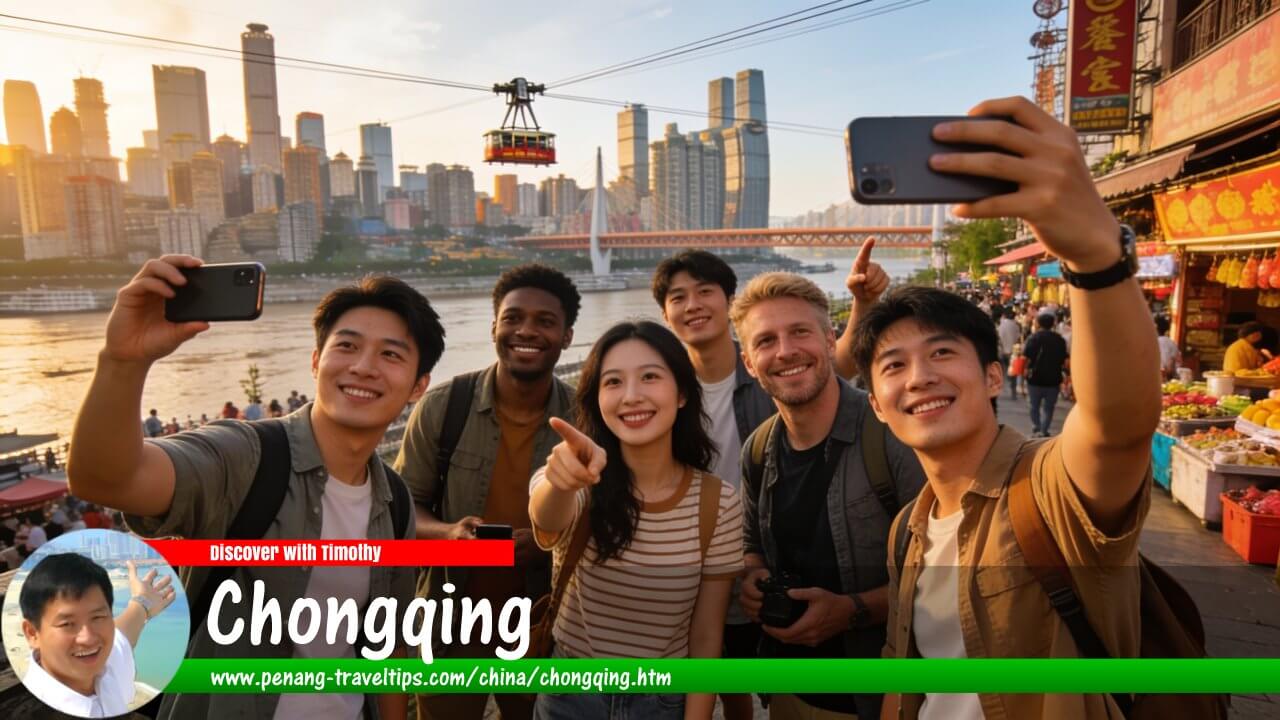 Chongqing, China (Photo edited with AI on 6 August 2026)
Also available: Chongqing (Malay Edition)
Chongqing (重庆; Chóngqìng) is one of China's four direct-administered municipalities and the largest municipality in the country by administrative area. Located in southwestern China at the confluence of the Yangtze River (长江) and the Jialing River (嘉陵江), Chongqing is renowned for its dramatic mountainous landscape, futuristic skyline, spicy cuisine and rich history.
Often called the "Mountain City" (山城) because of its steep hills and layered urban landscape, Chongqing is unlike any other city in China. Skyscrapers rise from hilltops, roads weave through valleys, bridges span deep rivers and monorail trains pass through residential buildings, creating one of the world's most distinctive cityscapes.
Historically, Chongqing has served as an important river port and commercial centre for western China. During the Second Sino-Japanese War (1937–1945), it became China's wartime capital, giving the city an important place in modern Chinese history. Today, Chongqing is a major economic, manufacturing and transportation hub that connects western China with the rest of the country through an extensive network of highways, railways, airports and inland waterways.
Chongqing is also the gateway to the famous Three Gorges along the Yangtze River. Many Yangtze River cruises begin or end here, making the city an ideal starting point for travellers wishing to explore one of China's greatest natural and engineering wonders, including the Three Gorges Dam further downstream.
The city's cuisine is among the most famous in China. Chongqing hot pot, known for its fiery chilli peppers and tongue-numbing Sichuan peppercorns, attracts food lovers from around the world. Beyond hot pot, visitors can enjoy a wide variety of local noodles, grilled dishes, street food and traditional teahouses that reflect the region's vibrant culinary heritage.
Visitors to Chongqing will find a fascinating blend of ancient culture and modern development. Historic temples and traditional neighbourhoods stand alongside gleaming skyscrapers, while ancient river ports coexist with high-speed rail lines and one of China's busiest metro systems.
Whether you are interested in history, architecture, spectacular scenery, river cruises, local cuisine or experiencing one of China's most dynamic cities, Chongqing offers an unforgettable travel experience that is unlike anywhere else in the country.
Why Visit Chongqing?
- Experience one of the world's most dramatic mountain cities.
- Visit the gateway to the Yangtze River and the Three Gorges.
- Sample authentic Chongqing hot pot and other local specialities.
- Ride the famous Yangtze River Cableway across the river.
- See the unique Liziba Monorail passing through a residential building.
- Explore historic districts such as Ciqikou Ancient Town.
- Discover museums, wartime history and cultural landmarks.
- Enjoy spectacular night views of the city's skyline and rivers.
- Take day trips to UNESCO World Heritage sites and stunning karst landscapes.
- Experience a city where traditional river culture meets modern urban innovation.
History of Chongqing
Chongqing (重庆) has a history spanning more than 3,000 years. From an ancient settlement of the Ba people to a wartime capital and a modern economic powerhouse, Chongqing has played an important role in the development of southwestern China.
The city's history has been shaped by its unique geography. Located at the meeting point of the Yangtze River (长江) and the Jialing River (嘉陵江), Chongqing became a natural centre for transportation, trade and military activity.
Ancient Origins: The Ba Kingdom (巴国)
The earliest known inhabitants of the Chongqing region were the Ba people (巴人), an ancient ethnic group that established the Ba Kingdom (巴国) more than 3,000 years ago.
The Ba people lived in the mountainous areas of present-day eastern Sichuan and Chongqing. They were known for their bravery in warfare, distinctive culture and strong connection with the rivers of the region.
The name "Ba" continued to influence the identity of the region. Even today, Chongqing and the surrounding area are sometimes associated with the historical name Bashu (巴蜀), referring to the ancient cultures of Ba and Shu in southwestern China.
Chongqing under the Qin and Han Dynasties
In 316 BC, the Qin state conquered the Ba Kingdom and incorporated the region into the expanding Qin Empire.
After the unification of China under the Qin Dynasty in 221 BC, Chongqing became part of China's imperial administrative system.
During the Han Dynasty (206 BC–220 AD), the region continued to develop as an important centre for agriculture, river transportation and administration.
Development during the Tang and Song Dynasties
During the Tang Dynasty (618–907), Chongqing became an important trading centre along the Yangtze River.
Ships travelling along the river transported goods between inland regions and eastern China, helping the city grow economically.
During the Song Dynasty (960–1279), Chongqing gained even greater importance. Its location made it strategically valuable for controlling access to southwestern China.
The Origin of the Name Chongqing (重庆)
The modern name Chongqing was officially adopted during the Southern Song Dynasty.
In 1189, Prince Zhao Dun (赵惇) of the Southern Song Dynasty was promoted twice in the same year — first becoming Prince Gong and later becoming Emperor Guangzong of Song.
To celebrate this "double celebration", the city was renamed Chongqing, meaning "double celebration" or "repeated happiness".
The name has remained in use for more than 800 years.
Chongqing during the Ming and Qing Dynasties
During the Ming (1368–1644) and Qing (1644–1912) dynasties, Chongqing continued to grow as a regional commercial centre.
The Yangtze River served as the city's economic lifeline, allowing merchants to transport goods throughout southwestern China.
Traditional river ports developed, and Chongqing became known as an important centre for salt, agricultural products and regional trade.
Chongqing Opens to Foreign Trade
Following China's defeat in the First Sino-Japanese War, the Treaty of Shimonoseki in 1895 led to changes in China's foreign trade arrangements.
Chongqing was opened as a treaty port in 1891, allowing foreign merchants and businesses to establish a presence in the city.
This introduced new influences in architecture, commerce and technology, while strengthening Chongqing's position as an international river port.
Chongqing as China's Wartime Capital
One of the most significant periods in Chongqing's history occurred during the Second Sino-Japanese War (1937–1945).
After Japanese forces occupied large parts of eastern China, the Nationalist government of the Republic of China moved its capital from Nanjing to Chongqing in 1937.
During this period, Chongqing served as China's wartime capital and became the political, military and cultural centre of the country.
The city endured years of intense bombing by Japanese forces, but continued to function as the headquarters of China's resistance effort.
International Role during World War II
During the war, Chongqing became an important base for China's cooperation with the Allied powers.
Foreign diplomats, military advisers and journalists lived in the city, making Chongqing one of the world's major wartime centres.
The city's wartime history remains an important part of its identity today and is remembered through museums and memorial sites.
Chongqing after 1949
After the establishment of the People's Republic of China in 1949, Chongqing continued to develop as a major industrial city.
The city became an important manufacturing base, producing machinery, automobiles, chemicals and other industrial products.
Its location made it a key economic gateway connecting China's developed eastern regions with the less developed western interior.
Chongqing Becomes a Direct-Controlled Municipality
In 1997, Chongqing was separated from Sichuan Province and became one of China's four direct-controlled municipalities, alongside Beijing, Shanghai and Tianjin.
This change gave Chongqing greater administrative authority and accelerated its economic development.
Since then, the city has undergone rapid transformation, with major investment in infrastructure, transportation, technology and urban development.
Chongqing Today
Modern Chongqing is a city where ancient history and futuristic development exist side by side.
Traditional riverfront neighbourhoods, historic temples and wartime landmarks stand alongside massive bridges, high-rise buildings and advanced transport systems.
Its history explains why Chongqing has such a distinctive character: it is at once a river port, a mountain city, an industrial centre and a symbol of China's development in the southwest.
Historical Legacy of Chongqing
The history of Chongqing is a story of adaptation. The city has repeatedly transformed itself according to the needs of each era — from ancient river settlement, to imperial frontier, to wartime capital, and finally to a modern global city.
For visitors, understanding this history makes exploring Chongqing far more meaningful. The steep hills, winding rivers and dense urban landscape are not merely geographical features; they are the foundation of a city shaped by thousands of years of human activity.
Geography and Climate of Chongqing
Chongqing is one of the most geographically distinctive cities in China. Unlike many major Chinese cities built on flat plains, Chongqing is located in a mountainous region where rivers, hills and valleys shape almost every aspect of urban life.
Known as the "Mountain City" (山城), Chongqing is famous for its dramatic terrain, where buildings climb hillsides, roads rise and fall with the landscape, and rivers divide different parts of the city.
This unique geography gives Chongqing some of the most spectacular urban scenery in China and is one of the main reasons why visitors find the city so memorable.
Location of Chongqing
Chongqing is located in southwestern China, at the southeastern edge of the Sichuan Basin (四川盆地).
The municipality borders several provinces and regions:
- Sichuan Province (四川省) to the west and northwest.
- Shaanxi Province (陕西省) to the north.
- Hubei Province (湖北省) to the east.
- Hunan Province (湖南省) to the southeast.
- Guizhou Province (贵州省) to the south.
Its strategic location makes Chongqing an important connection point between eastern China and the mountainous southwest.
The Yangtze River and Jialing River
The identity of Chongqing is inseparable from its rivers.
The city sits at the meeting point of two major waterways:
- Yangtze River (长江): China's longest river and one of the world's most important inland waterways.
- Jialing River (嘉陵江): A major tributary of the Yangtze River that flows through the heart of Chongqing.
The confluence of these two rivers has shaped Chongqing's history as a trading port and continues to define its spectacular city views today.
Many of Chongqing's most famous viewpoints, including Chaotianmen (朝天门), are located near this meeting point.
The Mountain City Landscape
Chongqing's nickname, "Mountain City", comes from its rugged terrain.
The city is built across hills and mountains rather than a flat landscape. As a result:
- Roads frequently climb steep slopes.
- Buildings are constructed at different elevations.
- Bridges connect areas separated by rivers and valleys.
- Public transport systems adapt to the challenging terrain.
This creates Chongqing's famous multi-level urban landscape, where a building entrance on one street may appear to be on a different floor from another entrance on a higher road.
Chongqing's Elevation
The elevation of Chongqing varies greatly because of its mountainous geography.
The central urban area generally lies between approximately 160 and 400 metres above sea level, while surrounding mountainous areas can rise much higher.
This variation contributes to Chongqing's dramatic scenery and diverse natural environments.
Climate of Chongqing
Chongqing has a humid subtropical climate (亚热带湿润气候), influenced by its location in the Sichuan Basin.
The city is famous for its:
- Hot and humid summers.
- Mild winters.
- Frequent cloudy and foggy conditions.
- High humidity throughout much of the year.
Because of its frequent mist and fog, Chongqing was historically known as one of China's famous "fog cities" (雾都).
Summer in Chongqing
Summer, especially from June to August, is the hottest period of the year.
Temperatures often rise above 30°C, while high humidity can make it feel even hotter.
Chongqing is sometimes described as one of China's "Three Furnaces" (三大火炉), together with Wuhan and Nanjing, because of its intense summer heat.
Visitors during summer should:
- Carry drinking water.
- Wear light clothing.
- Avoid long outdoor walks during midday.
- Plan sightseeing in the morning or evening.
Winter in Chongqing
Winters in Chongqing are relatively mild compared with northern China.
Snow is rare in the city centre, but the weather can feel cold because of high humidity and limited sunshine.
Typical winter temperatures range from around 5°C to 12°C.
Visitors should bring warm clothing, especially because indoor heating is less common than in northern Chinese cities.
Spring and Autumn: Best Seasons to Visit
The most comfortable times to visit Chongqing are generally spring and autumn.
Spring (March to May) offers pleasant temperatures and blooming landscapes.
Autumn (September to November) is often considered the best season, with cooler weather and clearer conditions.
These seasons are ideal for exploring:
- Mountain viewpoints.
- Historic districts.
- River cruises.
- Outdoor attractions.
Fog and the Chongqing Atmosphere
The fog of Chongqing has become part of the city's identity.
Historically, the surrounding mountains and humid river environment created frequent mist, giving the city a mysterious atmosphere.
Although modern weather patterns have changed, foggy mornings still contribute to Chongqing's unique visual character, especially when skyscrapers emerge through the mist.
Natural Environment Around Chongqing
Beyond the urban area, Chongqing is surrounded by impressive natural landscapes.
The municipality includes:
- Mountain ranges.
- Karst landscapes.
- Rivers and valleys.
- Forests and nature reserves.
This natural diversity makes Chongqing an excellent base for exploring attractions such as Wulong Karst and other scenic areas.
How Geography Shapes Chongqing Life
The geography of Chongqing influences almost everything about the city:
- Architecture: Buildings adapt to slopes and uneven land.
- Transportation: Bridges, tunnels and elevated railways are essential.
- Cuisine: The humid climate contributed to the popularity of spicy food.
- Culture: River trade shaped the city's openness and identity.
Chongqing: A City Shaped by Nature
Chongqing's mountains and rivers are not obstacles that limit the city; they are the foundation of its character.
The dramatic landscape has created one of the most unique urban environments in China, where nature and human development exist together in a way rarely seen elsewhere.
For visitors, understanding Chongqing's geography and climate helps explain why the city looks, feels and functions so differently from other major Chinese destinations.
How to Get to Chongqing
Chongqing is one of China's major transportation hubs, with extensive air, rail and road connections linking it to cities throughout China and overseas.
For international visitors, including travellers from Malaysia, the most convenient ways to reach Chongqing are by air or high-speed rail. The city's position in southwestern China means that many travellers will connect through major Chinese gateway cities such as Guangzhou, Shanghai, Beijing, Shenzhen or Chengdu.
By Air: Chongqing Jiangbei International Airport (重庆江北国际机场)
The main gateway to Chongqing is Chongqing Jiangbei International Airport (重庆江北国际机场).
Located in Yubei District (渝北区), approximately 20 kilometres northeast of central Chongqing, the airport is one of the busiest airports in western China.
The airport serves:
- Domestic flights to major Chinese cities.
- International flights to selected destinations in Asia.
- Regional flights connecting Chongqing with global travel networks.
Flights from Malaysia to Chongqing
Travellers from Malaysia may find direct or connecting flights depending on the current airline schedules.
Common options include:
- Kuala Lumpur to Chongqing: Direct flights may be available depending on season and airline operations.
- Kuala Lumpur to Guangzhou, Shenzhen or Shanghai: Connect by domestic flight or high-speed rail to Chongqing.
- Penang, Johor Bahru and other Malaysian cities: Usually require a connection through Kuala Lumpur or another regional hub.
Flight schedules change frequently, so travellers should check current availability before planning their journey.
Getting from Chongqing Airport to the City Centre
Chongqing Jiangbei International Airport is well connected to the urban area.
Transport options include:
Chongqing Metro
The metro is one of the most convenient and affordable ways to reach central Chongqing.
Airport stations serve the airport terminals through the Chongqing Rail Transit network.
Popular destinations accessible by metro include:
- Jiefangbei (解放碑).
- Hongya Cave (洪崖洞).
- Jiangbei CBD.
- Major railway stations.
Taxi and Ride-Hailing Services
Taxis and ride-hailing services such as DiDi are widely available.
A taxi is convenient for travellers carrying luggage, especially when travelling with family or arriving late at night.
Airport Shuttle Services
Airport buses connect the airport with various parts of Chongqing, although metro services are often more convenient for independent travellers.
By High-Speed Rail
China's extensive high-speed rail network makes Chongqing easily accessible from many major cities.
For many travellers, arriving by train is one of the most enjoyable ways to reach Chongqing because the journey passes through China's changing landscapes.
Chongqing Railway Stations
Chongqing has several major railway stations:
Chongqing North Railway Station (重庆北站)
This is the city's main high-speed railway station and handles many trains from major Chinese cities.
It connects Chongqing with destinations such as:
- Chengdu.
- Xi'an.
- Guangzhou.
- Shanghai.
- Beijing.
Chongqing West Railway Station (重庆西站)
Another major station serving high-speed and conventional railway services.
It is particularly important for routes connecting western China.
Chongqing Railway Station (重庆站)
This historic station is located closer to central Chongqing and continues to serve selected train services.
High-Speed Rail Travel from Major Cities
Examples of approximate journey times by high-speed rail include:
- Chengdu to Chongqing: Around 1 to 2 hours.
- Guangzhou to Chongqing: Around 7 to 9 hours.
- Shanghai to Chongqing: Around 9 to 11 hours.
- Beijing to Chongqing: Around 7 to 9 hours.
Journey times vary depending on the train type and route.
Travelling to Chongqing from Guangzhou
For visitors following a southern China itinerary, Chongqing combines well with Guangzhou.
Travellers can:
- Fly directly between Guangzhou and Chongqing.
- Take a high-speed train connecting the two cities.
- Combine Guangzhou, Chongqing and Chengdu into a western China journey.
Travelling to Chongqing from Chengdu
Chongqing and Chengdu are often visited together because of their geographical proximity and complementary attractions.
While Chengdu is famous for pandas, teahouses and Sichuan culture, Chongqing is known for its mountains, rivers, hot pot and dramatic cityscape.
The high-speed rail connection makes travelling between these two cities very convenient.
Travelling to Chongqing by Road
Long-distance buses connect Chongqing with nearby cities and towns, although most travellers prefer trains because of China's efficient railway system.
Road travel is more suitable for reaching smaller scenic destinations around Chongqing.
Tips for Malaysian Travellers
- Use official railway apps or trusted travel platforms to purchase train tickets.
- Arrive early at railway stations because security checks can take time.
- Keep your passport with you as it is required for many travel services.
- Install translation tools because English signage may be limited outside major transport hubs.
- Consider combining Chongqing with Chengdu, Xi'an or Guangzhou for a longer China itinerary.
Chongqing: A Gateway to Southwest China
Thanks to its airport, high-speed rail network and strategic location, Chongqing is one of the easiest cities to reach in southwestern China.
Whether arriving from Malaysia by air or travelling overland from another Chinese city, visitors will quickly discover that reaching Chongqing is only the beginning of an unforgettable journey through one of China's most distinctive destinations.
Getting Around Chongqing
Chongqing has one of the most distinctive urban transportation systems in China. Because the city is built across mountains, hills and rivers, getting around Chongqing is very different from travelling in flatter cities such as Guangzhou, Shanghai or Beijing.
The city has developed an extensive network of metro lines, monorails, buses, taxis and river transport to overcome its challenging terrain.
For visitors, the most convenient ways to explore Chongqing are the metro, walking, taxis and ride-hailing services. Many of the city's famous attractions are located close to metro stations, making independent travel relatively easy.
Chongqing Rail Transit (重庆轨道交通)
The Chongqing Rail Transit system is the backbone of public transportation in the city.
It includes both conventional metro lines and monorail lines, making Chongqing one of the world's most extensive urban rail networks.
The system connects:
- Major tourist attractions.
- Railway stations.
- Chongqing Jiangbei International Airport.
- Commercial districts.
- Residential areas throughout the municipality.
Using the Chongqing Metro
The metro is the most practical option for most tourists.
Advantages include:
- Affordable fares.
- Frequent services.
- Avoidance of road traffic congestion.
- Clear station signs in Chinese and English.
Popular tourist areas accessible by metro include:
- Jiefangbei (解放碑).
- Hongya Cave (洪崖洞).
- Ciqikou Ancient Town (磁器口古镇).
- Three Gorges Museum (三峡博物馆).
- Chongqing People's Auditorium (人民大礼堂).
Chongqing's Famous Monorail
One of Chongqing's most unique transportation experiences is its monorail system.
The city's elevated monorail lines navigate the mountainous terrain in ways that would be difficult for traditional rail systems.
The most famous example is Line 2, which passes through the city centre and offers spectacular views of Chongqing's urban landscape.
Liziba Station: The Monorail Through a Building
The most famous transportation landmark in Chongqing is Liziba Station (李子坝站).
At this station, the Line 2 monorail passes directly through a residential building.
This unusual design became an international attraction because it demonstrates how Chongqing's engineers adapted transportation infrastructure to the city's limited and uneven land space.
Visitors often stop at Liziba Station specifically to photograph the train entering and leaving the building.
Taxis in Chongqing
Taxis are widely available throughout Chongqing and are useful for locations that require uphill travel or are not directly connected by metro.
Advantages of taxis include:
- Convenient for luggage.
- Useful during rainy weather.
- Practical for groups travelling together.
However, visitors should remember that Chongqing's roads are complex, with many tunnels, bridges and elevated roads. A short distance on the map may take longer than expected.
Ride-Hailing Services
Ride-hailing services such as DiDi (滴滴出行) are popular among locals and visitors.
They are particularly useful when:
- Travelling late at night.
- Going to scenic areas outside the metro network.
- Travelling with elderly family members.
- Carrying shopping bags or luggage.
International visitors should prepare their payment method before using ride-hailing apps.
Buses in Chongqing
Chongqing has an extensive public bus network covering areas not reached by rail transit.
However, buses may be more challenging for first-time visitors because:
- Routes are mainly displayed in Chinese.
- Traffic conditions can affect travel time.
- Mountain roads may make journeys slower.
For tourists, buses are usually best used with navigation apps.
Walking Around Chongqing
Walking is one of the best ways to experience Chongqing, especially in historic districts and scenic areas.
However, visitors should understand that walking in Chongqing can be physically demanding.
The city has:
- Steep stairways.
- Hilly streets.
- Long pedestrian routes.
- Multiple elevation levels.
A location that appears nearby on a map may require climbing or taking different levels of roads to reach.
Chongqing's Famous Escalators
Because of its mountainous terrain, Chongqing has several unusual escalators and elevated walkways designed to help residents move between different levels of the city.
One famous example is the Crown Escalator (皇冠大扶梯), one of the longest public escalators in China.
It connects different elevations of the city and reflects Chongqing's creative approach to urban transportation.
Yangtze River Cableway (长江索道)
The Yangtze River Cableway is both a transportation facility and a popular tourist attraction.
Originally built as a practical means for residents to cross the river, it now provides visitors with panoramic views of Chongqing's skyline, rivers and mountains.
Although many locals now use bridges and metro lines instead, riding the cableway remains one of Chongqing's most memorable experiences.
River Transport
Historically, Chongqing developed because of its rivers, and boats remain part of the city's identity.
Today, river cruises are mainly a tourism experience rather than everyday transport.
Visitors can enjoy:
- Night cruises along the Yangtze and Jialing Rivers.
- Views of Hongya Cave and the skyline.
- Scenery around Chaotianmen.
Using Navigation Apps
Navigation apps are highly recommended when exploring Chongqing.
They help visitors:
- Find metro routes.
- Calculate walking distances.
- Locate restaurants and attractions.
- Understand the city's complex geography.
Visitors should remember that map distances in Chongqing can be misleading because of elevation changes.
Transport Tips for Malaysian Travellers
- Download essential travel apps before arrival.
- Carry your passport because it may be needed for ticket purchases and identification.
- Use the metro whenever possible to avoid traffic congestion.
- Wear comfortable shoes because many attractions involve walking and stairs.
- Allow extra time when travelling between districts.
- Visit transport landmarks such as Liziba Station because they are part of the Chongqing experience.
Exploring Chongqing Through Its Transport
In many cities, transportation is simply a way to get from one place to another. In Chongqing, it is part of the attraction itself.
Riding a monorail through a building, crossing the Yangtze River by cableway, walking through streets built on different elevations and travelling across bridges above deep valleys all reveal the unique relationship between Chongqing and its landscape.
Understanding how to move around the city will allow visitors to appreciate not only its attractions but also the remarkable engineering and adaptation that make Chongqing one of China's most fascinating urban environments.
Jiefangbei CBD (解放碑)
Jiefangbei (解放碑), short for Jiefangbei Central Business District, is the commercial and cultural heart of Chongqing. Located in the Yuzhong District (渝中区), the area represents modern Chongqing with its shopping streets, high-rise buildings, restaurants, entertainment venues and vibrant nightlife.
At the centre of this district stands the iconic People's Liberation Monument (人民解放碑), which has become one of the most recognisable symbols of Chongqing.
For first-time visitors, Jiefangbei is often the place where they experience Chongqing's unique combination of history, urban energy and mountainous city life.
History of Jiefangbei
The history of Jiefangbei reflects the major political changes that shaped modern Chongqing.
The monument at the centre of the district was originally built during the Republican period to commemorate China's victory in the Second Sino-Japanese War.
After 1949, following the establishment of the People's Republic of China, the monument was renamed People's Liberation Monument to commemorate the victory of the People's Liberation Army.
The surrounding area gradually developed into Chongqing's main commercial district.
The Meaning of Jiefangbei (解放碑)
The name Jiefangbei literally means "Liberation Monument".
The word:
- Jie (解): to liberate or release.
- Fang (放): to free or let go.
- Bei (碑): monument or stele.
The name reflects the monument's historical connection with the political changes of 20th-century China.
People's Liberation Monument (人民解放碑)
The People's Liberation Monument is the centrepiece of Jiefangbei.
The tower stands approximately 27 metres high and has a distinctive circular design.
It is surrounded by a pedestrian area where locals and visitors gather, making it one of the most photographed landmarks in Chongqing.
Today, the monument serves not only as a historical symbol but also as a meeting point in the centre of the city.
Jiefangbei as Chongqing's Commercial Centre
Jiefangbei is the busiest shopping and business district in Chongqing.
The area contains:
- Department stores.
- Shopping malls.
- Luxury brands.
- Local fashion shops.
- Restaurants and cafés.
- Hotels catering to business and leisure travellers.
Compared with older districts such as Ciqikou, Jiefangbei represents the modern face of Chongqing.
Shopping in Jiefangbei
Visitors looking for shopping opportunities will find a wide variety of choices.
Popular shopping destinations include:
- Chongqing Times Square (重庆时代广场).
- Metropolitan Plaza (重庆大都会广场).
- IFS and other modern shopping complexes.
- Department stores and underground shopping streets.
Shoppers can find:
- International brands.
- Chinese fashion labels.
- Cosmetics.
- Electronics.
- Local souvenirs.
Food Around Jiefangbei
Jiefangbei is one of the best places to experience Chongqing cuisine.
The surrounding streets are filled with restaurants serving:
- Chongqing hot pot (重庆火锅).
- Small noodles (重庆小面).
- Sichuan-style dishes.
- Grilled skewers (串串香).
- Spicy snacks and street food.
Visitors can enjoy both traditional local restaurants and modern dining establishments.
Bay Street (八一路好吃街)
One of the most popular food areas near Jiefangbei is Bay Street Food Street (八一路好吃街).
This lively food street is famous for Chongqing snacks and is a favourite among both locals and tourists.
Popular foods include:
- Chongqing noodles.
- Hot and spicy snacks.
- Glutinous rice desserts.
- Grilled foods.
- Traditional Sichuan-style dishes.
Nightlife in Jiefangbei
Jiefangbei is one of the best places to experience Chongqing at night.
After sunset, the district becomes lively with:
- Illuminated skyscrapers.
- Busy pedestrian streets.
- Restaurants operating late into the night.
- Young locals gathering after work.
The combination of lights, crowds and surrounding hills creates a unique urban atmosphere.
Jiefangbei and Chongqing's Mountain City Character
Even in this modern commercial district, visitors can still experience Chongqing's unusual geography.
Unlike flat city centres elsewhere, Jiefangbei has multiple levels connected by:
- Escalators.
- Stairways.
- Elevated walkways.
- Underground shopping areas.
This layered design is a reminder that Chongqing is a city built around mountains and rivers.
Nearby Attractions
Jiefangbei is conveniently located near several major attractions.
Visitors can easily combine their visit with:
- Hongya Cave (洪崖洞).
- Yangtze River Cableway (长江索道).
- Chaotianmen (朝天门).
- Shibati Traditional Area (十八梯).
- Huguang Guild Hall (湖广会馆).
How to Get to Jiefangbei
Jiefangbei is easily accessible by Chongqing Metro.
The most convenient stations are:
- Jiaochangkou Station (较场口站).
- Linjiangmen Station (临江门站).
The area is pedestrian-friendly and best explored on foot.
Best Time to Visit Jiefangbei
The recommended visiting times are:
- Late afternoon: To explore shops and attractions during daylight.
- Evening: To experience the illuminated city atmosphere.
- Night: For photography and nightlife.
Tips for Visiting Jiefangbei
- Visit the People's Liberation Monument first as it is the symbolic centre of the district.
- Explore the surrounding streets rather than staying only in shopping malls.
- Try local Chongqing snacks at Bay Street Food Street.
- Wear comfortable shoes because the area has many stairs and elevation changes.
- Combine the visit with Hongya Cave, which is within walking distance.
Jiefangbei: The Modern Heart of Chongqing
Jiefangbei represents the modern spirit of Chongqing — energetic, ambitious and constantly changing.
Here, visitors can see the transformation of a historic river port into a major Chinese metropolis.
Standing among skyscrapers, busy streets and the surrounding mountains, visitors experience the unique character of Chongqing: a city where history, commerce and geography come together.
Hongya Cave (洪崖洞)
Hongya Cave (洪崖洞; Hóngyá Dòng) is one of the most famous landmarks in Chongqing and one of the most photographed places in China. Located along the Jialing River (嘉陵江) near its meeting point with the Yangtze River (长江), Hongya Cave is renowned for its traditional-style buildings built into a steep hillside overlooking the river.
With its layered wooden structures, glowing lights at night and dramatic mountain-city setting, Hongya Cave has become a symbol of Chongqing's unique urban landscape.
For many visitors, especially first-time travellers to Chongqing, seeing Hongya Cave illuminated after sunset is one of the most unforgettable experiences in the city.
The Meaning of Hongya Cave (洪崖洞)
The name Hongya Cave comes from one of the ancient gates and cliff areas that once existed along the riverfront of Chongqing.
The name can be understood as:
- Hong (洪): associated with great waters or floods.
- Ya (崖): cliff or steep rock face.
- Dong (洞): cave or grotto.
Historically, the area was connected with the natural cliffs and caves along the riverbank.
History of Hongya Cave
Hongya Cave has a history dating back more than two thousand years.
During ancient times, the area was part of Chongqing's riverfront settlement and served as an important location for transportation and trade.
Because Chongqing developed around its rivers, cliffside areas such as Hongya Cave became closely linked with the daily life of merchants, boatmen and residents.
Traditional Bayu Culture
Hongya Cave reflects the traditional culture of the Bayu region (巴渝地区), the historical name for the Chongqing area.
Bayu culture developed from the ancient Ba people and is known for:
- Strong river traditions.
- Mountain lifestyle.
- Distinctive architecture.
- Local folk customs.
- Bold and spicy cuisine.
The architecture and atmosphere of Hongya Cave are designed to represent this regional identity.
Stilt Houses (吊脚楼)
The most recognisable feature of Hongya Cave is its stilt-house architecture (吊脚楼).
Traditional stilt houses were built on slopes and uneven terrain using wooden supports.
This design allowed people to adapt to Chongqing's mountainous environment.
Features of stilt houses include:
- Buildings supported above steep land.
- Multiple levels following the hillside.
- Wooden balconies overlooking rivers.
- Efficient use of limited space.
Hongya Cave uses this traditional style to recreate the visual identity of old Chongqing.
The Modern Hongya Cave Complex
The Hongya Cave visitors see today is a modern cultural and commercial complex developed to preserve and showcase traditional Chongqing architecture.
The complex contains:
- Restaurants.
- Tea houses.
- Souvenir shops.
- Traditional craft stores.
- Entertainment venues.
- Viewing platforms.
Although reconstructed, the design reflects Chongqing's historical relationship with mountains and rivers.
Hongya Cave at Night
Hongya Cave is most famous after sunset.
When thousands of lights illuminate the buildings, the complex appears like a scene from a traditional Chinese painting brought to life.
The best views are from across the river, where visitors can see:
- The entire illuminated building complex.
- The Jialing River waterfront.
- Bridges decorated with lights.
- Chongqing's modern skyline in the background.
This spectacular night view has made Hongya Cave one of China's most popular photography locations.
Food at Hongya Cave
Hongya Cave is also a popular place to sample Chongqing cuisine.
Visitors can find:
- Chongqing hot pot.
- Chongqing noodles (重庆小面).
- Spicy Sichuan dishes.
- Grilled skewers.
- Local snacks and desserts.
However, because Hongya Cave is a major tourist attraction, prices may be higher than in neighbourhood restaurants.
Viewing Hongya Cave from the Riverfront
One of the best ways to appreciate Hongya Cave is not from inside the complex but from the opposite riverbank.
Popular viewpoints include:
- The riverside promenade.
- Qiansimen Bridge (千厮门大桥).
- Jialing River viewing areas.
These locations provide the classic postcard view of Hongya Cave.
Hongya Cave and Qiansimen Bridge
Qiansimen Bridge (千厮门大桥) is located beside Hongya Cave and has become part of the attraction's famous scenery.
The bridge carries both road traffic and Chongqing Rail Transit Line 6, creating a striking combination of modern engineering and traditional architecture.
The contrast between the illuminated Hongya Cave buildings and the modern bridge represents Chongqing's blend of old and new.
How to Get to Hongya Cave
Hongya Cave is located in central Chongqing and is easily accessible.
Recommended metro stations include:
- Xiaoshizi Station (小什字站).
- Linjiangmen Station (临江门站).
From Jiefangbei, visitors can walk to Hongya Cave in approximately 10 to 15 minutes.
Best Time to Visit Hongya Cave
The best experience is:
- Late afternoon: Explore the shops and architecture in daylight.
- After sunset: Enjoy the famous illuminated view.
- Night: Take photographs from across the river.
Tips for Visiting Hongya Cave
- Arrive early in the evening because the area becomes extremely crowded.
- Visit the opposite riverbank for the best photographs.
- Wear comfortable shoes because the complex has many levels and stairs.
- Do not judge the distance between floors by normal city standards; Chongqing's vertical layout can be confusing.
- Combine the visit with Jiefangbei because both attractions are close together.
Hongya Cave: The Symbol of Chongqing's Character
Hongya Cave represents everything that makes Chongqing unique.
Its hillside architecture reflects the city's adaptation to difficult terrain, while its location beside the rivers reflects Chongqing's history as a major inland port.
Whether viewed during the day or glowing under the night lights, Hongya Cave offers visitors a powerful impression of Chongqing — a city where mountains, rivers, tradition and modern life exist together.
Ciqikou Ancient Town (磁器口古镇)
Ciqikou Ancient Town (磁器口古镇; Cíqìkǒu Gǔzhèn) is one of the best-preserved historical areas in Chongqing. Located on the banks of the Jialing River (嘉陵江) in Shapingba District (沙坪坝区), Ciqikou is famous for its ancient streets, traditional architecture, teahouses, local snacks and connection with Chongqing's river-trading history.
Known as the "Little Chongqing" (小重庆), Ciqikou offers visitors a chance to experience the atmosphere of an old Chinese riverside town, where merchants, craftsmen and travellers once gathered.
Today, the town is one of Chongqing's most popular tourist attractions, attracting visitors who wish to experience traditional culture away from the modern skyscrapers of the city centre.
The Meaning of Ciqikou (磁器口)
The name Ciqikou means "Porcelain Port".
The name comes from the area's historical connection with porcelain production and trade.
- Ci (磁): porcelain or ceramics.
- Qi (器): vessel or object.
- Kou (口): port, entrance or harbour.
The name reflects the town's former role as a trading port where porcelain products were transported along the Jialing River.
History of Ciqikou
Ciqikou has a history of more than 1,800 years.
The settlement developed during the Ming and Qing dynasties as an important river port and commercial centre.
Because of its location along the Jialing River, Ciqikou became a place where merchants exchanged goods and travellers passed through on their journeys.
At its peak, the town was known for:
- Porcelain trading.
- Salt transportation.
- Agricultural products.
- Handicrafts.
- Local commerce.
Ciqikou as an Ancient River Port
Before modern highways and railways transformed transportation, rivers were the most important routes for trade in southwestern China.
The Jialing River connected Ciqikou with Chongqing and other inland regions, allowing goods to be transported efficiently.
The town's narrow streets, traditional shops and riverside location developed because of this trading role.
Traditional Streets and Architecture
The most attractive feature of Ciqikou is its preserved old-town atmosphere.
The historic area contains:
- Narrow stone-paved streets.
- Traditional wooden buildings.
- Courtyard houses.
- Old shops.
- Tea houses.
- Small temples.
Walking through Ciqikou gives visitors a sense of what a traditional southwestern Chinese market town looked like before rapid urbanisation.
Bayu Culture in Ciqikou
Ciqikou is an important showcase of Bayu culture (巴渝文化), the traditional culture of the Chongqing region.
Visitors can experience:
- Traditional music.
- Local crafts.
- Folk performances.
- Tea culture.
- Regional cuisine.
The town reflects the practical and lively character associated with the people of Chongqing.
Ba Culture and Chongqing Identity
The history of Ciqikou is connected to the wider cultural heritage of the ancient Ba people.
The Ba people were known for their connection with rivers, mountains and trade routes, elements that continue to influence Chongqing's identity today.
Ciqikou preserves this relationship between people, commerce and the natural environment.
Food in Ciqikou
Ciqikou is one of the best places in Chongqing to sample local snacks.
Popular foods include:
- Chen Mahua (陈麻花): a famous twisted fried dough snack.
- Chongqing noodles (重庆小面).
- Spicy tofu dishes.
- Hot and sour noodles (酸辣粉).
- Traditional pastries.
- Local tea.
The most famous speciality is Chen Mahua, which has become strongly associated with Ciqikou.
Chen Mahua (陈麻花)
Chen Mahua is a traditional Chongqing snack made from twisted dough that is fried until crisp.
It comes in different flavours, including:
- Original.
- Sweet.
- Spicy.
- Sesame.
- Peanut.
Many visitors buy packets of Chen Mahua as souvenirs.
Teahouses of Ciqikou
Traditional teahouses are an important part of Ciqikou's atmosphere.
Historically, teahouses served as places where locals gathered to:
- Drink tea.
- Discuss news.
- Listen to performances.
- Socialise with neighbours.
Today, visitors can still experience the relaxed tea culture of Chongqing.
Baolun Temple (宝轮寺)
One of the important historical sites in Ciqikou is Baolun Temple (宝轮寺).
The temple has a long history and represents the religious traditions that existed alongside commerce in the ancient town.
It provides a quieter contrast to the busy shopping streets nearby.
Atmosphere of Ciqikou Today
Today, Ciqikou combines heritage preservation with tourism development.
Visitors will find:
- Traditional-style shops.
- Restaurants.
- Souvenir stores.
- Cultural performances.
- Photography opportunities.
Although it can become crowded, especially on weekends and holidays, the town remains one of the best places to experience Chongqing's cultural heritage.
How to Get to Ciqikou
Ciqikou is easily accessible by Chongqing Metro.
The nearest station is:
- Ciqikou Station (磁器口站) on Chongqing Metro Line 1.
From the station, visitors can walk to the ancient town entrance.
Best Time to Visit Ciqikou
The recommended visiting times are:
- Morning: For fewer crowds and a quieter atmosphere.
- Afternoon: To explore shops and enjoy snacks.
- Evening: For a more relaxed atmosphere with traditional lighting.
Tips for Visiting Ciqikou
- Visit early if you want to photograph the historic streets without crowds.
- Try Chen Mahua and other local snacks.
- Explore side alleys away from the main tourist street.
- Wear comfortable shoes because the streets are uneven.
- Combine Ciqikou with other Shapingba attractions if you have extra time.
Ciqikou: A Window into Old Chongqing
Ciqikou Ancient Town provides a valuable connection to Chongqing's past.
While the city around it has transformed into a modern metropolis, Ciqikou preserves the memory of Chongqing as a river port where merchants, craftsmen and travellers shaped local culture.
For visitors who wish to understand the historical soul of Chongqing, a walk through Ciqikou is an essential experience.
Three Gorges Museum (三峡博物馆)
Three Gorges Museum (三峡博物馆; Sānxiá Bówùguǎn), officially known as the Chongqing China Three Gorges Museum (重庆中国三峡博物馆), is one of the most important museums in southwestern China.
Located in the centre of Chongqing, opposite the Chongqing People's Auditorium (重庆人民大礼堂), the museum introduces visitors to the history, culture, natural environment and development of the Three Gorges region.
For travellers who want to understand Chongqing beyond its food and scenery, the Three Gorges Museum provides essential background about the city and its relationship with the Yangtze River.
History of the Museum
The museum was officially opened in 2005 as part of the cultural preservation efforts associated with the Three Gorges Project.
Its purpose was to preserve and display the history, archaeology and cultural heritage of the Three Gorges region, especially during a period when many sites were affected by the construction of the Three Gorges Dam.
Today, the museum has become one of Chongqing's leading cultural attractions and receives visitors from around the world.
Location of Three Gorges Museum
The museum is located in the Yuzhong District (渝中区), the central district of Chongqing.
It stands at:
- Opposite the Chongqing People's Auditorium.
- Near the Chongqing Municipal Government area.
- Close to several important city attractions.
The location makes it convenient to combine a visit with the People's Auditorium, Jiefangbei and other central Chongqing attractions.
Architecture of Three Gorges Museum
The museum building itself is an impressive example of modern architecture.
Its design incorporates elements inspired by:
- The Yangtze River.
- The Three Gorges landscape.
- Traditional Chinese architectural ideas.
The large blue glass facade reflects the importance of water and rivers in the history of Chongqing.
Main Exhibitions
The Three Gorges Museum contains numerous permanent and temporary exhibitions.
The major themes include:
- The history and culture of the Three Gorges region.
- The natural environment of the Yangtze River.
- Ancient Chongqing and Bayu culture.
- The history of Chongqing during World War II.
- Chinese art and archaeology.
Three Gorges Exhibition
The museum's most important exhibition focuses on the Three Gorges region.
It explains:
- The geography of the Yangtze River.
- The formation of the Three Gorges landscape.
- The communities that lived along the river.
- The impact of the Three Gorges Dam project.
Visitors can learn how the river shaped human settlement, transportation and economic development for thousands of years.
The Yangtze River and Chongqing
The Yangtze River has always been central to Chongqing's identity.
The river provided:
- A transportation route.
- A source of trade and commerce.
- A connection between inland China and the coast.
- A foundation for the city's development.
The museum helps visitors understand why Chongqing grew into such an important river port.
Ancient Bayu Culture Exhibition
The museum also introduces Bayu culture (巴渝文化), the traditional culture of the Chongqing region.
Exhibits include:
- Ancient tools.
- Bronze objects.
- Pottery.
- Archaeological discoveries.
- Cultural artefacts from southwestern China.
These collections reveal the long history of human settlement in the Chongqing area.
Chongqing during World War II
One of the most significant sections of the museum focuses on Chongqing's role as China's wartime capital.
Between 1937 and 1945, Chongqing served as the headquarters of the Nationalist government during the Second Sino-Japanese War.
The exhibition explains:
- The relocation of China's government to Chongqing.
- The city's role in resistance against Japan.
- The bombing campaigns against Chongqing.
- The experiences of civilians during wartime.
This section helps visitors understand why Chongqing holds such an important place in modern Chinese history.
The Three Gorges Dam and Cultural Preservation
The construction of the Three Gorges Dam was one of the largest engineering projects in modern history.
It also resulted in major changes to communities and landscapes along the Yangtze River.
The museum documents efforts to:
- Record historical sites.
- Preserve cultural objects.
- Protect archaeological discoveries.
- Document the lives of communities affected by the project.
Collections and Artefacts
The museum houses a large collection of objects related to Chinese history and culture.
Visitors can see:
- Ancient ceramics.
- Paintings and calligraphy.
- Bronze artefacts.
- Traditional clothing.
- Historical photographs.
- Documents related to Chongqing's past.
Why Visit the Three Gorges Museum?
The museum is highly recommended because it provides context for many of Chongqing's attractions.
After visiting the museum, visitors will better understand:
- Why the Yangtze River is so important.
- Why Chongqing developed as a river port.
- Why the city has a unique Bayu identity.
- Why the Three Gorges region matters to China.
How to Get to Three Gorges Museum
The museum is easily accessible by Chongqing Metro.
Nearby stations include:
- Zengjiayan Station (曾家岩站).
- Daxigou Station (大溪沟站).
It is also within walking distance of Chongqing People's Auditorium.
Admission and Visiting Time
The museum generally offers free admission, although visitors may need to register or reserve a ticket depending on current arrangements.
A typical visit takes:
- 1 to 2 hours for a general visit.
- Longer for visitors interested in history and archaeology.
Tips for Visiting Three Gorges Museum
- Combine your visit with Chongqing People's Auditorium, located directly opposite.
- Allow enough time to read the historical explanations.
- Visit before taking a Yangtze River cruise to better understand the region.
- Check opening hours before visiting as museum schedules may change.
- Use the museum as an introduction to Chongqing's history before exploring the city.
Three Gorges Museum: Understanding Chongqing Through History
The Three Gorges Museum is more than a collection of historical objects. It tells the story of a city shaped by rivers, mountains and human ambition.
From ancient Bayu culture to wartime history and modern engineering achievements, the museum explains the forces that created today's Chongqing.
For visitors seeking a deeper understanding of the city, the Three Gorges Museum is one of the most meaningful places to begin exploring Chongqing's identity.
People's Liberation Monument (解放碑)
People's Liberation Monument (人民解放碑; Rénmín Jiěfàng Bēi) is one of the most important historical landmarks in Chongqing. Located at the centre of the Jiefangbei (解放碑) commercial district, the monument represents the city's modern history and has become a symbol of Chongqing's identity.
Standing among busy shopping streets and modern skyscrapers, the monument provides a striking contrast between Chongqing's historical past and its present-day role as one of China's most dynamic cities.
History of the People's Liberation Monument
The monument was first constructed during the Republican era before the establishment of the People's Republic of China.
Its original purpose was connected with China's wartime history and the commemoration of victory during the Second Sino-Japanese War (1937–1945).
After 1949, the monument was renamed the People's Liberation Monument to commemorate the victory of the People's Liberation Army and the establishment of the new government.
Since then, it has remained an important symbol in Chongqing's public life.
Original Name: Monument to the Victory of the War of Resistance
The original monument was known as the Monument to the Victory of the War of Resistance (抗战胜利纪功碑).
It was built to celebrate China's victory over Japan in World War II.
At that time, Chongqing held a special place in Chinese history because it had served as the wartime capital of the Republic of China from 1937 to 1945.
Chongqing's Wartime Role
During the Second Sino-Japanese War, Chongqing became the political and military centre of China's resistance effort.
The city experienced years of bombing attacks but continued functioning as the headquarters of the Chinese government.
The monument therefore represents not only military victory but also the resilience of Chongqing and its people during one of the most difficult periods in modern Chinese history.
Architecture of the Monument
The People's Liberation Monument is a circular tower approximately 27 metres high.
The structure features:
- A white concrete exterior.
- A cylindrical design.
- A clock tower at the top.
- Four clock faces facing different directions.
The clock mechanism once served as an important public time reference for residents of Chongqing.
Symbolism of the Monument
The monument carries several layers of meaning.
It represents:
- The victory of China during wartime.
- The political changes of modern China.
- The resilience of Chongqing's people.
- The transformation of the city after 1949.
For many residents, it is more than a historical structure — it is a place associated with important memories and public celebrations.
The Jiefangbei Pedestrian Area
The area surrounding the monument is one of the busiest pedestrian zones in Chongqing.
Visitors will find:
- Shopping centres.
- Restaurants.
- Hotels.
- Entertainment venues.
- Street performances.
The contrast between the old monument and the modern commercial environment reflects Chongqing's rapid development.
The Monument as Chongqing's City Centre
For decades, the People's Liberation Monument has served as a central meeting point for Chongqing residents.
People often gather here for:
- Public celebrations.
- Festivals.
- Social gatherings.
- Photography.
Similar to how other Chinese cities have iconic central landmarks, the monument functions as a symbol of the city itself.
Night View of the Monument
The People's Liberation Monument is particularly attractive at night.
When the surrounding commercial district is illuminated, the monument stands surrounded by colourful lights, modern buildings and busy pedestrian streets.
The night atmosphere demonstrates the contrast between Chongqing's historical memory and its modern urban energy.
Nearby Attractions
The monument is located close to many major Chongqing attractions.
Visitors can combine their visit with:
- Hongya Cave (洪崖洞).
- Bay Street Food Street (八一路好吃街).
- Shibati Traditional Area (十八梯).
- Yangtze River Cableway (长江索道).
- Chaotianmen (朝天门).
How to Get to the People's Liberation Monument
The monument is located in the heart of central Chongqing and is easily accessible by metro.
Nearby stations include:
- Jiaochangkou Station (较场口站).
- Linjiangmen Station (临江门站).
The monument is located within the pedestrian area, making walking the easiest way to explore the surroundings.
Best Time to Visit
The best times to visit are:
- Late afternoon: For historical exploration and shopping.
- Evening: For the lively atmosphere.
- Night: For photography and city lights.
Tips for Visiting the People's Liberation Monument
- Combine the visit with Jiefangbei shopping streets and restaurants.
- Look up at the surrounding skyscrapers to appreciate Chongqing's modern skyline.
- Visit at night to see the monument illuminated.
- Learn about Chongqing's wartime history before visiting to better appreciate its significance.
- Use the monument as a starting point for exploring central Chongqing.
People's Liberation Monument: A Symbol of Chongqing
The People's Liberation Monument is a reminder that Chongqing's modern identity was shaped by both hardship and transformation.
Surrounded by one of China's busiest commercial districts, the monument continues to connect the present city with its historical past.
For visitors, standing beneath the monument offers a unique perspective of Chongqing — a city that remembers its history while continuously moving towards the future.
Chongqing People's Auditorium (重庆人民大礼堂)
Chongqing People's Auditorium (重庆人民大礼堂; Chóngqìng Rénmín Dàlǐtáng) is one of the most beautiful and distinctive architectural landmarks in Chongqing. Located in the Yuzhong District (渝中区), the building is famous for its traditional Chinese design, grand scale and cultural importance.
Standing opposite the Three Gorges Museum (三峡博物馆), the People's Auditorium is one of the best examples of 20th-century Chinese architecture that combines modern construction techniques with traditional architectural ideas.
For many visitors, the building provides a striking reminder that Chongqing is not only a city of mountains and skyscrapers but also a city with a rich cultural and historical identity.
History of Chongqing People's Auditorium
The People's Auditorium was constructed between 1951 and 1954, shortly after the establishment of the People's Republic of China.
The building was designed as a major venue for:
- Government meetings.
- Cultural performances.
- Public events.
- Important ceremonies.
Its construction reflected the importance placed on creating impressive public buildings that represented the new era of China.
Architectural Style
The Chongqing People's Auditorium is famous for its traditional Chinese architectural style.
The design incorporates elements inspired by classical Chinese buildings, including:
- A symmetrical layout.
- Large red columns.
- Decorative roof structures.
- A central dome.
- Traditional colour schemes.
The overall appearance resembles a grand imperial-style hall, creating a strong visual contrast with the modern city surrounding it.
The Dome and Roof Design
The most distinctive feature of the auditorium is its large central dome.
The circular dome is surrounded by traditional roof structures, creating an appearance that has often been compared with famous historical buildings in Beijing.
This design gives the building a majestic appearance when viewed from the front plaza.
Comparison with the Temple of Heaven
Because of its circular design and traditional Chinese appearance, the People's Auditorium is sometimes compared with the Temple of Heaven (天坛) in Beijing.
While it is much younger than the imperial-era Temple of Heaven, the similarity reflects the designers' intention to create a building inspired by China's architectural heritage.
However, the People's Auditorium is a modern political and cultural building rather than a religious site.
Cultural Importance
The People's Auditorium remains an important venue for Chongqing's cultural and official activities.
It continues to host:
- Performances.
- Conferences.
- Ceremonies.
- Public events.
The building is considered one of Chongqing's representative landmarks and appears frequently in photographs promoting the city.
The Square in Front of the Auditorium
The open square in front of the auditorium provides one of the best viewpoints of the building.
Visitors often gather here to:
- Take photographs.
- Admire the architecture.
- Relax in the city centre.
- View the building illuminated at night.
The square also creates a peaceful contrast to the busy commercial areas nearby.
Night View of Chongqing People's Auditorium
The auditorium becomes especially attractive after sunset.
When illuminated, its traditional design stands out against the surrounding modern buildings.
The combination of warm lighting, the grand entrance and the city skyline makes it one of the most photographed night scenes in Chongqing.
Inside the Auditorium
The interior contains a large performance hall designed for major gatherings.
The main hall features:
- A spacious auditorium.
- Decorative details inspired by Chinese design.
- Facilities for performances and official events.
Visitors may be able to enter depending on current arrangements and event schedules.
Three Gorges Museum and People's Auditorium Combination Visit
The People's Auditorium and Three Gorges Museum are located directly opposite each other, making them ideal to visit together.
A recommended route is:
- Visit the Three Gorges Museum to understand Chongqing's history.
- Cross the square to admire the People's Auditorium.
- Take photographs from different viewpoints.
- Continue exploring central Chongqing.
How to Get to Chongqing People's Auditorium
The auditorium is easily accessible by Chongqing Metro.
Nearby stations include:
- Zengjiayan Station (曾家岩站).
- Daxigou Station (大溪沟站).
It is located in the central area and can be reached easily from Jiefangbei and other major attractions.
Best Time to Visit
The best times to visit are:
- Morning: For clear photographs and fewer visitors.
- Late afternoon: To combine with the Three Gorges Museum.
- Evening: To enjoy the illuminated building.
Tips for Visiting Chongqing People's Auditorium
- Stand across the square for the best full view of the building.
- Combine your visit with the Three Gorges Museum.
- Visit after dark if you enjoy architectural photography.
- Wear comfortable shoes because nearby attractions involve walking.
- Check whether interior access is available before planning a visit inside.
Chongqing People's Auditorium: A Bridge Between Past and Present
The Chongqing People's Auditorium represents an important chapter in the city's modern history.
Its traditional appearance, built during a period of rapid national change, reflects an effort to connect modern China with its architectural heritage.
Today, surrounded by skyscrapers and busy streets, the auditorium remains a reminder that Chongqing's identity is shaped not only by its mountains and rivers but also by its history, culture and artistic traditions.
Yangtze River Cableway (长江索道)
Yangtze River Cableway (长江索道; Chángjiāng Suǒdào) is one of Chongqing's most iconic attractions and a unique way to experience the city's famous mountain-and-river landscape.
Often described as the "first air corridor over the Yangtze River", the cableway carries passengers across the Yangtze River in suspended cabins, offering spectacular views of the river, bridges, hills and Chongqing's skyline.
Originally built as a practical means of transportation for local residents, the cableway has become one of Chongqing's most popular visitor experiences.
History of the Yangtze River Cableway
The Yangtze River Cableway began operation in 1987.
Before the construction of many modern bridges and metro lines, crossing the Yangtze River was more difficult, especially for residents travelling between the Yuzhong Peninsula and the southern districts.
The cableway was built to provide a convenient river-crossing option and became an important part of daily life in Chongqing.
A Transportation Solution for a Mountain City
Chongqing's geography has always created transportation challenges.
The city is surrounded by:
- Steep hills.
- Deep valleys.
- Wide rivers.
- Uneven terrain.
Instead of building only traditional roads and bridges, Chongqing developed creative transport solutions, including the Yangtze River Cableway.
The cableway demonstrates how the city adapted its infrastructure to its unique natural environment.
The Route Across the Yangtze River
The cableway connects:
- Xinhua Road Station (新华路站) on the Yuzhong Peninsula side.
- Shangxin Street Station (上新街站) on the Nan'an District side.
The total route length is approximately 1,100 metres, with the cabins crossing above the Yangtze River.
The journey takes only a few minutes but provides impressive views throughout the ride.
The Cable Car Experience
The cableway cabins are relatively small and enclosed with large windows.
During the ride, passengers can see:
- The flowing Yangtze River below.
- Ships travelling along the waterway.
- Chongqing's bridges.
- High-rise buildings on the riverbanks.
- Mountain slopes surrounding the city.
The experience is especially memorable because it reveals Chongqing from a completely different perspective.
Views from the Cableway
The Yangtze River Cableway offers some of the best panoramic views in Chongqing.
Depending on weather conditions, passengers may see:
- The Yuzhong Peninsula skyline.
- The confluence area of Chongqing's rivers.
- Modern bridges crossing the Yangtze.
- Traditional neighbourhoods built on hillsides.
The contrast between natural landscapes and urban development is what makes the journey special.
Yangtze River Cableway at Night
Night rides are particularly popular because Chongqing's skyline becomes illuminated after sunset.
From the cableway, visitors can enjoy views of:
- City lights reflecting on the river.
- Illuminated bridges.
- Hongya Cave in the distance.
- Skyscrapers glowing along the riverbanks.
However, night rides are also the busiest period, especially during weekends and holidays.
The Cableway as a Cultural Symbol
The Yangtze River Cableway represents more than transportation.
It symbolises Chongqing's relationship with its rivers and mountains.
For generations of residents, the cableway was part of everyday life. For visitors today, it represents the ingenuity and adaptability that define Chongqing.
How to Ride the Yangtze River Cableway
Visitors can purchase tickets at either station.
Because of its popularity, waiting times can be long during peak periods.
Visitors should:
- Arrive early if they want to avoid crowds.
- Check ticket availability before travelling.
- Allow extra time during holidays.
How to Get to Yangtze River Cableway
The cableway is easily accessible by Chongqing Metro.
For the Yuzhong side:
- Xiaoshizi Station (小什字站) is the nearest metro station.
For the Nan'an side:
- Shangxinjie Station (上新街站) provides convenient access.
Best Time to Visit
The best times to experience the cableway are:
- Morning: For clearer views and fewer crowds.
- Late afternoon: To enjoy changing scenery from daylight to sunset.
- Night: For Chongqing's illuminated skyline.
Tips for Visiting the Yangtze River Cableway
- Book or check ticket availability before visiting during busy periods.
- Avoid peak holiday periods if possible.
- Stand near the window for the best views.
- Bring a camera because the scenery changes quickly.
- Combine the visit with Jiefangbei, Hongya Cave or Chaotianmen.
- Remember that the cableway may be affected by weather conditions.
Yangtze River Cableway vs Chongqing's Modern Bridges
Today, Chongqing has many impressive bridges crossing the Yangtze River.
However, the cableway remains special because it provides a slower, more intimate experience of the river.
While bridges allow people to cross efficiently, the cableway allows visitors to appreciate the relationship between Chongqing's cityscape and its natural environment.
Yangtze River Cableway: Seeing Chongqing from Above
The Yangtze River Cableway is one of the experiences that defines a visit to Chongqing.
It combines history, transportation, engineering and sightseeing in a single short journey.
For visitors hoping to understand why Chongqing is called the "Mountain City", few experiences provide a clearer answer than travelling above the Yangtze River while surrounded by hills, rivers and skyscrapers.
Liziba Monorail Station (李子坝站)
Liziba Monorail Station (李子坝站; Lǐzǐbà Zhàn) is one of Chongqing's most unique transportation landmarks. It became internationally famous because the Chongqing Rail Transit Line 2 monorail passes directly through a residential building.
The sight of a train entering and leaving a high-rise apartment block has fascinated visitors around the world and has become one of the most recognisable images of modern Chongqing.
However, Liziba is not a tourist attraction that was created artificially. It is a real transportation solution designed to overcome the challenges of Chongqing's mountainous landscape.
The Story Behind Liziba Station
Liziba Station opened in 2005 as part of Chongqing Rail Transit Line 2.
When engineers planned the route, they faced a difficult challenge: Chongqing has limited flat land, and the city is already densely developed across hills and valleys.
Instead of demolishing the existing residential building, engineers designed the station and railway structure to pass through the building itself.
A Railway Inside a Residential Building
The most surprising feature of Liziba Station is that the monorail track passes through levels six to eight of a residential building.
The station platform is integrated into the structure, while the railway passes through a specially designed opening in the building.
Although it appears unusual, the design was carefully engineered to ensure that the railway operates safely without affecting the residents living above and below the station.
How Does the Train Passing Through Work?
Many visitors wonder whether the train creates noise and vibration for the residents.
The building and railway were designed with special engineering measures, including:
- Sound insulation.
- Vibration reduction technology.
- Separate structural systems.
- Careful alignment between the railway and building.
The monorail system also produces less noise compared with traditional steel-wheel trains.
The result is a practical example of how modern engineering can adapt to challenging urban environments.
Why Was the Building Not Demolished?
In many cities, a railway project might require removing existing buildings.
However, Chongqing's mountainous terrain and dense urban development made land extremely valuable.
By integrating the railway into the existing building, engineers preserved valuable urban space while creating an efficient transport connection.
This approach reflects Chongqing's broader philosophy of adapting to geography rather than fighting against it.
Liziba Station and Chongqing's Mountain City Identity
Liziba Station is a perfect example of why Chongqing is called the "Mountain City".
In a flat city, transportation networks can usually be built horizontally. In Chongqing, engineers must think vertically.
The city has developed:
- Railways through buildings.
- Roads on multiple levels.
- Bridges crossing deep valleys.
- Escalators connecting different elevations.
Liziba Station represents this creative relationship between urban development and natural geography.
Liziba Station as an Internet Sensation
Although Liziba Station had served local commuters for years, it became globally famous through social media.
Images and videos of the train disappearing into a building attracted millions of viewers worldwide.
The station became a symbol of Chongqing's unusual architecture and innovative urban planning.
The Viewing Platform
A dedicated viewing platform has been built near Liziba Station to allow visitors to safely photograph the monorail.
From the viewing area, visitors can see:
- The monorail approaching the station.
- The train entering the building.
- The surrounding hillside neighbourhood.
- The layered urban landscape of Chongqing.
The best photographs are usually taken when the train arrives or departs.
Riding the Monorail Through Liziba
Visitors can experience Liziba not only from outside but also by riding the train itself.
When travelling on Line 2, passengers pass through the building in a few seconds.
The experience provides a different perspective, allowing visitors to appreciate how seamlessly the railway integrates into the urban environment.
How to Get to Liziba Station
Liziba Station is located along Chongqing Rail Transit Line 2.
The easiest way to reach it is:
- Take Metro Line 2.
- Alight at Liziba Station (李子坝站).
- Exit towards the viewing area.
The station is also accessible from central Chongqing attractions such as Jiefangbei by metro.
Best Time to Visit Liziba Station
The best visiting times are:
- Morning: For fewer visitors.
- Late afternoon: For better lighting and photography.
- Evening: To see the city lights around the station.
Tips for Visiting Liziba Station
- Check the train frequency before waiting for photographs.
- Be patient because the train passes quickly.
- Stand at the designated viewing area rather than blocking local residents.
- Combine the visit with nearby attractions along Line 2.
- Remember that this is still an active residential and transport area.
Nearby Attractions
Visitors can combine Liziba Station with several nearby attractions:
- Eling Park (鹅岭公园).
- Eling Testbed 2 Arts Centre (鹅岭二厂文创公园).
- People's Auditorium (重庆人民大礼堂).
- Three Gorges Museum (三峡博物馆).
Liziba Station: A Symbol of Chongqing's Creativity
Liziba Station is much more than a place to take a unique photograph.
It represents the creativity and practicality required to build a modern city in a difficult geographical environment.
For visitors, the sight of a monorail disappearing into a residential building captures the essence of Chongqing — a city where mountains, technology and everyday life exist together in remarkable ways.
Chaotianmen (朝天门)
Chaotianmen (朝天门; Cháotiānmén) is one of the most important historical landmarks in Chongqing. Located at the eastern tip of the Yuzhong Peninsula (渝中半岛), it is where the Jialing River (嘉陵江) joins the Yangtze River (长江).
For centuries, Chaotianmen served as Chongqing's main river gateway, connecting the city with other regions through China's vast inland waterway network.
Today, Chaotianmen represents the meeting point between Chongqing's ancient river-port history and its modern identity as a global metropolis.
The Meaning of Chaotianmen (朝天门)
The name Chaotianmen literally means "Gate Facing Heaven".
The name comes from the Ming Dynasty period when Chongqing was surrounded by city walls with seventeen gates.
Chaotianmen was the easternmost and most important gate because it faced the direction from which imperial messengers arrived.
The gate was used to welcome officials carrying imperial orders, giving rise to the name "Facing Heaven".
History of Chaotianmen
Chaotianmen has a history stretching back hundreds of years.
During the Ming and Qing dynasties, Chongqing was an important commercial centre, and Chaotianmen served as a major entrance to the city.
Merchants, officials and travellers arrived through this gateway by river, making it one of the busiest areas of old Chongqing.
Chongqing as a River Port
The importance of Chaotianmen comes from its location at the meeting point of two major rivers.
The Yangtze River connected Chongqing with eastern China, while the Jialing River connected the city with northern Sichuan and surrounding regions.
This geographical advantage allowed Chongqing to become:
- A major trading port.
- A transportation hub.
- An economic centre in southwestern China.
- A meeting place of different cultures.
The Confluence of the Yangtze and Jialing Rivers
One of the most famous sights at Chaotianmen is the meeting point of the Yangtze and Jialing Rivers.
From viewpoints around Chaotianmen, visitors can see the two rivers flowing together before continuing eastward as the Yangtze River.
The different colours of the two rivers are sometimes visible, creating a distinctive natural spectacle.
Chaotianmen Square
Chaotianmen Square is the main public area overlooking the rivers.
The square provides views of:
- The Yangtze River.
- The Jialing River.
- River boats and cruise ships.
- Modern Chongqing skyscrapers.
- The surrounding mountain landscape.
It is one of the best locations to appreciate why Chongqing is known as a city shaped by rivers.
Raffles City Chongqing (重庆来福士)
One of the most recognisable modern landmarks at Chaotianmen is Raffles City Chongqing (重庆来福士).
Completed in 2019, this impressive complex transformed the Chaotianmen waterfront into a modern commercial and tourism destination.
The development consists of multiple towers connected by a horizontal skybridge known as The Crystal.
The design reflects Chongqing's position as a modern city while respecting the importance of its historic riverfront location.
The Crystal Skybridge
The Crystal is one of the most distinctive architectural features of Raffles City Chongqing.
Located high above the city, the glass-enclosed skybridge offers:
- Panoramic views of Chongqing.
- Views of the Yangtze and Jialing Rivers.
- A unique perspective of the mountain city landscape.
It has become one of the newest viewpoints in Chongqing.
Chaotianmen River Cruises
Chaotianmen is the main departure point for many Chongqing river cruises.
These cruises allow visitors to experience:
- The illuminated city skyline.
- Hongya Cave from the river.
- Major bridges crossing the Yangtze.
- The meeting point of the two rivers.
Night cruises are especially popular because Chongqing's buildings and bridges are beautifully illuminated after dark.
Chaotianmen and Chongqing's Shipping History
Before modern highways and railways, river transport was the lifeline of Chongqing.
Chaotianmen was the centre of this activity, where ships loaded and unloaded:
- Grain.
- Salt.
- Timber.
- Industrial goods.
- Daily necessities.
The port helped Chongqing become one of China's most important inland commercial cities.
Modern Chaotianmen Waterfront
Today, the Chaotianmen area has been transformed into a modern waterfront district.
Visitors will find:
- Shopping centres.
- Restaurants.
- Viewing platforms.
- River cruise terminals.
- Modern architectural landmarks.
Despite its modern appearance, the area's identity remains closely connected with the rivers.
How to Get to Chaotianmen
Chaotianmen is easily accessible by Chongqing Metro.
The nearest station is:
- Chaotianmen Station (朝天门站) on Chongqing Metro Line 1.
The area is also within walking distance of Jiefangbei and Hongya Cave.
Best Time to Visit Chaotianmen
The best times to visit are:
- Late afternoon: To enjoy river views in daylight.
- Sunset: For photographs of the rivers and skyline.
- Night: To see the illuminated waterfront.
Tips for Visiting Chaotianmen
- Visit the viewing areas to see the Yangtze and Jialing River confluence.
- Combine the visit with Raffles City Chongqing.
- Consider taking a night river cruise.
- Wear comfortable shoes because the waterfront area is large.
- Check weather conditions because mist and fog can affect visibility.
Chaotianmen: Where Chongqing Meets the World
Chaotianmen has always been Chongqing's gateway.
In ancient times, it welcomed imperial messengers and merchant ships. Today, it welcomes visitors from around the world.
Standing at the meeting point of the Yangtze and Jialing Rivers, visitors can see the complete story of Chongqing: a city born from rivers, shaped by mountains and transformed by modern development.
Eling Park (鹅岭公园) and Eling Testbed 2 Arts Centre (鹅岭二厂文创公园)
Eling Park (鹅岭公园; Élǐng Gōngyuán) and Eling Testbed 2 Arts Centre (鹅岭二厂文创公园; Èlíng Èrchǎng Wénchuàng Gōngyuán) are two popular attractions located on Eling Hill in central Chongqing.
Together, they offer visitors two different perspectives of the city: one through nature, history and panoramic views, and the other through art, creativity and urban renewal.
Because of their location on elevated ground, both places provide excellent views of Chongqing's famous mountain-city landscape.
Eling Hill (鹅岭)
The name Eling means "Goose Ridge".
The hill received this name because its shape was said to resemble the neck of a goose.
Located in the Yuzhong District (渝中区), Eling Hill occupies an important position overlooking the Yangtze River and Jialing River.
Its elevated location made it historically valuable for observing and controlling movement along the rivers.
Eling Park (鹅岭公园)
Eling Park is one of Chongqing's oldest and most scenic urban parks.
Originally developed as a private garden during the late Qing Dynasty period, it later became a public park and an important recreational space for residents.
The park combines:
- Traditional Chinese garden design.
- Historical buildings.
- Walking paths.
- Beautiful viewpoints.
- Natural greenery.
History of Eling Park
The park was originally created by Li Yaoting (李耀庭), a wealthy Chongqing merchant, as a private residence and garden.
Because of its location and views, the garden became known as an elegant retreat overlooking the rivers.
Over time, the area changed from a private garden into a public cultural and scenic attraction.
Traditional Garden Landscape
Eling Park reflects traditional Chinese garden principles, where architecture and nature are designed to complement each other.
Visitors can find:
- Pavilions.
- Stone paths.
- Garden ponds.
- Old trees.
- Traditional buildings.
The park provides a peaceful escape from the busy streets of central Chongqing.
Liangjiang Pavilion (两江亭)
One of the most famous viewpoints in Eling Park is Liangjiang Pavilion (两江亭).
The name means "Two Rivers Pavilion", referring to the views of Chongqing's two major rivers:
- The Yangtze River.
- The Jialing River.
From this viewpoint, visitors can appreciate the unique geography that shaped Chongqing's development.
Best Views of Chongqing from Eling Park
Eling Park is one of the best places to observe Chongqing's layered urban landscape.
From the viewpoints, visitors can see:
- High-rise buildings rising from the hills.
- Bridges crossing the rivers.
- Neighbourhoods built along slopes.
- The changing skyline of central Chongqing.
The views are especially beautiful during sunset and after dark when the city lights appear.
Eling Testbed 2 Arts Centre (鹅岭二厂文创公园)
Located near Eling Park, Eling Testbed 2 Arts Centre is a creative cultural district developed from a former printing factory.
The site demonstrates Chongqing's approach to urban renewal by transforming an old industrial facility into a modern creative space.
History of Testbed 2
The area was originally home to Chongqing Printing Factory No. 2, which operated for many years as an important industrial facility.
After industrial activity declined, the abandoned factory was renovated into a cultural and creative centre.
The project preserved elements of the original industrial architecture while introducing new artistic spaces.
Industrial Heritage and Creative Culture
Testbed 2 combines old industrial character with contemporary creativity.
Visitors will find:
- Converted factory buildings.
- Art installations.
- Design studios.
- Cafés.
- Independent shops.
- Photography spots.
The mixture of concrete structures, old machinery and creative design creates a distinctive atmosphere.
Photography at Testbed 2
Eling Testbed 2 has become one of Chongqing's favourite photography locations.
Popular photo opportunities include:
- Industrial-style buildings.
- Colourful murals.
- Creative installations.
- Views of the city from elevated platforms.
- Retro architectural details.
The location is especially popular among young travellers and photography enthusiasts.
Food and Shopping at Testbed 2
The creative park contains cafés, restaurants and small shops.
Visitors can enjoy:
- Coffee.
- Local snacks.
- Creative products.
- Art-related souvenirs.
It is a pleasant place to relax after exploring Eling Park.
Combining Eling Park and Testbed 2
These two attractions are best visited together because they are located close to each other.
A recommended route is:
- Start at Eling Park.
- Enjoy the viewpoints and garden scenery.
- Walk to Testbed 2.
- Explore the creative spaces.
- Enjoy coffee or a meal while viewing the city.
How to Get to Eling Park and Testbed 2
The easiest way to reach the area is by Chongqing Metro.
The nearest station is:
- Eling Station (鹅岭站) on Chongqing Metro Line 1.
From the station, visitors can walk to both attractions.
Best Time to Visit
The best visiting times are:
- Morning: For peaceful walks in Eling Park.
- Afternoon: For exploring Testbed 2.
- Sunset: For panoramic city views.
- Evening: For photography of Chongqing's lights.
Tips for Visiting Eling Park and Testbed 2
- Wear comfortable shoes because the area involves walking uphill.
- Bring a camera because both locations offer excellent views.
- Allow several hours to enjoy both attractions.
- Visit Eling Park before Testbed 2 to appreciate the transition from nature to creative urban space.
- Check opening hours of individual shops at Testbed 2.
Eling: From Garden Retreat to Creative Landmark
Eling represents the changing character of Chongqing.
Its park preserves the elegance of traditional gardens, while Testbed 2 demonstrates the city's ability to transform old industrial spaces into places of creativity.
Together, these attractions reveal another side of Chongqing — a city that respects its past while continuously reinventing itself.
Shibati Traditional Area (十八梯)
Shibati Traditional Area (十八梯; Shíbātī) is one of Chongqing's most significant historic neighbourhoods. Located between Jiefangbei (解放碑) and the upper and lower levels of the Yuzhong Peninsula (渝中半岛), Shibati preserves the memory of old Chongqing's hillside streets, traditional houses and community life.
The name Shibati means "Eighteen Steps", referring to the long stone staircase that once connected the upper city with the lower riverside area.
Today, the area has been revitalised as a cultural and commercial district, combining restored historical features with modern shops, restaurants and public spaces.
The Meaning of Shibati (十八梯)
The name Shibati comes from the traditional stone steps that linked two different elevations of Chongqing.
- Shi (十): ten.
- Ba (八): eight.
- Ti (梯): staircase or steps.
The name literally means "eighteen stairways", although the original staircase was not simply a fixed set of eighteen steps. Instead, it referred to the historic route made up of many sections of steps and pathways.
History of Shibati
For hundreds of years, Shibati was an important connection between the upper part of Chongqing and the riverfront areas below.
Before modern roads and elevators existed, residents depended on hillside pathways to move between different levels of the city.
The neighbourhood developed around these routes, becoming a lively residential and commercial area.
Old Chongqing Neighbourhood Life
Before redevelopment, Shibati represented the everyday life of traditional Chongqing communities.
The neighbourhood was known for:
- Narrow lanes.
- Wooden houses.
- Small shops.
- Local restaurants.
- Tea houses.
- Close-knit communities.
The area reflected the practical lifestyle created by Chongqing's mountainous environment.
Shibati and Chongqing's Mountain City Character
Shibati is one of the best places to understand why Chongqing is called the Mountain City.
Traditional residents had to adapt to:
- Steep slopes.
- Uneven land.
- Different street levels.
- Limited flat space.
The stairways, terraces and hillside buildings demonstrate how generations of Chongqing residents lived with the city's challenging geography.
Historical Importance During Wartime
Like many areas of central Chongqing, Shibati experienced the changes brought by the city's role as China's wartime capital during the Second Sino-Japanese War.
The area was close to important government and commercial districts and witnessed the transformation of Chongqing during this turbulent period.
Its history provides a connection between ordinary residents and the major events that shaped modern China.
Redevelopment of Shibati
Over time, many traditional neighbourhoods in central Chongqing faced challenges due to ageing buildings and modern urban development.
The original Shibati area underwent major redevelopment to preserve its cultural identity while improving infrastructure.
The revitalised district incorporates:
- Traditional-style architecture.
- Modern commercial spaces.
- Cultural exhibitions.
- Restaurants and shops.
- Public areas for visitors.
Architecture of Modern Shibati
The renewed Shibati area combines historical references with modern design.
Visitors can see:
- Stone stairways.
- Traditional-style buildings.
- Wooden architectural details.
- Lantern-lit streets.
- Modern urban facilities.
The design aims to recreate the atmosphere of old Chongqing while making the area suitable for contemporary visitors.
Food at Shibati
Shibati is a good place to experience Chongqing cuisine.
Visitors can find:
- Chongqing hot pot (重庆火锅).
- Chongqing noodles (重庆小面).
- Sichuan snacks.
- Grilled skewers (串串香).
- Traditional desserts.
The area combines traditional flavours with modern dining environments.
Photography at Shibati
Shibati is popular among photographers because it captures the layered appearance of Chongqing.
Interesting photography subjects include:
- Stairways climbing the hillside.
- Traditional buildings surrounded by skyscrapers.
- Night lighting.
- Street scenes.
- Views showing different city elevations.
The contrast between old neighbourhoods and modern towers makes Shibati visually distinctive.
How to Get to Shibati
Shibati is located in central Chongqing and is easy to reach.
The nearest metro stations are:
- Jiaochangkou Station (较场口站).
- Shibati Station (十八梯站).
It is within walking distance of Jiefangbei.
Best Time to Visit
The recommended visiting times are:
- Morning: For a quieter atmosphere.
- Afternoon: To explore shops and restaurants.
- Evening: For illuminated streets and photography.
Tips for Visiting Shibati
- Wear comfortable shoes because the area contains many steps.
- Explore beyond the main streets to discover quieter corners.
- Combine the visit with Jiefangbei and Hongya Cave.
- Visit in the evening to experience the atmosphere created by traditional lighting.
- Remember that the current area is a revitalised district rather than the untouched old neighbourhood.
Shibati: Remembering Everyday Chongqing
Many of Chongqing's famous attractions showcase grand architecture, dramatic views or modern engineering achievements.
Shibati offers something different — a glimpse into the daily lives of ordinary people who built their homes and communities on the slopes of the Mountain City.
By preserving the memory of stairways, neighbourhoods and traditional lifestyles, Shibati helps visitors understand the human side of Chongqing's remarkable urban story.
Wulong Karst National Park (武隆喀斯特)
Wulong Karst National Park (武隆喀斯特; Wǔlóng Kāsītè) is one of the most spectacular natural attractions in Chongqing and a UNESCO World Heritage Site. Located in Wulong District (武隆区), about 130 kilometres southeast of central Chongqing, the park is famous for its dramatic karst landscapes, enormous natural bridges, deep gorges and impressive caves.
Unlike the urban attractions of Chongqing city, Wulong reveals the natural beauty of the region, shaped over millions of years by geological processes.
For visitors who have experienced Chongqing's mountain city scenery, a trip to Wulong provides a deeper understanding of the mountains and landscapes that surround the municipality.
UNESCO World Heritage Status
Wulong Karst was inscribed as a UNESCO World Heritage Site in 2007 as part of the South China Karst World Heritage Site.
The area was recognised for its exceptional examples of karst formations, including:
- Natural bridges.
- Sinkholes.
- Caves.
- Underground rivers.
- Limestone landscapes.
The site demonstrates the remarkable geological diversity of southwestern China.
The Meaning of Wulong (武隆)
The name Wulong means "Martial Dragon".
- Wu (武): martial, military or powerful.
- Long (龙): dragon.
The name reflects traditional Chinese naming customs, where powerful natural landscapes were often associated with symbolic creatures such as dragons.
Geological Formation of Wulong Karst
The landscape of Wulong was formed over hundreds of millions of years.
The area consists mainly of limestone, which was gradually shaped by:
- Rainwater erosion.
- Underground rivers.
- Natural weathering.
- Geological movements.
Over time, these processes created the dramatic cliffs, caves and bridges that visitors see today.
Three Natural Bridges (天生三桥)
The most famous attraction in Wulong is the Three Natural Bridges (天生三桥; Tiānshēng Sānqiáo).
This group of enormous natural limestone bridges is considered one of the world's most impressive examples of karst landforms.
The three bridges are:
- Tianlong Bridge (天龙桥).
- Qinglong Bridge (青龙桥).
- Heilong Bridge (黑龙桥).
These natural formations were created when underground rivers carved through the limestone mountains.
Three Natural Bridges Landscape
The scale of the Three Natural Bridges is difficult to appreciate until visitors stand beneath them.
The area features:
- Massive stone arches.
- Vertical cliffs.
- Green valleys.
- Walking paths through the canyon.
- Traditional-style structures integrated into the landscape.
The combination of enormous geological formations and peaceful natural scenery creates a dramatic experience.
Qinglong Bridge (青龙桥)
Qinglong Bridge means "Azure Dragon Bridge".
It is one of the largest and most impressive natural arches in the area.
The bridge demonstrates the enormous scale of geological forces that shaped Wulong over millions of years.
Tianlong Bridge (天龙桥)
Tianlong Bridge means "Heavenly Dragon Bridge".
This natural arch is one of the first major formations visitors encounter in the scenic area.
The huge opening beneath the bridge creates a dramatic entrance into the canyon landscape.
Heilong Bridge (黑龙桥)
Heilong Bridge means "Black Dragon Bridge".
The bridge is named because of its darker appearance caused by the surrounding rock formations and lighting conditions.
It adds another distinctive feature to the Three Natural Bridges landscape.
Furong Cave (芙蓉洞)
Another major attraction in Wulong is Furong Cave (芙蓉洞; Fúróng Dòng).
Discovered in 1993, the cave is considered one of China's most beautiful limestone caves.
It contains spectacular formations including:
- Stalactites.
- Stalagmites.
- Stone curtains.
- Underground formations created by mineral deposits.
Furong Cave was also recognised as a UNESCO World Heritage site as part of the Wulong Karst area.
Longshuixia Fissure Gorge (龙水峡地缝)
The Longshuixia Fissure Gorge is another remarkable geological attraction in Wulong.
This narrow canyon was formed through geological movements and erosion.
Visitors can walk through:
- Deep limestone walls.
- Waterfalls.
- Streams.
- Narrow passages.
The dramatic scenery makes it a favourite destination for nature lovers and photographers.
Wulong and Film Tourism
Wulong became internationally known after appearing in the Chinese film Transformers: Age of Extinction.
The spectacular natural landscapes attracted global attention and encouraged more international visitors to explore the area.
However, Wulong's importance goes far beyond film locations because its geological value and natural beauty existed long before modern tourism.
How to Get to Wulong from Chongqing
Wulong can be visited as a day trip from Chongqing, although staying overnight allows visitors to explore more comfortably.
Common transport options include:
- High-speed train: From Chongqing North Railway Station to Wulong Station.
- Bus: Long-distance buses are available from Chongqing.
- Private transport or tour: Convenient for visitors with limited time.
From Wulong town, visitors need additional transport to reach the scenic areas.
Best Time to Visit Wulong
The best seasons are:
- Spring: Pleasant weather and green landscapes.
- Summer: Good for waterfalls and mountain scenery, although more crowded.
- Autumn: Cooler temperatures and beautiful scenery.
- Winter: Fewer visitors, but some areas may be colder.
Tips for Visiting Wulong Karst
- Wear comfortable walking shoes because the scenic areas involve many steps.
- Bring water because some routes require extended walking.
- Allow a full day if visiting the Three Natural Bridges and Furong Cave.
- Check weather conditions because rain and fog can affect visibility.
- Consider staying overnight if you want to explore the area at a relaxed pace.
Wulong Karst: Chongqing's Natural Wonder
Wulong Karst reveals a side of Chongqing that many visitors do not expect.
Beyond the city's famous skyscrapers and transportation innovations lies a landscape shaped by millions of years of geological history.
With its enormous natural bridges, mysterious caves and spectacular mountain scenery, Wulong is one of the most unforgettable destinations in Chongqing and a must-visit for travellers who appreciate nature and geology.
Dazu Rock Carvings (大足石刻)
Dazu Rock Carvings (大足石刻; Dàzú Shíkè) are among the most important examples of ancient Chinese Buddhist rock art. Located in Dazu District (大足区), about 100 kilometres west of central Chongqing, the carvings are famous for their artistic quality, religious significance and remarkable preservation.
Inscribed as a UNESCO World Heritage Site in 1999, Dazu Rock Carvings represent the development of Chinese Buddhist sculpture from the late Tang Dynasty through the Song Dynasty.
Unlike earlier Buddhist cave sites in China that were strongly influenced by foreign artistic traditions, Dazu represents a distinctly Chinese interpretation of Buddhist beliefs, combining religion, philosophy, social values and everyday life.
UNESCO World Heritage Status
Dazu Rock Carvings was recognised by UNESCO for its exceptional artistic and historical importance.
The site was praised for:
- The high artistic quality of the sculptures.
- The variety of religious themes.
- The excellent state of preservation.
- The integration of Buddhist teachings with Chinese culture.
The carvings provide valuable insight into Chinese religious beliefs and social life during medieval times.
The Meaning of Dazu (大足)
The name Dazu means "Great Sufficiency" or "Great Abundance".
- Da (大): great or large.
- Zu (足): sufficient, complete or abundant.
The name reflects traditional Chinese ideas of prosperity and completeness.
History of Dazu Rock Carvings
The creation of the Dazu carvings began during the late Tang Dynasty in the 7th century.
However, the greatest expansion took place during the Song Dynasty (960–1279), when artists created thousands of sculptures and inscriptions throughout the region.
The carvings continued to develop over several centuries, reflecting changes in:
- Buddhist teachings.
- Social values.
- Artistic styles.
- Chinese philosophy.
More Than 50,000 Sculptures
Dazu Rock Carvings consist of more than 50,000 statues and over 100,000 Chinese characters of inscriptions spread across numerous sites.
The carvings are located in caves, cliffs and rock faces throughout Dazu District.
The major groups include:
- Baodingshan (宝顶山).
- Beishan (北山).
- Nanshan (南山).
- Shizhuanshan (石篆山).
- Shimenshan (石门山).
Baodingshan Rock Carvings (宝顶山石刻)
Baodingshan is the most famous and most visited section of Dazu Rock Carvings.
Created mainly during the Southern Song Dynasty under the direction of the monk Zhao Zhifeng (赵智凤), Baodingshan contains some of the finest examples of Chinese Buddhist sculpture.
The carvings are arranged along a horseshoe-shaped cliff and tell a continuous story through religious scenes.
The Six Realms of Existence
One of the most famous themes at Baodingshan is the Buddhist concept of the Six Realms of Existence.
The sculptures illustrate the cycle of life and rebirth, showing:
- Human suffering.
- Moral consequences.
- The importance of compassion.
- The possibility of spiritual improvement.
The artwork uses powerful visual storytelling to communicate complex Buddhist teachings.
The Reclining Buddha
One of the most impressive sculptures at Dazu is the large reclining Buddha.
The sculpture represents the Buddha entering nirvana, symbolising spiritual liberation and the completion of his earthly journey.
The peaceful expression and detailed craftsmanship demonstrate the exceptional skill of Song Dynasty artists.
Scenes of Everyday Life
A unique feature of Dazu Rock Carvings is that they do not only depict religious figures.
Many carvings show scenes from everyday Chinese society, including:
- Family relationships.
- Farming activities.
- Education.
- Moral lessons.
- Social responsibilities.
This makes Dazu valuable not only as religious art but also as a record of medieval Chinese life.
Confucianism, Buddhism and Taoism
Although mainly associated with Buddhism, Dazu Rock Carvings also reflect China's tradition of combining different philosophical and religious ideas.
The site includes influences from:
- Buddhism.
- Confucianism.
- Taoism.
This reflects the traditional Chinese approach of allowing different belief systems to exist together.
Beishan Rock Carvings (北山石刻)
Beishan is another important section of Dazu Rock Carvings.
Unlike Baodingshan, which focuses on large narrative scenes, Beishan is known for its refined sculptures and elegant artistic details.
The carvings here were created mainly between the Tang and Song dynasties.
Artistic Importance of Dazu
Dazu Rock Carvings are considered masterpieces because of their:
- Realistic expressions.
- Detailed clothing and decoration.
- Complex compositions.
- Emotional depth.
- Excellent preservation.
The sculptures demonstrate the high level of artistic achievement reached by Chinese craftsmen.
How to Get to Dazu Rock Carvings
Dazu can be visited from Chongqing city as a day trip.
Common transport options include:
- Bus: From Chongqing's long-distance bus stations.
- High-speed train: To Dazu South Railway Station, followed by local transport.
- Private transport: Convenient for travellers visiting multiple attractions.
Baodingshan is located several kilometres from Dazu town centre.
Best Time to Visit Dazu
The best seasons are:
- Spring: Comfortable weather for walking.
- Autumn: Cooler temperatures and pleasant conditions.
- Winter: Fewer crowds.
Summer can be hot, so visitors should prepare for warm weather.
Tips for Visiting Dazu Rock Carvings
- Allow several hours to explore the major sites.
- Visit Baodingshan first because it contains the most famous carvings.
- Read the explanations to understand the meaning behind the sculptures.
- Wear comfortable shoes because walking is required.
- Avoid touching the carvings to help preserve them.
Dazu Rock Carvings: The Spiritual Heritage of Chongqing
Dazu Rock Carvings represent one of China's greatest artistic achievements.
They reveal not only the religious beliefs of ancient China but also the values, emotions and daily experiences of the people who created them.
For travellers exploring Chongqing, a visit to Dazu provides a deeper appreciation of the region's cultural heritage and demonstrates that Chongqing is not only a city of modern innovation but also a guardian of ancient civilisation.
Fengdu Ghost City (丰都鬼城)
Fengdu Ghost City (丰都鬼城; Fēngdū Guǐchéng) is one of Chongqing's most unique cultural attractions. Located on the northern bank of the Yangtze River in Fengdu County (丰都县), about 170 kilometres downstream from central Chongqing, it is famous for its temples, legends and connection with traditional Chinese concepts of the underworld.
Despite its unusual name, Fengdu Ghost City is not a place of ghosts or supernatural activity. Instead, it is a historic religious and cultural site that reflects ancient Chinese beliefs about justice, morality, life and death.
For visitors interested in Chinese mythology and traditional culture, Fengdu offers a rare opportunity to explore ideas that have influenced Chinese society for centuries.
The Meaning of Fengdu (丰都)
The name Fengdu refers to the historic county and city where this cultural site is located.
- Feng (丰): abundance, richness or prosperity.
- Du (都): capital, city or important place.
The name itself does not mean "ghost city". The nickname comes from the area's association with legends about the afterlife.
Why Is Fengdu Called Ghost City?
The name comes from traditional Chinese mythology that developed around Fengdu over many centuries.
According to legend, Fengdu became associated with the underworld after two officials from the Eastern Han Dynasty were believed to have achieved immortality and transformed into powerful spiritual beings.
Over time, stories developed that Fengdu was the place where souls travelled after death to be judged according to their actions during life.
Taoist Concepts of the Underworld
Fengdu reflects traditional Taoist ideas about the afterlife.
According to these beliefs, the underworld was not simply a place of punishment but a system of judgement and moral order.
The stories associated with Fengdu taught important lessons:
- Good actions bring positive consequences.
- Wrongdoing has consequences.
- People should live morally and responsibly.
In this sense, Fengdu functioned as a place of moral education rather than a place designed to frighten people.
History of Fengdu Temples
The religious traditions of Fengdu developed over more than 1,800 years.
During different dynasties, temples and shrines were built on Ming Mountain (名山), creating a complex of religious structures connected with Taoist beliefs.
The site became a place where people came to:
- Worship deities.
- Seek blessings.
- Reflect on moral values.
- Learn traditional teachings about life and death.
Mingshan (名山)
The main scenic area of Fengdu Ghost City is located on Mingshan Mountain (名山).
The mountain contains many historic temples and buildings associated with legends of the underworld.
Visitors walking through Mingshan will encounter:
- Traditional temples.
- Stone carvings.
- Religious statues.
- Mythological scenes.
- Ancient-style architecture.
Important Temples and Structures
Fengdu contains several important religious buildings, including:
Emperor Hall (天子殿)
The Emperor Hall is one of the most important structures in Fengdu.
It represents the legendary ruler of the underworld who judges the souls of the deceased.
The hall contains statues and artworks depicting traditional ideas about judgement and justice.
Naihe Bridge (奈何桥)
Naihe Bridge is based on Chinese folklore about the bridge that souls must cross before entering the afterlife.
The bridge represents the transition between the world of the living and the spiritual world.
Ghost Gate (鬼门关)
The Ghost Gate represents the entrance to the legendary underworld.
It is one of the most recognisable symbols associated with Fengdu.
Art and Sculpture at Fengdu
Fengdu's temples contain many sculptures and artworks illustrating traditional Chinese mythology.
Common themes include:
- Judges of the underworld.
- Spiritual beings.
- Moral lessons.
- Stories of reward and punishment.
These artworks provide insight into how ancient Chinese communities visualised abstract ideas about morality and the afterlife.
Fengdu and Chinese Folk Culture
Fengdu is especially valuable because it represents popular religious beliefs rather than only official religious traditions.
Chinese folk culture often combined:
- Taoist ideas.
- Buddhist concepts.
- Local legends.
- Traditional customs.
Fengdu reflects this mixture of beliefs that developed among ordinary people over generations.
The Impact of the Three Gorges Dam
The original Fengdu old town was affected by the construction of the Three Gorges Dam.
As the water level of the Yangtze River rose, parts of the original settlement were relocated.
The historic temples and cultural attractions on Mingshan were preserved and remain accessible to visitors today.
Fengdu as a Yangtze River Cruise Destination
Fengdu is one of the popular stops on Yangtze River cruises.
Many visitors arrive by cruise ship and explore the temples on Mingshan Mountain.
The location makes Fengdu an interesting combination of:
- River scenery.
- Historical culture.
- Religious traditions.
- Chinese mythology.
How to Get to Fengdu from Chongqing
Fengdu can be reached from Chongqing by:
- High-speed train: From Chongqing to Fengdu Railway Station.
- Bus: Long-distance buses are available from Chongqing.
- Yangtze River cruise: A popular option for visitors following the Three Gorges route.
From Fengdu town, local transport connects visitors to the Ghost City scenic area.
Best Time to Visit Fengdu
The best seasons are:
- Spring: Pleasant temperatures and greenery.
- Autumn: Comfortable weather for walking.
- Winter: Fewer visitors and quieter atmosphere.
Summer can be hot, especially when climbing the mountain paths.
Tips for Visiting Fengdu Ghost City
- Understand the cultural meaning before visiting; it is a religious site, not a theme park.
- Wear comfortable shoes because the area involves walking uphill.
- Allow enough time to explore the temples and viewpoints.
- Combine the visit with a Yangtze River cruise if possible.
- Respect the religious nature of the site.
Fengdu Ghost City: A Journey into Chinese Beliefs
Fengdu Ghost City offers visitors a fascinating glimpse into traditional Chinese ideas about morality, spirituality and the afterlife.
Its temples and legends reveal how ancient communities used stories and religious traditions to explain questions about life, death and human behaviour.
For travellers seeking more than scenery, Fengdu provides a cultural experience that connects the physical landscape of the Yangtze River with the spiritual imagination of Chinese civilisation.
Three Gorges of the Yangtze River (长江三峡)
Three Gorges of the Yangtze River (长江三峡; Chángjiāng Sānxiá) is one of China's most famous natural wonders. Stretching along the upper Yangtze River between Chongqing and Hubei Province, the Three Gorges are renowned for their dramatic cliffs, winding waterways, historic sites and breathtaking scenery.
For centuries, the Three Gorges have inspired Chinese poets, painters and travellers. Today, they remain one of the country's most popular scenic destinations and one of the most memorable experiences for visitors to Chongqing.
Although the Three Gorges extend beyond Chongqing Municipality, Chongqing serves as the traditional gateway for exploring this magnificent river landscape.
The Meaning of Three Gorges (三峡)
The name Three Gorges refers to three major sections of the Yangtze River where the river passes through steep mountains:
- Qutang Gorge (瞿塘峡).
- Wu Gorge (巫峡).
- Xiling Gorge (西陵峡).
Together, they form one of the most spectacular river landscapes in the world.
The Yangtze River (长江)
The Yangtze River is the longest river in China and the third-longest river in the world.
The river has played a central role in Chinese civilisation for thousands of years.
It has served as:
- A transportation route.
- A source of agriculture and water.
- A connection between inland and coastal regions.
- An inspiration for literature and art.
The Three Gorges represent one of the most dramatic sections of this enormous river system.
Qutang Gorge (瞿塘峡)
Qutang Gorge is the shortest but arguably the most dramatic of the Three Gorges.
It stretches for approximately 8 kilometres between Baidi City (白帝城) and Daxi Town (大溪镇).
The gorge is famous for:
- Steep limestone cliffs.
- A narrow river passage.
- Powerful currents.
- Dramatic mountain scenery.
The narrowest sections create a spectacular feeling of the mountains closing in around the river.
Qutang Gorge and Kuimen Gate (夔门)
The most famous landmark of Qutang Gorge is Kuimen Gate (夔门).
Kuimen is the entrance to Qutang Gorge and is considered one of the most iconic views of the Yangtze River.
The image of Kuimen appears on the back of the Chinese 10-yuan banknote, making it one of the most recognisable landscapes in China.
Wu Gorge (巫峡)
Wu Gorge is famous for its beautiful scenery and mysterious atmosphere.
Stretching for approximately 45 kilometres, it is known for:
- Steep green mountains.
- Cloud-covered peaks.
- Deep valleys.
- Legends associated with ancient China.
Compared with Qutang Gorge, Wu Gorge is longer and more peaceful, creating a sense of travelling through a natural painting.
The Twelve Peaks of Wu Gorge
One of the most famous sights in Wu Gorge is the Twelve Peaks of Wu Mountain (巫山十二峰).
These mountain peaks have inspired countless poems and legends.
The most famous among them is:
- Goddess Peak (神女峰).
According to Chinese legend, the peak represents a goddess who watches over travellers along the river.
Xiling Gorge (西陵峡)
Xiling Gorge is the longest of the Three Gorges.
Located mainly in Hubei Province, it extends approximately 66 kilometres between Zigui (秭归) and Nanjinguan (南津关).
The gorge was historically known for:
- Strong river currents.
- Difficult navigation.
- Dangerous waters.
- Important shipping routes.
Three Gorges Dam (三峡大坝)
The Three Gorges Dam is one of the largest engineering projects in modern history.
Located near Yichang in Hubei Province, the dam was constructed for:
- Hydroelectric power generation.
- Flood control.
- Improving navigation along the Yangtze River.
The project significantly changed the landscape of the Three Gorges region.
Impact of the Three Gorges Dam
The construction of the dam brought major changes to the region.
Positive impacts include:
- Improved river navigation.
- Renewable electricity production.
- Reduced flood risks.
However, the project also resulted in:
- Relocation of communities.
- Changes to river landscapes.
- Loss of some historical sites.
The Three Gorges Museum and other preservation projects document many aspects of this transformation.
Yangtze River Cruises from Chongqing
Chongqing is one of the main starting points for Three Gorges cruises.
A typical downstream cruise travels from Chongqing towards Yichang, passing through:
- Fengdu Ghost City.
- Qutang Gorge.
- Wu Gorge.
- Xiling Gorge.
- Three Gorges Dam.
The journey allows travellers to experience both natural scenery and cultural attractions along the river.
Types of Three Gorges Cruises
Visitors can choose from different cruise options:
- Luxury multi-day cruises: Comfortable ships with accommodation and guided excursions.
- Shorter sightseeing cruises: Suitable for visitors with limited time.
- River transport experiences: More basic options connecting river towns.
Best Time for a Three Gorges Cruise
The best seasons are:
- Spring: Mild weather and green landscapes.
- Autumn: Clearer skies and comfortable temperatures.
- Summer: Beautiful scenery but hotter weather.
Foggy conditions can also create a dramatic atmosphere, especially in Wu Gorge.
Tips for Experiencing the Three Gorges
- Choose a cruise that allows enough time for shore excursions.
- Bring a camera because scenery changes constantly.
- Prepare for changing weather conditions.
- Learn some history before travelling to better appreciate the landscape.
- Consider combining the cruise with Chongqing sightseeing.
The Three Gorges: Where Nature and History Meet
The Three Gorges are more than a beautiful landscape. They represent the relationship between China's rivers, mountains, people and civilisation.
For thousands of years, the Yangtze River has shaped the culture and economy of China. Today, the Three Gorges continue to inspire visitors with their dramatic scenery and powerful connection to history.
For travellers beginning their journey in Chongqing, exploring the Three Gorges is one of the most unforgettable experiences the region has to offer.
Ciqikou Ancient Town (磁器口古镇)
Ciqikou Ancient Town (磁器口古镇; Cíqìkǒu Gǔzhèn) is one of Chongqing's most famous historic neighbourhoods. Located in Shapingba District (沙坪坝区), about 14 kilometres from central Chongqing, it is known for its traditional streets, old buildings, local snacks and connection with Chongqing's past as a river trading centre.
The name Ciqikou means "Porcelain Port", reflecting the town's historical role in producing and transporting ceramics along the Jialing River (嘉陵江).
Today, Ciqikou offers visitors an opportunity to experience traditional Chongqing culture, although it has also become one of the city's busiest tourist destinations.
The Meaning of Ciqikou (磁器口)
The name Ciqikou is closely connected with the town's ceramic industry.
- Ci (磁): porcelain or ceramics.
- Qi (器): objects, vessels or utensils.
- Kou (口): port, entrance or harbour.
The name refers to the town's historical role as a port where ceramic goods were produced, traded and transported.
History of Ciqikou Ancient Town
Ciqikou has a history of more than 1,000 years.
The town developed during the Song Dynasty and became an important commercial settlement because of its location along the Jialing River.
During the Ming and Qing dynasties, Ciqikou grew into a busy trading port.
Merchants gathered here to trade:
- Ceramics.
- Salt.
- Textiles.
- Agricultural products.
- Local goods from surrounding regions.
Ciqikou as a River Port
Before modern roads and railways transformed transportation in China, rivers were the main trade routes.
Ciqikou's location on the Jialing River allowed it to connect Chongqing with other parts of Sichuan and southwestern China.
The town became a lively centre filled with:
- Merchants.
- Boatmen.
- Craftsmen.
- Travellers.
- Local residents.
Traditional Streets and Architecture
Ciqikou is famous for its narrow stone-paved streets and traditional buildings.
The historic area features:
- Wooden structures.
- Grey brick buildings.
- Traditional shop houses.
- Courtyard-style homes.
- Old alleyways.
The layout reflects the traditional design of old Chinese river towns.
Baolun Temple (宝轮寺)
One of the most important historical sites in Ciqikou is Baolun Temple (宝轮寺).
The temple has a history of several centuries and is associated with Buddhism.
Visitors can find:
- Traditional temple buildings.
- Buddhist statues.
- Religious architecture.
- A peaceful atmosphere away from the busy streets.
The temple provides a reminder that Ciqikou was not only a commercial centre but also a place of spiritual life.
Ciqikou Food Culture
Ciqikou is one of the best places in Chongqing to sample local snacks.
Popular foods include:
- Mahua (麻花): A traditional fried dough snack.
- Chongqing spicy noodles (重庆小面).
- Bean curd dishes.
- Spicy snacks.
- Sichuan-style preserved foods.
The streets are filled with shops selling traditional snacks, making food exploration one of the highlights of visiting Ciqikou.
Mahua: The Famous Ciqikou Snack
The most famous food associated with Ciqikou is mahua (麻花), a twisted fried dough snack.
Different shops offer various flavours, including:
- Sweet flavours.
- Salty flavours.
- Spicy flavours.
Many visitors buy mahua as a souvenir to bring home.
Ciqikou Tea Houses
Traditional tea houses are an important part of Chongqing culture.
In Ciqikou, visitors can experience the slower pace of old-town life by visiting tea houses where locals gather to:
- Drink tea.
- Chat with friends.
- Watch traditional performances.
- Relax after walking through the streets.
Ciqikou and Chongqing Folk Culture
Ciqikou preserves many elements of traditional Chongqing culture.
Visitors may encounter:
- Traditional crafts.
- Local music.
- Folk performances.
- Calligraphy and art shops.
The town provides a cultural contrast to Chongqing's modern skyscrapers and advanced transportation systems.
Ciqikou Today
Today, Ciqikou has become one of Chongqing's most visited attractions.
The restored historic area contains:
- Souvenir shops.
- Restaurants.
- Tea houses.
- Cultural stores.
- Photography locations.
While commercial activity has increased, the town remains an important symbol of Chongqing's historical identity.
Best Time to Visit Ciqikou
The best times to visit are:
- Morning: For quieter streets and better photographs.
- Afternoon: To explore shops and enjoy local food.
- Evening: To experience the illuminated streets.
Weekends and public holidays can be extremely crowded.
How to Get to Ciqikou Ancient Town
Ciqikou is easily accessible by Chongqing Metro.
The nearest station is:
- Ciqikou Station (磁器口站) on Chongqing Metro Line 1.
From the station, it is a short walk to the ancient town entrance.
Tips for Visiting Ciqikou
- Visit early in the day to avoid large crowds.
- Explore side alleys away from the busiest streets.
- Try local snacks but compare prices before purchasing souvenirs.
- Wear comfortable shoes because the streets are paved and involve walking.
- Combine the visit with nearby Shapingba attractions.
Ciqikou: A Window into Old Chongqing
Ciqikou Ancient Town provides a glimpse of the Chongqing that existed before skyscrapers, highways and modern rail systems transformed the city.
Its streets, temples, food and river-port history reveal how ordinary communities lived and traded along the waterways of southwestern China.
For visitors, Ciqikou is a reminder that behind Chongqing's futuristic image lies a city with centuries of tradition and cultural heritage.
Nanshan Mountain (南山)
Nanshan Mountain (南山; Nánshān) is one of Chongqing's most popular scenic areas and one of the best locations to enjoy panoramic views of the city. Located south of the Yangtze River in Nan'an District (南岸区), Nanshan offers a completely different perspective of Chongqing's famous mountain-city landscape.
From its viewpoints, visitors can see the Yuzhong Peninsula (渝中半岛), where the Yangtze River and Jialing River surround the city's historic core.
Because of its elevated position and spectacular views, Nanshan has become one of the most popular places to experience Chongqing's famous night skyline.
The Meaning of Nanshan (南山)
The name Nanshan simply means "Southern Mountain".
- Nan (南): south.
- Shan (山): mountain.
The name refers to its location south of the central Chongqing urban area.
Nanshan Mountain and Chongqing's Geography
Nanshan is part of the mountain landscape that defines Chongqing.
Standing on Nanshan, visitors can clearly understand why Chongqing developed differently from flat Chinese cities.
The view reveals:
- The Yangtze River surrounding the city centre.
- The Jialing River meeting the Yangtze.
- Buildings built on steep hillsides.
- Bridges connecting different parts of the city.
- Multiple layers of urban development.
It is one of the best places to appreciate Chongqing's nickname, the "Mountain City".
One Tree Viewing Platform (一棵树观景台)
The most famous viewpoint on Nanshan is One Tree Viewing Platform (一棵树观景台; Yīkēshù Guānjǐngtái).
The name means "One Tree", referring to a former lone tree that became associated with the location.
The viewing platform is famous for its unobstructed view of central Chongqing.
The Famous Chongqing Night View
One Tree Viewing Platform is considered one of the best places to see Chongqing at night.
After sunset, visitors can see:
- The illuminated Yuzhong Peninsula.
- High-rise buildings glowing along the rivers.
- Bridges decorated with lights.
- Traffic moving through the layered city.
The view is often compared with famous city nightscapes around the world because of its combination of rivers, mountains and skyscrapers.
Photography at One Tree Viewing Platform
The viewpoint is especially popular among photographers.
Good photography opportunities include:
- Sunset over the city.
- Blue-hour skyline views.
- Night photography.
- Long-exposure images of city lights.
A clear evening usually provides the best visibility.
Nanshan Botanical Garden (南山植物园)
Another important attraction on Nanshan is Nanshan Botanical Garden (南山植物园).
The garden covers a large area and contains many species of plants from different regions.
It is known for:
- Flower displays.
- Green landscapes.
- Walking paths.
- Mountain scenery.
- Peaceful natural surroundings.
The botanical garden provides a relaxing contrast to the busy urban areas of Chongqing.
Best Seasons for Nanshan Botanical Garden
Different seasons offer different experiences:
- Spring: Flowers and fresh greenery.
- Summer: Cooler mountain atmosphere.
- Autumn: Pleasant walking conditions.
- Winter: Quieter environment.
Huangjue Ancient Trail (黄桷古道)
The Huangjue Ancient Trail (黄桷古道) is a historic mountain path on Nanshan.
The trail follows routes that were once used by local residents travelling between mountain communities and the city.
Walking along the trail allows visitors to experience a quieter side of Chongqing, away from the modern city centre.
Nanshan Cuisine
Nanshan is also known for local dining experiences, especially restaurants with views overlooking Chongqing.
Visitors can enjoy:
- Chongqing hot pot.
- Sichuan cuisine.
- Local farmhouse-style dishes.
- Tea and snacks.
Many restaurants take advantage of the mountain location by offering views of the city below.
Nanshan and Chongqing Hot Pot Culture
Dining on Nanshan combines two important Chongqing experiences:
- The city's famous spicy cuisine.
- The dramatic mountain-city scenery.
Enjoying hot pot while overlooking Chongqing's lights is considered one of the memorable experiences for visitors.
How to Get to Nanshan Mountain
Nanshan is accessible by:
- Taxi or ride-hailing services: The most convenient option.
- Bus: Public buses connect the area with central Chongqing.
- Private transport: Useful for visiting multiple Nanshan attractions.
Because Nanshan covers a large area, visitors should plan their route before arriving.
Best Time to Visit Nanshan
The recommended visiting times are:
- Late afternoon: For daylight views.
- Sunset: For changing colours over the city.
- Night: For the famous Chongqing skyline.
Tips for Visiting Nanshan
- Check weather conditions because fog can affect visibility.
- Bring a camera for the panoramic views.
- Arrive before sunset if you want a good viewing position.
- Wear comfortable shoes if exploring walking trails.
- Combine viewpoints with Nanshan Botanical Garden or local restaurants.
Nanshan Mountain: The Best View of the Mountain City
Nanshan Mountain allows visitors to understand Chongqing in a way that is impossible from street level.
From the viewpoint, the city's unique relationship with mountains and rivers becomes immediately clear.
As skyscrapers rise from hillsides and rivers curve around the urban centre, the panorama from Nanshan reveals the true character of Chongqing — a city where nature and human engineering exist together in remarkable harmony.
Chongqing Food Culture (重庆饮食文化)
Chongqing Food Culture (重庆饮食文化; Chóngqìng Yǐnshí Wénhuà) is one of the most distinctive culinary traditions in China. Famous for bold flavours, intense spices and unforgettable aromas, Chongqing cuisine reflects the character of the city itself — energetic, adventurous and full of personality.
Although Chongqing cuisine is often associated with Sichuan cuisine (川菜), the city has developed its own unique culinary identity.
For visitors, exploring Chongqing's food is not merely about eating. It is a way to experience the city's history, lifestyle and social culture.
The Relationship Between Chongqing and Sichuan Cuisine
Chongqing was historically part of Sichuan Province before becoming a directly administered municipality in 1997.
As a result, Chongqing food shares many characteristics with Sichuan cuisine, including:
- Spiciness.
- The use of Sichuan peppercorns.
- Strong flavours.
- Complex seasoning.
However, Chongqing cuisine is often considered more rustic, intense and street-food oriented compared with other styles of Sichuan cooking.
The Flavour Profile of Chongqing Cuisine
Chongqing dishes are known for a combination of flavours rather than simple heat.
Common characteristics include:
- Ma (麻): The numbing sensation from Sichuan peppercorns.
- La (辣): The heat from chilli peppers.
- Xian (鲜): Fresh and savoury flavours.
- Xiang (香): Rich fragrance from spices and cooking techniques.
The famous combination of "ma" and "la" creates the unique sensation associated with Sichuan-style food.
Chongqing Hot Pot (重庆火锅)
The most famous dish associated with Chongqing is undoubtedly Chongqing hot pot (重庆火锅; Chóngqìng Huǒguō).
Unlike many hot pots that use a mild broth, Chongqing hot pot is famous for its spicy, aromatic soup base made with:
- Chilli peppers.
- Sichuan peppercorns.
- Beef fat.
- Fermented ingredients.
- Various spices.
The result is a rich and fragrant broth with a powerful flavour.
How Chongqing Hot Pot Is Eaten
Chongqing hot pot is a communal dining experience.
Diners cook ingredients together in the shared pot, including:
- Thinly sliced meat.
- Vegetables.
- Mushrooms.
- Tofu.
- Seafood.
- Noodles.
A typical meal can last for several hours as friends and family gather around the table.
Butter-Based Hot Pot Broth
A distinctive feature of traditional Chongqing hot pot is the use of beef fat in the soup base.
The fat helps carry the flavours of the spices and creates the rich aroma that makes Chongqing hot pot famous.
Many traditional restaurants still prepare the broth using old recipes passed down through generations.
Chongqing Hot Pot Culture
Hot pot represents more than food. It is a social activity deeply connected with Chongqing life.
People gather around hot pot to:
- Celebrate occasions.
- Meet friends.
- Conduct business discussions.
- Spend time with family.
The lively atmosphere of a hot pot restaurant is an important part of the Chongqing experience.
Chongqing Xiaomian (重庆小面)
Another essential Chongqing food experience is Chongqing noodles (重庆小面; Chóngqìng Xiǎomiàn).
Unlike hot pot, which is often enjoyed during gatherings, xiaomian is an everyday meal commonly eaten by local residents.
The dish consists of noodles served with:
- Chilli oil.
- Sichuan peppercorns.
- Minced meat or vegetables.
- Spring onions.
- Seasonings.
Despite its simple ingredients, the flavour is rich and complex.
Why Chongqing Xiaomian Is Important
Chongqing xiaomian represents the everyday rhythm of the city.
Many locals enjoy it:
- For breakfast.
- As a quick meal.
- Before work.
- Late at night.
A small bowl of noodles reflects the practical and energetic lifestyle of Chongqing residents.
Chongqing Snacks and Street Food
Beyond hot pot and noodles, Chongqing has many popular snacks.
Visitors should try:
- Mahua (麻花): Fried twisted dough snacks, especially famous in Ciqikou.
- Chuan Chuan Xiang (串串香): Skewers cooked in spicy broth.
- Suanlafen (酸辣粉): Sour and spicy sweet potato noodles.
- Jiangtuan Fish (江团鱼): Freshwater fish dishes from the Yangtze River region.
- Cold noodles (凉面): Refreshing noodles with spicy seasoning.
Chongqing Chuan Chuan Xiang (串串香)
Chuan chuan xiang is a popular variation of hot pot.
Instead of ordering ingredients directly into a shared pot, diners select skewers of food and cook them in a spicy broth.
It is casual, affordable and especially popular among younger diners.
Sichuan Peppercorns (花椒)
One of the defining ingredients of Chongqing cuisine is Sichuan peppercorn (花椒).
Unlike ordinary black pepper, Sichuan pepper creates a unique tingling or numbing sensation on the tongue.
This sensation allows diners to experience the famous "ma la" combination of numbness and spice.
Is Chongqing Food Too Spicy?
Many visitors worry that Chongqing food may be too spicy.
While traditional dishes can be extremely spicy, many restaurants allow customers to choose their preferred spice level.
Visitors can request:
- Mild spice.
- Less chilli.
- Non-spicy options.
However, trying some authentic flavours is part of the Chongqing experience.
Halal Food in Chongqing
Muslim travellers can find halal food options in Chongqing, although they are not as widespread as in some northern Chinese cities.
Visitors can look for restaurants displaying:
- 清真 (Qīngzhēn) signs.
- Halal certification.
- Muslim-friendly menus.
Popular halal choices may include:
- Lanzhou-style beef noodles.
- Xinjiang cuisine.
- Muslim barbecue restaurants.
Vegetarian Options
Although Chongqing cuisine is famous for meat dishes, vegetarian travellers can still find suitable options.
Options include:
- Vegetable hot pot ingredients.
- Tofu dishes.
- Vegetable noodles.
- Buddhist vegetarian restaurants.
Food Etiquette in Chongqing
Dining in Chongqing follows many Chinese dining customs.
Visitors should remember:
- Meals are often shared among everyone at the table.
- Chopsticks are commonly used.
- Leaving a little food can show that enough food was provided.
- Toasting and social conversation are common during meals.
Tips for Eating in Chongqing
- Start with a lower spice level if you are not used to spicy food.
- Drink plenty of water because spicy food can be intense.
- Try both famous dishes and everyday local foods.
- Explore smaller neighbourhood restaurants for authentic experiences.
- Do not judge Chongqing cuisine only by its spiciness; the balance of flavours is what makes it special.
Chongqing Food: The Taste of the Mountain City
Chongqing cuisine captures the spirit of the city — bold, lively and unforgettable.
From the fiery communal experience of hot pot to the humble bowl of noodles enjoyed by local residents every morning, food reveals the character of Chongqing better than almost anything else.
For travellers, tasting Chongqing's cuisine is not simply a meal; it is an essential part of understanding the culture and lifestyle of the Mountain City.
Shopping in Chongqing (重庆购物)
Shopping in Chongqing (重庆购物; Chóngqìng Gòuwù) offers visitors a wide variety of experiences, from modern luxury shopping malls and busy pedestrian streets to traditional markets selling local specialities and souvenirs.
As one of China's largest cities, Chongqing has developed into a major commercial hub in southwestern China. Visitors can find international brands, Chinese fashion labels, local handicrafts and regional food products.
For travellers, shopping in Chongqing is not only about buying things but also about experiencing the city's urban lifestyle.
Jiefangbei Pedestrian Street (解放碑步行街)
Jiefangbei Pedestrian Street (解放碑步行街; Jiěfàngbēi Bùxíngjiē) is Chongqing's most famous shopping district.
Located in the heart of the Yuzhong District, it is the commercial centre of the city and one of the busiest shopping areas in western China.
The area features:
- Large shopping malls.
- Department stores.
- Fashion shops.
- Restaurants.
- Cafes.
- Entertainment venues.
Because of its central location, many visitors naturally pass through Jiefangbei while exploring Chongqing.
Jiefangbei Monument (解放碑)
The landmark of the area is the Jiefangbei Monument (解放碑), officially known as the People's Liberation Monument.
The monument commemorates China's victory in the Second Sino-Japanese War and later became a symbol of Chongqing.
Today, it stands surrounded by modern skyscrapers, creating a striking contrast between history and contemporary urban life.
Modern Shopping Malls in Chongqing
Chongqing has many large shopping malls offering international and domestic brands.
Popular shopping centres include:
- IFS Chongqing (重庆IFS).
- Raffles City Chongqing (重庆来福士).
- Chongqing Times Paradise Walk (重庆时代天街).
- Paradise Walk Jiangbei (北城天街).
These malls combine shopping with:
- Restaurants.
- Cinemas.
- Entertainment facilities.
- Family activities.
Raffles City Chongqing (重庆来福士)
Raffles City Chongqing is one of the city's most recognisable modern landmarks.
Located near Chaotianmen (朝天门), where the Yangtze River and Jialing River meet, the complex features:
- Shopping facilities.
- Restaurants.
- Hotels.
- Office spaces.
- A sky bridge known as The Crystal.
The location also provides excellent views of the rivers and surrounding cityscape.
Traditional Souvenirs from Chongqing
Visitors looking for souvenirs can consider products that represent Chongqing's culture and cuisine.
Popular choices include:
- Chongqing hot pot seasoning.
- Sichuan peppercorns.
- Chilli products.
- Mahua snacks.
- Tea products.
- Local handicrafts.
Chongqing Hot Pot Seasoning
One of the most popular souvenirs is Chongqing hot pot seasoning.
Many visitors bring home packaged soup bases to recreate the Chongqing hot pot experience.
When purchasing, check:
- Ingredients.
- Expiry dates.
- Spice level.
- Import restrictions in your home country.
Chongqing Mahua (麻花)
Ciqikou Ancient Town is especially famous for mahua (麻花), a traditional twisted fried dough snack.
It is available in different flavours, including:
- Sweet.
- Savoury.
- Spicy.
Mahua is a convenient souvenir because it is lightweight and easy to carry.
Local Tea Products
Tea is an important part of Chinese culture, and visitors can find many varieties in Chongqing.
Popular regional choices include:
- Green tea.
- Sichuan tea varieties.
- Jasmine tea.
- Chinese herbal teas.
Tea shops often allow customers to sample products before purchasing.
Markets and Local Shopping Areas
Besides modern malls, visitors can explore local shopping streets and markets for a more traditional experience.
These places offer:
- Local snacks.
- Affordable clothing.
- Household products.
- Traditional goods.
Exploring neighbourhood markets also provides a glimpse into everyday life in Chongqing.
Shopping in Ciqikou Ancient Town
Ciqikou is one of the best places to purchase traditional-style souvenirs.
Visitors can find:
- Local snacks.
- Handmade crafts.
- Tea.
- Traditional artworks.
- Cultural souvenirs.
However, prices in tourist areas may be higher than in ordinary local shops.
Electronic Payments in Chongqing
China is one of the world's most advanced cashless societies.
Many shops, restaurants and markets accept:
- Mobile payments.
- QR code payments.
- Bank cards.
International visitors should prepare suitable payment arrangements before travelling.
Tax Refund Shopping
Eligible foreign visitors may be able to claim tax refunds on certain purchases at approved shops.
Travellers should:
- Look for participating stores.
- Keep purchase receipts.
- Bring passports when making purchases.
Rules and participating locations may change, so visitors should check current requirements.
What Malaysians May Want to Buy
For travellers from Malaysia, popular Chongqing purchases may include:
- Packaged hot pot ingredients.
- Sichuan spices.
- Tea.
- Chinese snacks.
- Cultural souvenirs.
Travellers should remember to check Malaysian customs regulations before bringing food products home.
Shopping Tips in Chongqing
- Major malls usually have fixed prices.
- Traditional markets may allow some negotiation.
- Keep receipts for expensive purchases.
- Check luggage restrictions before buying food products.
- Visit shopping districts in the evening when Chongqing becomes especially lively.
Best Time for Shopping
Shopping in Chongqing is possible throughout the year.
However, major shopping periods include:
- Chinese New Year: For festive goods and decorations.
- National Day holiday: For shopping promotions.
- Major online shopping festivals: Often reflected in physical store promotions.
Chongqing Shopping: From Tradition to Modernity
Shopping in Chongqing reflects the city's transformation from an inland river port into a modern global metropolis.
Visitors can move from traditional streets selling local snacks to futuristic shopping complexes within the same day.
Whether buying spicy hot pot ingredients, exploring Ciqikou souvenirs or experiencing the city's modern malls, shopping provides another way to discover the culture and character of Chongqing.
Chongqing: The Mountain City Where Tradition Meets the Future
Chongqing (重庆; Chóngqìng) is one of China's most fascinating destinations — a city where mountains, rivers, history and modern urban development come together in a way unlike anywhere else in the country.
Known as the Mountain City (山城; Shānchéng), Chongqing is famous for its dramatic landscape, with skyscrapers rising from hillsides, roads passing through different levels of the city and bridges connecting areas separated by the Yangtze River and Jialing River.
For visitors, Chongqing offers a rare combination of natural scenery, cultural heritage, technological innovation and unforgettable cuisine.
A City Shaped by Rivers and Mountains
The geography of Chongqing has always defined its character.
Located at the meeting point of the Yangtze River and Jialing River, the city developed as an important inland port and trading centre.
The surrounding mountains influenced:
- The city's architecture.
- Its transportation systems.
- The lifestyle of its residents.
- The way neighbourhoods developed.
Unlike many modern cities built on flat plains, Chongqing grew vertically, creating one of the most unique urban landscapes in China.
A City with Thousands of Years of History
Although Chongqing is now recognised for its modern skyline, its history stretches back more than 3,000 years.
The city has experienced many important periods, including:
- Ancient Ba culture.
- Imperial Chinese dynasties.
- Its role as a wartime capital during the Second Sino-Japanese War.
- Its establishment as a directly administered municipality in 1997.
Historic attractions such as Ciqikou Ancient Town, Dazu Rock Carvings and Fengdu Ghost City preserve different chapters of this long history.
A Gateway to Southwest China
Chongqing serves as one of the most important transportation and economic centres in southwestern China.
From Chongqing, travellers can explore:
- The Three Gorges of the Yangtze River.
- Sichuan Province.
- Chengdu and the giant panda region.
- Mountain landscapes and ancient towns.
The city's airports, railway networks and metro system make it an increasingly accessible destination for international travellers.
A City of Spectacular Attractions
Chongqing offers attractions for many different types of travellers.
Nature lovers can explore:
- Wulong Karst Landscape.
- The Three Gorges.
- Nanshan Mountain.
- River scenery.
History and culture enthusiasts can visit:
- Dazu Rock Carvings.
- Ciqikou Ancient Town.
- Fengdu Ghost City.
- Historic temples and museums.
Urban explorers can experience:
- Hongya Cave.
- Jiefangbei.
- Modern shopping districts.
- The city's famous night views.
A Food Capital of China
No visit to Chongqing is complete without experiencing its food culture.
The city has created some of China's most famous dishes, especially:
- Chongqing hot pot.
- Chongqing noodles.
- Chuan chuan xiang.
- Spicy local snacks.
Chongqing cuisine reflects the personality of the city itself — bold, energetic and unforgettable.
Even visitors who cannot tolerate very spicy food can still discover many flavours by choosing milder options and exploring different types of local dishes.
Modern Chongqing: A City of Innovation
Today's Chongqing is one of China's largest urban centres and an important economic powerhouse.
The city has developed strongly in industries such as:
- Automobile manufacturing.
- Electronics.
- Technology.
- Logistics.
- Advanced manufacturing.
At the same time, Chongqing has preserved its cultural identity, creating a city where traditional neighbourhoods exist alongside futuristic architecture.
Chongqing for Malaysian Travellers
For travellers from Malaysia, Chongqing offers a different side of China compared with popular destinations such as Beijing, Shanghai and Guangzhou.
Visitors from Malaysia may appreciate:
- The affordability compared with some major coastal cities.
- The unique mountain-city scenery.
- The rich food culture.
- The availability of halal food options.
- The efficient public transportation system.
Travellers should prepare for:
- Cold winters compared with Malaysia's tropical climate.
- Hot and spicy cuisine.
- Large crowds at popular attractions.
- China's mobile payment environment.
How Many Days Should You Spend in Chongqing?
A recommended itinerary depends on the traveller's interests.
- 2–3 days: Suitable for major city attractions such as Hongya Cave, Jiefangbei, Ciqikou and Nanshan viewpoints.
- 4–5 days: Allows time for day trips such as Dazu Rock Carvings or Wulong.
- Longer stays: Suitable for travellers combining Chongqing with Yangtze River cruises or destinations in Sichuan.
Best Time to Visit Chongqing
The most comfortable seasons are:
- Spring: Pleasant temperatures and blooming landscapes.
- Autumn: Cooler weather and good sightseeing conditions.
Summer can be very hot and humid, while winter is generally mild but may be cloudy and damp.
Final Travel Tips for Chongqing
- Wear comfortable shoes because Chongqing involves many slopes and stairs.
- Allow extra time when travelling because distances can be deceptive in a mountainous city.
- Experience Chongqing both during the day and at night.
- Try local food beyond the famous hot pot.
- Respect cultural sites and local traditions.
- Use public transport where possible because traffic can be heavy.
Chongqing: An Unforgettable Journey Through China's Mountain City
Chongqing is not a city that can be understood through photographs alone. Its true character emerges when visitors walk through its steep streets, cross its bridges, taste its cuisine and watch the city lights reflect on its rivers at night.
It is a city where ancient temples stand alongside modern skyscrapers, where traditional food culture thrives in a futuristic metropolis, and where nature remains deeply connected with urban life.
For travellers seeking a destination that combines history, culture, scenery and authentic Chinese experiences, Chongqing offers one of the most memorable journeys in China.
References
The following references were consulted in preparing this Chongqing Travel Guide:
- Chongqing Municipal People's Government — Official information on Chongqing's geography, administration, development and public services.
- China National Tourist Office — General travel information, cultural attractions and tourism guidance for China.
- UNESCO World Heritage Centre — Information on Dazu Rock Carvings and other World Heritage sites.
- China Highlights: Chongqing Travel Guide — Background information on Chongqing attractions, food, transportation and travel planning.
- TravelChinaGuide: Chongqing Travel Guide — Information on Chongqing's attractions, history, transport and sightseeing.
- China Daily — Articles and background information on Chongqing's history, economy, culture and urban development.
- Encyclopaedia Britannica: Chongqing — Historical and geographical overview of Chongqing.
- Chongqing Municipal Commission of Culture and Tourism — Official tourism information on attractions, cultural sites and travel resources.
- Three Gorges Cruise Information — Background information on Yangtze River cruises and the Three Gorges route.
- China Discovery: Chongqing Travel Information — Information on Chongqing attractions, local culture and travel experiences.
Information was cross-checked from multiple sources to provide an overview of Chongqing's history, geography, attractions, cuisine, transportation and practical travel considerations.
Page Details
This page was created/modified on 6 August 2026. Hi, my name is Timothy and created it from my research, for my own entertainment, knowledge and to satisfy my curiosity. I am providing the information to you in good faith and hope it is useful. I try to get the details as accurate as possible. I also try to update the page whenever I stumble on new details. So this and all my other pages are perpetual work in progress. If you discover any error, please politely inform me, pointing out where the error lies, and I will correct it as soon as possible. Your helpfulness will keep this page accurate, relevant and helpful to those who need the information.